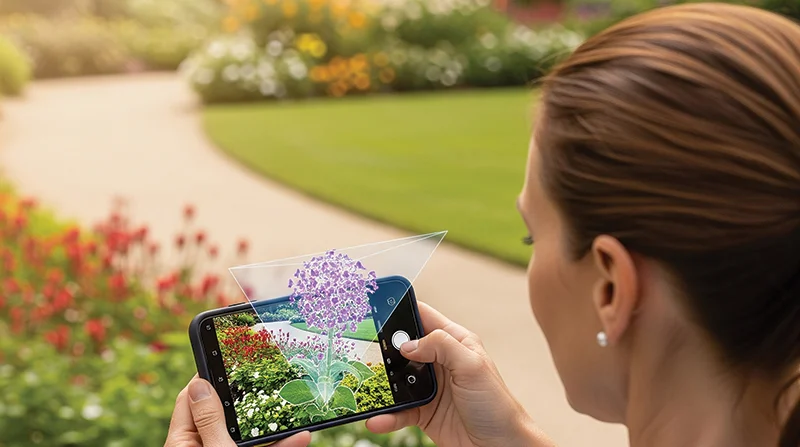
At the Ecolandscape Studio blog, we often discuss how new technologies help create gardens that amaze with both beauty and functionality. Today, augmented reality (AR) and the Internet of Things (IoT) are changing the approach to landscape design, turning ordinary plots into smart, interactive, and environmentally sustainable spaces.
What AR and IoT Mean in the Garden
AR (Augmented Reality) is a technology that overlays virtual elements onto the real world. In the context of a garden, AR allows you to see the future project directly on your plot. Using a smartphone or tablet, you can visualize plantings, pathways, flower beds, decorative elements, lighting, and relaxation zones. AR shows how plants will grow in different seasons, how color schemes will change, and how sunlight and shadows will play throughout the garden.
IoT (Internet of Things) is a network of connected devices and sensors that collect data and can control processes. In a garden, IoT includes smart irrigation systems, soil moisture and temperature sensors, light sensors, automated lighting, and climate control. This allows the garden to “live” independently: plants receive the optimal amount of water and light, the owner gets notifications about the garden’s condition, and systems automatically adjust conditions for plant growth.
Why These Technologies Are Needed
AR and IoT address several tasks that were previously complex or time-consuming. AR helps plan designs and experiment with compositions, shapes, colors, and materials before construction begins. This saves time, money, and helps avoid mistakes when planting.
IoT makes the garden smart and autonomous. It allows you to monitor watering, lighting, and climate, track plant health, prevent diseases and overwatering. For larger plots, IoT enhances security by integrating alarms, lighting, and motion sensors.
Combining AR and IoT makes the garden interactive and personalized. AR allows you to see how the plot will look, while IoT ensures that this vision is maintained in real time. This creates ecosystems where every detail is carefully planned, protected, and develops harmoniously.
How It Works
In practice, AR is used during the design stage. Ecolandscape Studio designers create a 3D garden model that clients can view on their plot through a device. You can change plant arrangements, test different materials for pathways, decorative elements, and lighting, and evaluate shadows, sunlight, and seasonal changes.
IoT works by installing sensors in the soil, on trees, and in lighting systems. Sensors measure moisture, temperature, and light levels, while irrigation and lighting systems respond to this data in real time. For example, after rain, irrigation automatically turns off, and at night, lighting softly illuminates pathways and flower beds without disturbing plant growth. In a mobile app, the garden owner receives plant status updates and care recommendations, making garden management simple and convenient.
Benefits for Garden Owners
Gardens with AR and IoT combine aesthetics, convenience, and sustainability. They allow experimentation with design, save resources, maintain plant health, and let owners enjoy the beauty of the garden without extra stress. On the Ecolandscape Studio blog, we share tips on integrating these technologies, choosing plants for smart irrigation and lighting, placing sensors correctly, and managing automation systems.
As Martin Palma, founder and CEO of Ecolandscape Studio, notes: «Integrating AR and IoT into landscape design allows us to create gardens that live alongside their owners. It’s not just a tool – it’s a way to bring dreams of a perfect garden to life while preserving its beauty, health, and harmony for years to come.»
Using these technologies makes a garden not only beautiful but also smart, eco-friendly, and durable. AR helps plan and visualize ideas, IoT supports them in real life, and our advice and experience allow the creation of gardens that delight every day and inspire experimentation with nature.