At Ecolandscape Studio, we integrate cutting-edge technologies to create unique landscape solutions and ensure the most accurate and productive interaction with clients at every stage of design. In this process, we actively use Virtual Reality (VR) and Augmented Reality (AR), which open new horizons for landscape design. These innovative tools allow us to design with greater precision and significantly improve communication with clients, facilitating decision-making and speeding up the development process.
Why Use VR and AR in Landscape Design?
One of the key factors for success in landscape design is a clear understanding of the project concept by both the designer and the client. By using VR and AR, we offer our clients a unique opportunity not just to view blueprints or 3D models, but to literally «immerse» themselves in the future space. For instance, they can «walk» through the planned garden or park, experience the scale and proportions, and see how different elements will interact with each other.
This allows our clients to experience the future project in real-time, evaluate selected materials, plants, and shapes, which significantly reduces the risk of misunderstandings and helps make more informed decisions.
Landscape design often requires multiple options and experiments. How will plants look in a particular area of the site? How does the perception of space change under different lighting conditions? Thanks to VR and AR, we can instantly adapt the project and test different scenarios without the need for physical modeling, saving time and resources.
These technologies allow us to work efficiently with multiple options simultaneously, quickly adjusting parameters such as object placement, material and color choices. We can quickly adapt to the changing preferences of the client and the project’s requirements.
Using AR helps overlay virtual elements onto the real environment, allowing clients to immediately see how the design will look on their property. This is extremely useful when finalizing details like pathways, water features, decorative elements, and lighting.
With AR, we can ensure high accuracy and reduce the risk of errors and misunderstandings. Clients are able to see the exact result of the design in its real environment, which greatly speeds up the approval process and minimizes changes during implementation.
Why VR and AR Are Important for Landscape Design
With VR and AR, we can model and test solutions with a high degree of precision. For example, we can test how various elements plants, pathways, lights will interact in different climatic and seasonal conditions. This allows us to design more sustainable and durable landscapes that will delight clients for years to come.
Accurate 3D models and simulations help visualize all the nuances of a project before construction begins, which minimizes risks and allows us to create a design that closely matches the client’s expectations and the site’s conditions.
Modern landscape design projects require a careful approach not only to visual aesthetics but also to ecological and climatic conditions. VR allows us to model the impact of various elements on local flora and fauna and calculate how site conditions will change with seasonal variations and climate factors.
It’s important to create landscapes that are not only beautiful but also environmentally sustainable. Using VR and AR, we can assess in advance how different elements will interact with the natural environment, helping to avoid issues with vegetation or water resources in the future.
How VR and AR Work in Landscape Design
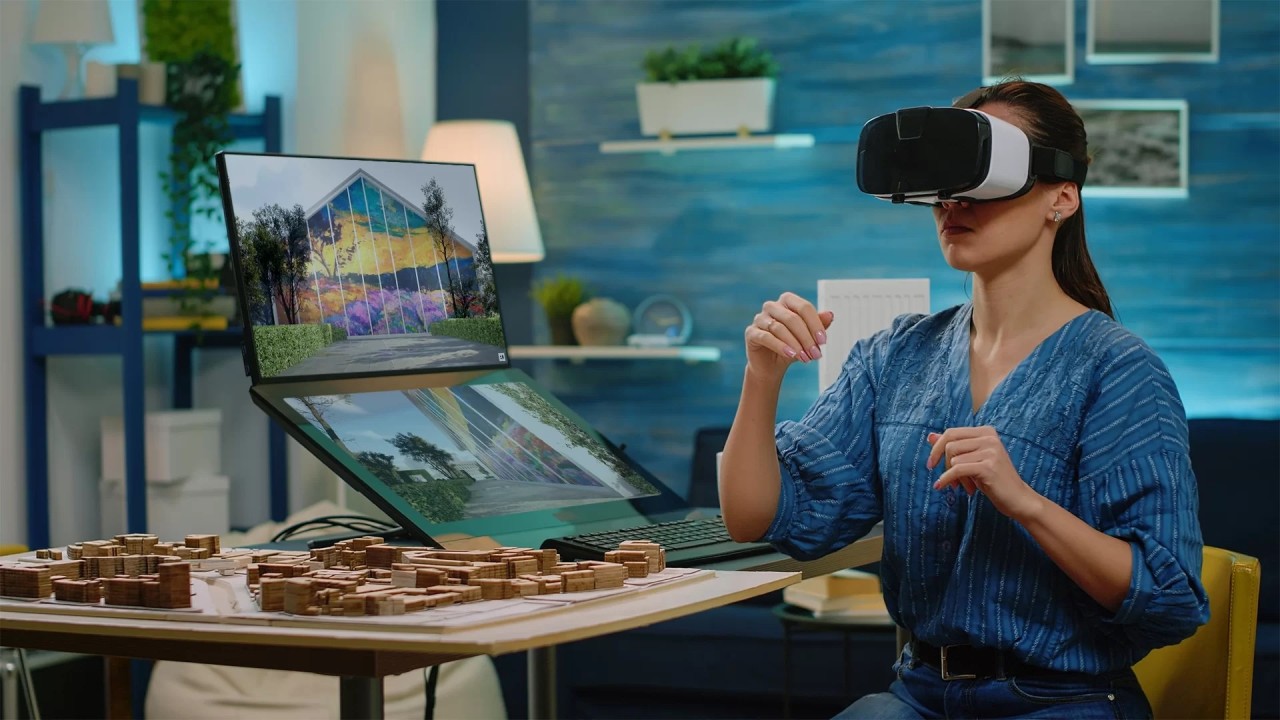
Virtual reality allows us to create a complete digital model of the future landscape, which clients can interact with. Using VR headsets, they can walk through the garden or park, see how the space will look from different viewpoints, assess the interaction between various elements and materials.
We create detailed 3D models of the landscape using professional modeling tools. These models become interactive, allowing the client to explore the project in virtual space and adjust parameters such as lighting, textures, and materials. Additionally, we can simulate seasonal changes, weather conditions, and plant growth dynamics.
Augmented reality allows us to overlay virtual elements onto the real environment. Using a smartphone or tablet, the client can see how different landscape elements such as pathways, plants, or lights will appear directly on their property.
Using AR applications, we overlay virtual objects onto an image of the real site, displayed through the device’s camera. This enables the client to immediately see how design elements will fit into the existing surroundings, helping to adjust the project to account for site-specific features.
As Martin Palma, founder and CEO of Ecolandscape Studio, notes: «When we first began using VR and AR in landscape design, we immediately realized the immense potential these technologies hold. The ability to model space in real-time and assess how each element fits into the overall picture allows us to work on projects with a level of precision that would be impossible with traditional tools.»
Why Is This Important for Your Landscape Project?
At Ecolandscape Studio, we actively use VR and AR to create more precise, interactive, and sustainable landscape solutions. These technologies allow us not only to model and test various options but also to improve interaction with clients, giving them a unique opportunity to «immerse» themselves in the project. With VR and AR, we create landscape spaces that are beautiful, functional, and environmentally sustainable, perfectly suited for real-world conditions.
By using VR and AR, we create unique and high-quality projects that meet the most modern requirements and our clients’ desires.