The air of modern megacities has turned into an invisible aggressor, saturated with fine particulate matter PM2.5, nitrogen dioxide, and industrial emissions. In an attempt to neutralize this destructive background, advocates of healthy lifestyles long relied on isolating themselves indoors, using household air purifiers, sleep capsules, and dietary supplements. However, premium landscaping of suburban properties is now reaching a fundamentally new level. The concept “Garden as Pharmacy 2.0” expands the boundaries of classical biohacking, transforming private estates into personalized open air climate therapy stations. Specialists at Ecolandscape Studio believe that the era of primitive apothecary gardens with chaotic beds of mint and chamomile is irreversibly gone. They are being replaced by the design of controlled ecosystems capable of precisely adjusting psychoemotional state and physiological parameters through precision phytocide programming and natural aeroion therapy.
The foundation of such a healing environment is based on extremely precise mathematical calculation of the density and dispersion radius of volatile organic compounds (VOCs) generated by plants. Plant phytocides are not merely sources of pleasant aroma, but act as native antibiotics and neuromodulators. Coniferous biogroups formed from common juniper, eastern white pine, and Siberian fir are capable of releasing massive amounts of alpha and beta pinene. These compounds stimulate the production and activity of natural killer cells in the human bloodstream, activating a powerful antiviral and immune response. While implementing turnkey landscape design, the team at Ecolandscape Studio models so called closed phytocide fields. This takes into account not only dendrological parameters and planting density, but also local wind patterns, allowing therapeutic concentrations of beneficial gases to be maintained in the ground level atmosphere.
The spatial logic of movement across the site follows the principles of dynamic climatotherapy implemented through a network of functional terrenkurs, or therapeutic walking routes. These are not ordinary walking paths, but scientifically grounded health routes where therapeutic effects alternate in a strict sequence. Movement begins in an activation zone dominated by conifer alleys and dense barberry clusters. Here concentrated phytocides effectively stimulate cognitive functions, gently raise blood pressure in hypotensive individuals, and eliminate morning asthenia. The individual route then leads deeper into the territory, smoothly transitioning into lavender and sage anti stress lakes. In this location, extensive plantings of narrow leaved lavender, monarda, and oak sage dominate. The linalool they emit targets GABA receptors in the brain, reducing cortisol production, stabilizing pulse, and preparing the nervous system for deep relaxation. Carefully designed elevation changes and controlled shading optimize lung ventilation, accelerating absorption of therapeutic air fractions.
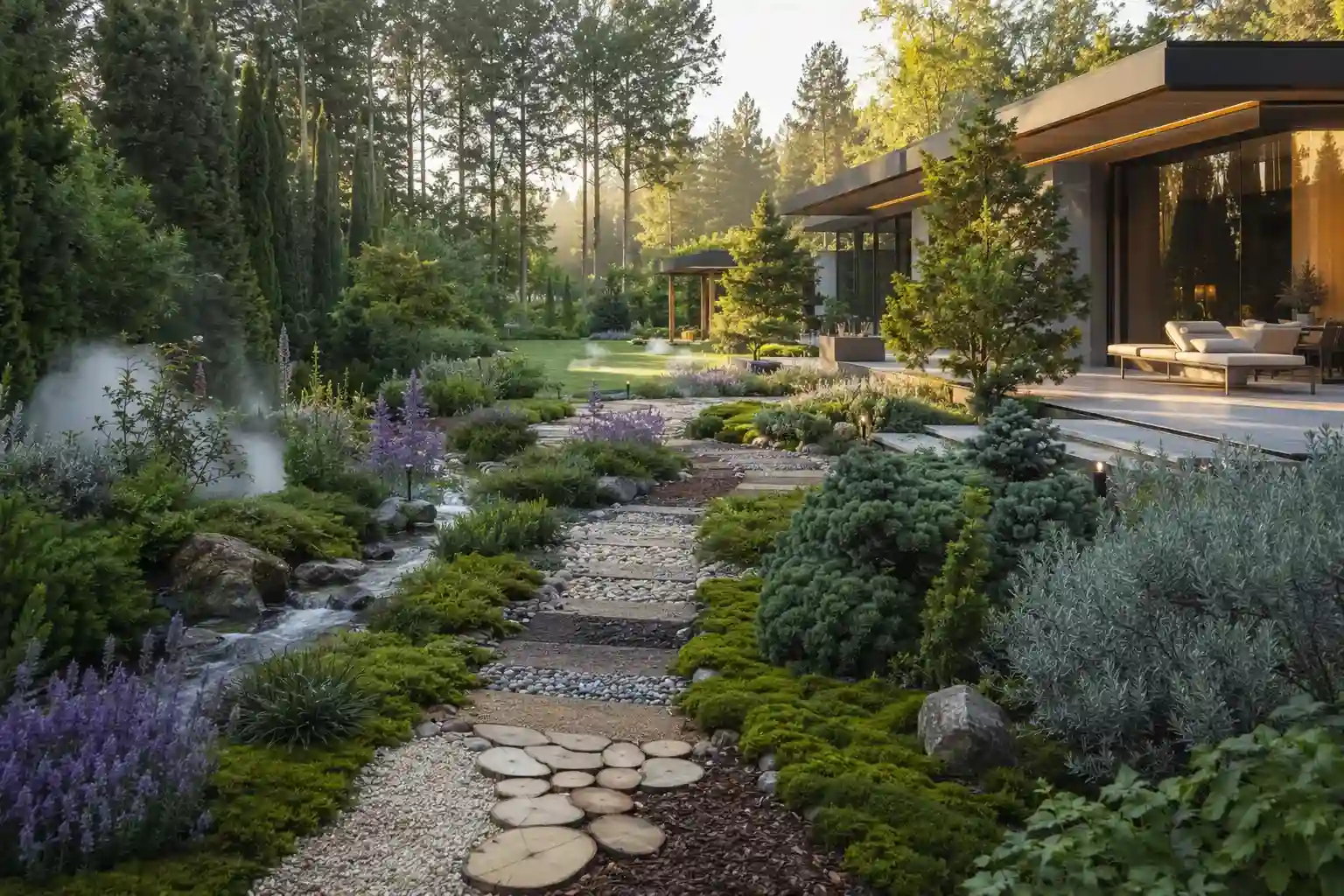
A key objective of professional landscaping is the creation of an impenetrable biological barrier against technogenic pollution, which is critically important when a suburban home is located near a busy roadway. Air purification is achieved through multi layer anti stress botany. Trees and shrubs with pubescent, rough, or sticky leaf textures such as elm, silver oleaster, and high bush cranberry act as living electrostatic filters, effectively trapping fine dust and soot. At the same time, birch and poplar plantings generate large amounts of negatively charged aeroions. High density of these so called air vitamins neutralizes free radicals, optimizes tissue respiration, and stabilizes serotonin metabolism. Integration of fine mist fountains, cascades, or artificial streams into the ecosystem triggers hydro aeroionization, bringing air purity and humidity parameters to ideal resort level conditions.
Modern suburban biohacking is impossible without verification and digitization of data, therefore the natural environment of the innovative garden is seamlessly synchronized with smart devices. Wireless climate sensors are installed throughout the territory, continuously analyzing air quality index (AQI), volatile organic compounds, temperature, humidity, and ion density. The collected information is transmitted to the smart home ecosystem and displayed on users’ smartphones. Intelligent algorithms do not merely record metrics, but provide personalized recommendations for walks or meditation. For example, when sensors detect peak emission of essential oils by conifer species after midday warming, the system sends a push notification indicating the ideal time for a natural immunostimulation session. In relaxation zones, automated pergolas with smart screens are installed, dynamically adjusting insolation and directing streams of therapeutic air toward resting areas.
The founder and CEO of Ecolandscape Studio, Martin Palma, based on many years of experience in designing premium spaces, notes: “For a long time, the global landscape industry evaluated private gardens purely through visual aesthetics and composition. But when we began connecting our clients’ biometric smartwatches to on site engineering infrastructure, a real technological revolution occurred. We discovered that automated irrigation and ultrasonic misting systems can precisely regulate plant phytostress levels. As soon as sensors detect a critical increase in stress levels or heart rate of the estate owner, hidden nozzles embedded in rosemary and thyme masses instantly generate a fine dry mist cloud that absorbs essential oils from the leaves. By taking just one breath on the open terrace, a person receives an emergency scientifically grounded dose of natural sedative.”
A logical continuation of integrating humans into the garden’s biological circuit is the development of specialized barefoot trails designed for grounding and deep stimulation of reflexogenic zones on the feet. The physiological basis of grounding lies in the absorption of free electrons from the Earth’s surface, effectively equalizing the body’s electrical potential and reducing markers of systemic inflammation. To achieve maximum therapeutic response, engineers design pathways combining more than five types of fractional materials: large river pebbles, soft conifer needle litter, Siberian larch bark, fine quartz sand, and polished oak slices. Alternating compression and relaxation of foot muscles while moving across textures activates thousands of nerve endings reflexively connected to all key internal organs.
A scientific approach to biohacking landscape design also involves regulating humidity and thermal capacity of used substrates. Since electrical conductivity of skin and ground directly depends on moisture, a hidden drip irrigation circuit is installed beneath barefoot paths, maintaining optimal levels of moss, sand, and gravel without risk of overwatering. The shift of temperature sensations, for example moving from sun warmed quartz sand to cool moisture retaining larch bark, creates a gentle contrast effect that trains the vascular system and activates thermoregulation mechanisms.
In winter, when deciduous trees enter dormancy, the 2.0 garden continues functioning thanks to a powerful evergreen framework. Coniferous trees such as spruce, mountain pine, and yew continue to release volatile antiseptics even at subzero temperatures. Their architecture also helps retain snow cover, which acts as a natural hygroscopic filter cleaning ground level air from winter urban smog. Professional turnkey landscape design transforms a suburban residence into an autonomously functioning biological shield that continuously restores human biorhythms and resource state.