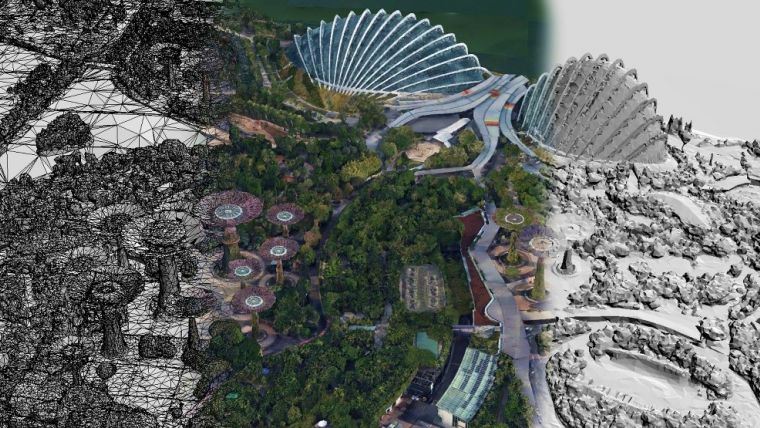
At Ecolandscape Studio, we completely reimagined the approach to creating private outdoor spaces after realizing that traditional 3D visualization had exhausted its potential. The glossy renderings typically presented to clients capture only an illusory moment detached from reality, while the natural environment itself remains dynamic and inherently aggressive. Seeking to stay ahead of time, our team introduced the concept of dynamic site modeling based on interactive Digital Twins. This software ecosystem functions as an exact virtual replica of a landscape operating in real time alongside the living garden, continuously processing incoming data and protecting the owner’s investment from critical long term planning mistakes.
The primary flaw of classical landscaping has always been the inability of the human mind to flawlessly predict how living organisms evolve over time. Digital garden modeling successfully resolves this dilemma by allowing designers to examine the condition of a property twenty or even thirty years into the future. Into the analytical core of the platform, engineers at Ecolandscape Studio integrate biological growth patterns of specific plant species while accounting for soil composition and regional macroclimate conditions. The system reconstructs the future expansion of tree canopies and root systems with centimeter level precision. This predictive analysis clearly demonstrates whether powerful roots may deform underground structural elements or a swimming pool basin within fifteen years, and whether mature trees will deprive lower sun loving shrubs of necessary daylight. As a result, planting density can be adjusted at the conceptual stage, guaranteeing clients a flawless turnkey landscape design without requiring expensive reconstruction in the future.
Beyond biological management, the virtual estate model performs detailed calculations of physical phenomena, including insolation maps and hydrological processes. Since light exposure and water balance constantly evolve, the digital avatar continuously calculates shadow movement throughout different seasons, allowing terraces, patios, and functional areas to be positioned with absolute precision. The key breakthrough, however, lies in the analysis of hidden underground processes. Algorithms accurately reproduce groundwater circulation, forecasting soil behavior during spring snowmelt or intense summer storms. The platform identifies areas vulnerable to water stagnation, slope erosion, and excessive pressure on drainage infrastructure. All of this is achieved entirely within the digital environment long before excavation begins or utilities are installed, eliminating flooding risks caused by structural miscalculations.
After the landscaping process is completed, the digital twin transforms into an intelligent estate management center. Specialists from Ecolandscape Studio deploy a wireless IoT sensor network throughout the property to monitor environmental indicators including moisture levels, pH balance, micronutrient concentration, and air temperature fluctuations. This information synchronizes instantly with the virtual model, enabling the garden to communicate directly with both the owner and our service department. Artificial intelligence compares real time conditions with meteorological forecasts and generates precise recommendations delivered to the user’s smartphone, from localized nutrient deficiencies to automatic irrigation adjustments before incoming rainfall.
This technological approach fundamentally changes the philosophy of interaction between humans and natural ecosystems. As Martin Palma, founder and CEO of Ecolandscape Studio, explains:
“For years I realized that nature always defeats flat drawings. My personal discovery was that truly luxurious and durable landscape design is created not at the moment of planting, but when technology submits itself to the algorithms of nature. A digital twin is not a fashionable accessory. It is the only way to guarantee that a client’s investment in land will not be destroyed by the first abnormal flood ten years later.”
The virtual prototype serves as a pragmatic instrument of predictive analytics and budget optimization, transforming the chaotic evolution of a garden into a fully controlled, safe, and autonomous ecosystem.
Replacing static blueprints with intelligent digital twins marks a profound evolution within the landscape industry. Instead of a fixed image destined to deteriorate over time, developers receive a flexible self evolving system created at the intersection of BIM technologies, GIS platforms, and advanced graphic engines such as Unreal Engine 5 capable of reproducing physical laws with extraordinary realism.
The initial design stage at Ecolandscape Studio eliminates intuitive planning entirely. Sites are surveyed using aerial and terrestrial LiDAR scanning that generates a highly accurate three dimensional relief matrix capturing the geometry of every hill, structure, and existing tree. Ground penetrating radar identifies underground utilities and hydrogeological conditions. Integrating this point cloud with decades of regional climate statistics provides architects not with an empty schematic, but with a detailed digital environment aware of exact sunlight trajectories and wind loads at every geodetic elevation.
For long term dendrological planning, the system relies on the principles of phytocenology. Software modules analyze not only geometric branch growth but also allelopathy, the biochemical influence plants exert on one another through root systems, as well as interspecies competition. The model can simulate how a mature tree canopy will alter the local microclimate fifteen years into the future by adjusting soil temperature, humidity, and wind protection. By modeling these processes, designers identify risks of lawn degradation caused by stagnant air circulation and proactively select alternative plant species, transforming premium garden creation into an evidence based science.
Hydrological analysis within the digital twin far exceeds conventional slope calculations. The platform recreates moisture infiltration dynamics across different soil horizons ranging from sandy fractions to dense clay loams. By stress testing the model against extreme weather anomalies occurring once every fifty years, engineers at Ecolandscape Studio identify critical vulnerabilities long before construction begins. Simulations reveal localized overloads in drainage collectors, risks of soil displacement, and the degree of hydraulic pressure affecting building foundations. In addition, the system calculates precise specifications for stormwater storage reservoirs, enabling a closed water cycle that reduces dependence on external utility networks.
The integration of IoT technologies during the operational stage transforms the virtual copy into an interactive analytical center for the residence. Sensors installed within the root systems of mature trees monitor sap movement and internal wood fiber tension, detecting biological stress or windthrow hazards long before visible symptoms appear. Multispectral monitoring identifies foliage pathologies at the microscopic level by analyzing thermal radiation changes caused by pests or disease. The system correlates this data with maintenance schedules so that automation not only irrigates the property but also distributes nutrient emulsions with pinpoint precision, preventing excessive chemical saturation of the soil.
Ultimately, Digital Twins eliminate the key vulnerability of the luxury landscape segment: the unpredictability of living material. Investors acquire a detailed strategy for managing a countryside asset where operational costs and maintenance procedures are verified decades in advance while the risks of plant loss are reduced to a minimum. Landscaping ceases to be a source of unforeseen expenses and becomes a high technology self regulating extension of contemporary architectural design.
Professional landscape development by Ecolandscape Studio fundamentally changes the economics of interaction between architects, developers, and landowners. Life Cycle Cost assessment allows financial expenditures for maintaining a private park or estate garden to be calculated before the first construction machine even arrives on site. The virtual avatar forecasts long term consumption of electricity and water resources while accounting for pump wear, equipment depreciation, and organic waste logistics generated after seasonal pruning operations, transforming aesthetic decisions into precise financial planning.
Mathematical modeling of biological processes today relies on generative algorithms and machine learning. Software has evolved far beyond schematic tree models, operating instead with digital plant passports and fractal L systems connected to the inventories of leading international nurseries. The platform reproduces competition for sunlight between different species. Architects can observe how uneven canopy illumination may eventually cause trunk asymmetry, increasing instability during hurricane force winds. The system instantly generates protective strategies ranging from revised planting distances to annual pruning schedules automatically integrated into maintenance workflows.
Digital twins become particularly relevant in the era of accelerating climate change. During the design process, the model undergoes rigorous stress testing that simulates periods of extreme drought, snowless winters, and violent storms. It also analyzes how new buildings and fences alter the aerodynamics of the site. Detected zones of wind turbulence capable of drying soil or damaging fragile ornamental plants are compensated through precisely calculated placement of living wind barriers composed of resilient species that reduce airflow velocity and create a stable internal microclimate.
At the engineering preparation stage, the Common Data Environment of the digital twin unifies the work of all specialized professionals. Landscape architects, utility engineers, surveyors, and general contractors collaborate without spatial conflicts. The algorithm blocks routing of landscape lighting if it intersects with the root zone of protected mature trees or geothermal infrastructure. Furthermore, when calculating earthworks balance, the system optimizes internal soil logistics by determining how excavated material from foundation works can be reused for terrain sculpting without disrupting natural water flows or creating flooding risks for neighboring properties.
Within modern private residences, the digital twin acts as the core of environmental management, monitoring the condition of the soil biome itself. Specialized sensors evaluate electrical conductivity levels directly reflecting the availability of mineral compounds for root systems. Instead of conventional timer based irrigation, the digital twin controls differential water distribution while considering plant transpiration rates according to cloud cover, wind intensity, and atmospheric humidity. This approach reduces water consumption by more than fifty percent, prevents degradation of fertile soil layers, and eliminates excessive fertilizer penetration into deep ground horizons.
Creating a digital avatar by Ecolandscape Studio justifies itself with the very first prevented incident. Whether preserving a relic tree, detecting hidden drainage failures, or protecting basement structures from flooding, Digital Twin technology elevates countryside estate ownership to a level of complete predictability where natural cycles operate in perfect harmony with the architecture of the home.