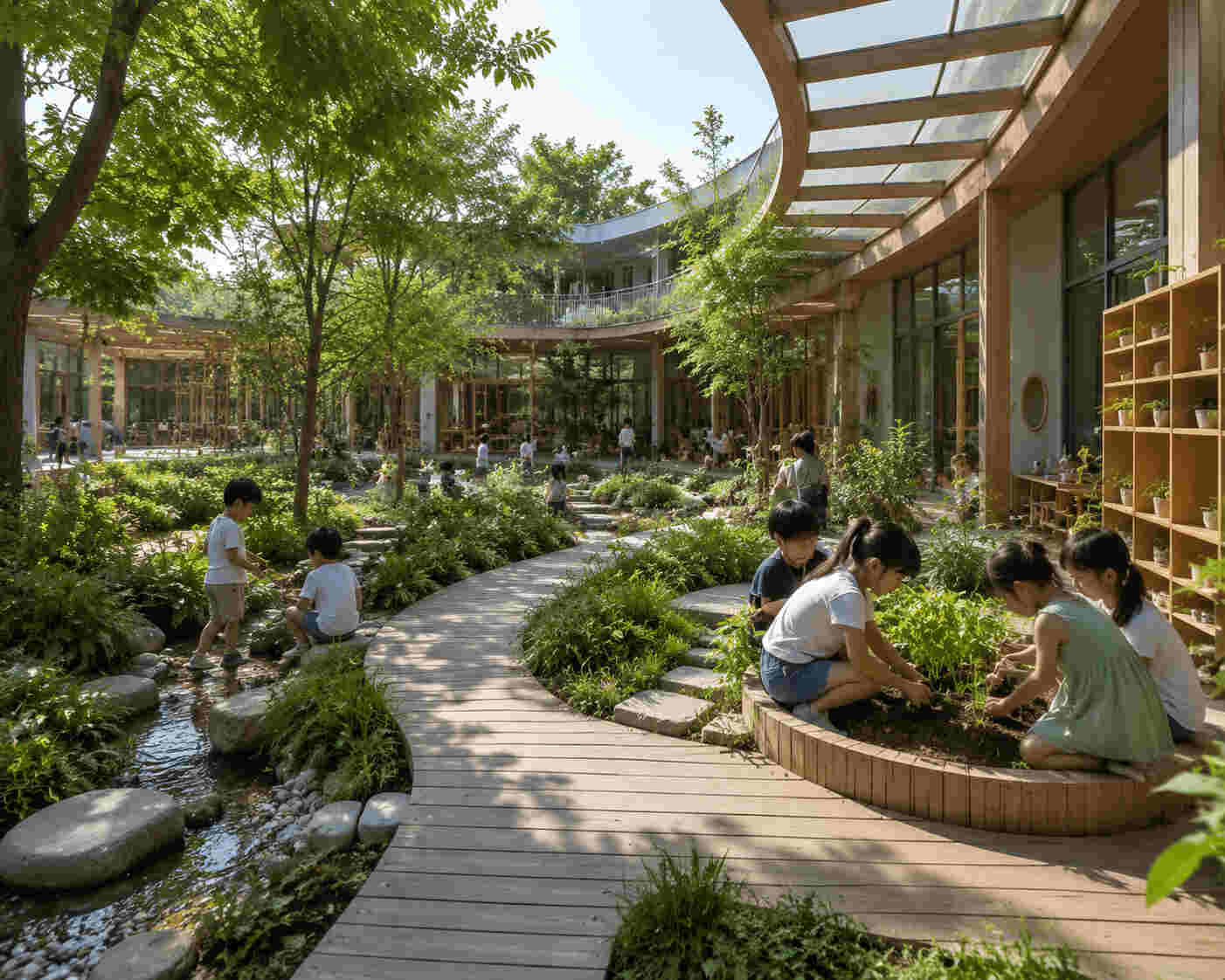
In the modern world, the role of educational spaces goes beyond the traditional classroom. Today, a schoolyard or kindergarten can become an environment that stimulates development, creativity, and emotional well-being in children. Ecolandscape Studio actively implements biophilic design concepts in educational institutions, creating green, living, and inspiring spaces where nature becomes a full-fledged participant in the learning process.
Innovative approaches to designing school grounds have been implemented in Japan and South Korea. Here, covered green areas, mini-gardens, and sensory trails are appearing, transforming schoolyards into ecosystems. Sensory trails are routes filled with different textures, plants, sounds, and scents, helping children develop focus, explore the surrounding world, and interact with nature through play.
Research shows that children who regularly spend time in biophilic environments become more creative, concentrate better, and experience less stress. The presence of greenery and natural elements fosters a sense of harmony, improves emotional well-being, and supports overall development.
Practical examples are impressive: in one Japanese school, a mini-forest has been organized in the yard, where children care for plants, observe seasonal changes, and conduct lessons outdoors. In South Korea, covered gardens and “green corridors” are being implemented safe, functional, and inspiring spaces that encourage creativity and learning. These environments become tools in the educational process, making learning engaging and dynamic.
Professional opinion from Martin Palma, Founder and CEO of Ecolandscape Studio: “For us, it is important that nature in educational spaces is not merely a decorative element. Every plant, every sensory area, and every green corner creates an environment that stimulates children’s observational skills, attentiveness, and emotional resilience. Biophilic design is an investment in the future, in the health and harmonious development of the next generation.”
Creating such spaces requires careful planning. Safety, the use of eco-friendly materials, and selection of plants suitable for the local climate must be considered. The benefits are clear: children become more engaged and proactive, teachers gain an inspiring educational environment, and parents notice positive changes in their child’s mood and activity.
For Ecolandscape Studio, the biophilic approach is a design philosophy. Our goal is to create schools and kindergartens where nature is part of learning, supports children’s emotional well-being, and fosters a sense of responsibility toward the environment.
Integrating biophilic design into educational spaces is becoming a global trend. Each new school or kindergarten designed according to these principles demonstrates that nature can be a partner in learning, nurturing creativity, observational skills, and aligning harmoniously with educational goals.