The premium landscape development industry is currently undergoing a tectonic transformation driven by the global degradation of fertile land, prolonged droughts, and increasing water scarcity. Ecolandscape Studio views these climate-related challenges as a powerful catalyst for developing fundamentally new design strategies that exist at the intersection of advanced biochemistry, microbiology, and archaeo-engineering. One of the most revolutionary responses to the environmental crisis is the Terra Preta 2.0 concept. This trend is rooted in the ancient Amazonian practice of creating anthropogenic super-fertile soils, now fully modernized through cutting-edge technologies. Our studio approaches the design of such spaces not merely as the creation of an aesthetic landscape, but as the launch of a personal engineering system for long-term atmospheric carbon capture and storage.
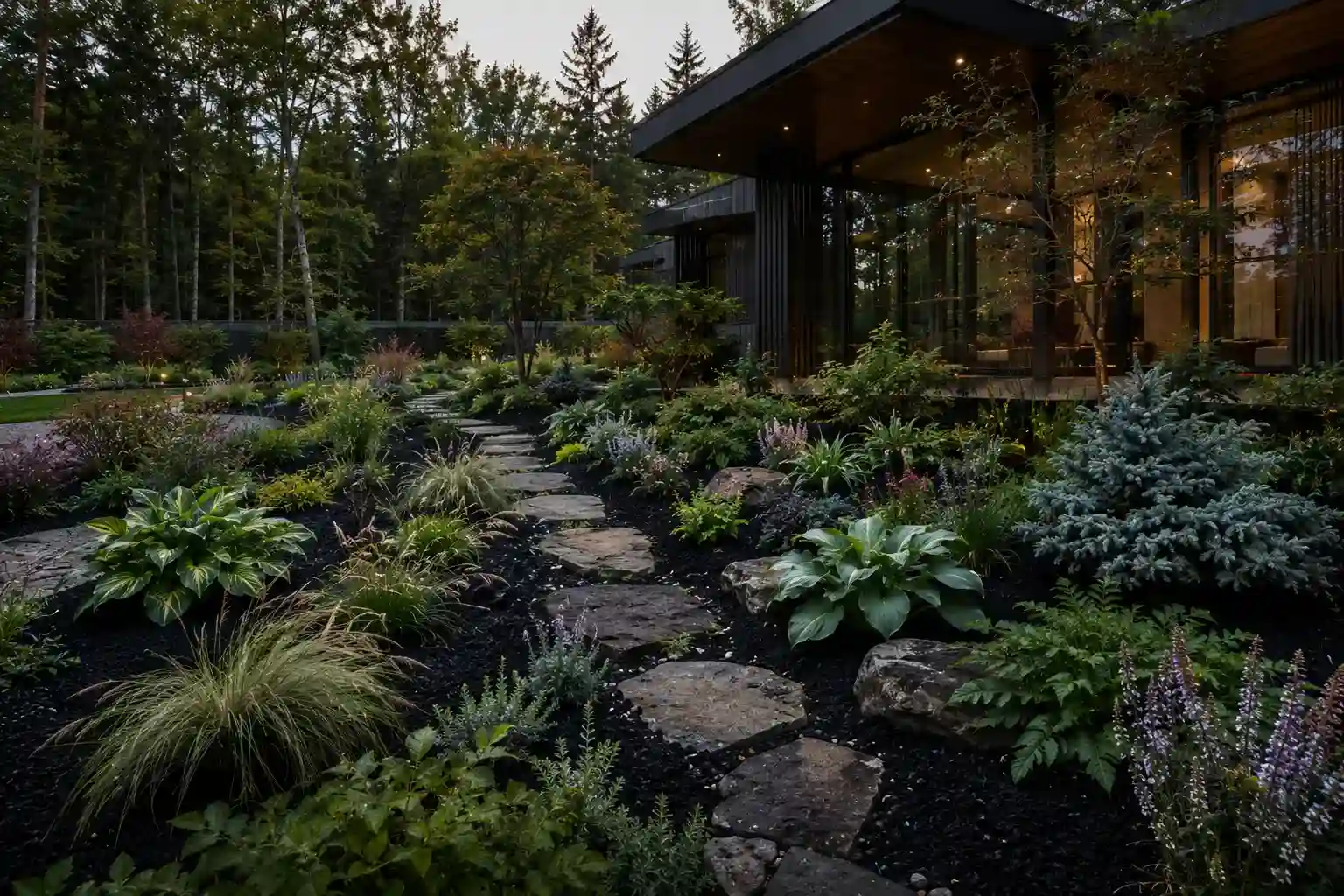
The artistic framework of these next-generation permanent gardens is based on integrating high-tech biochar into the soil structure. This material is a highly porous carbon matrix produced through the thermal decomposition of woody biomass in the absence of oxygen at temperatures ranging from 450 to 700 degrees Celsius, ensuring complete removal of tar, resins, and toxic compounds. At Ecolandscape Studio, we see extraordinary aesthetic potential in this pristine black substrate. Instead of conventional gray-brown soil or traditional bark mulch, planting beds acquire a magnetic, deep velvet-charcoal appearance with a refined matte finish. Against this flawless monochromatic backdrop, lush ornamental grasses, glossy hosta foliage, silvery conifers, and vibrant perennial blooms achieve maximum visual impact. Such dramatic contrast fundamentally transforms spatial perception, turning plant compositions into futuristic living sculptures.
The technological core of the Terra Preta 2.0 concept is the creation of so-called sponge gardens with permanent hydrological autonomy. The unique clustered microstructure of pyrolytic carbon possesses an enormous specific surface area and exceptional capillary performance. Martin Palma, Founder and CEO of Ecolandscape Studio, notes that during field studies of regenerative substrates in harsh arid climates, he was particularly impressed by the ability of modified soil horizons to accumulate and retain moisture together with dissolved nutrients within the root zone for decades while completely preventing soil compaction. Guided by these practical findings, our team creates autonomous ecosystems that eliminate the need for conventional irrigation systems, extensive drainage infrastructure, and regular applications of mineral fertilizers. Even when landscape projects are established on depleted clay, loose sand, or rocky terrain, the introduction of biochar pre-inoculated with endomycorrhizal fungi, nitrogen-fixing microorganisms, and bioactive humates initiates a self-sustaining cycle of regeneration and plant nutrition.
The global environmental mission of Terra Preta gardens is to transform a property’s carbon footprint into a consistently carbon-negative asset. Unlike conventional compost, peat, or manure, which release carbon dioxide back into the atmosphere through decomposition and oxidation within a few seasons, stabilized biochar consists of pure carbon. It is chemically inert, resistant to biological degradation by soil organisms, and capable of remaining in the soil for hundreds or even thousands of years. Ecolandscape Studio believes that a private residential landscape covering only a few hundred square meters and designed according to Terra Preta 2.0 principles becomes a highly effective carbon sink, storing quantities of carbon comparable to those captured by an established protective forest belt. At the same time, plant growth rates and overall biomass production can increase by more than 100%, accelerating the natural absorption of atmospheric CO₂.
To maximize the carbon storage capacity of a landscape, our engineers implement a multi-layer carbon sequestration strategy. The lower subsurface horizon is composed of coarse pyrolytic carbon enriched with anaerobic bacterial consortia, creating a long-term geo-reservoir. The intermediate layer is customized according to the site’s dendrological plan. Areas designated for mature trees receive biochar charged with phosphorus and potassium-rich organic complexes, while lawns and ornamental grass meadows are established on substrates with elevated concentrations of nitrogen-fixing agents. This approach not only optimizes plant nutrition but also significantly enhances the landscape’s resilience to temperature stress. The crystalline carbon structure within the soil functions as a thermal buffer, reducing peak summer soil temperatures while protecting sensitive root systems of exotic perennials from severe winter freezing.
At Ecolandscape Studio, we place special emphasis on selecting phytoremediation species. Terra Preta 2.0 carbon gardens feature plants with high metabolic activity and strong mycorrhizal associations. The deep root systems of these species actively transport sugars and carbon compounds into the porous biochar structure, initiating a chain reaction that promotes the formation of stable humus at the molecular level. As a result, a dynamic system emerges in which the soil does not become depleted over time but instead continuously increases in biological density, fertility, and ecological value.
This approach fundamentally redefines the role of the property owner, transforming them from a passive consumer of natural resources into a conscious eco-innovator who makes a direct contribution to global climate stabilization.