Underground site architecture is the foundational level of landscape design that determines the long-term stability, functionality, and engineering reliability of a territory. In professional practice, it is not a preparatory stage but an independent design layer in which the structure of interactions between soil, water regime, plant root systems, and engineering utilities is formed before any planting or above-ground landscape development begins.
In Ecolandscape Studio, this approach is considered a mandatory design standard, since it is the underground environment that determines the long-term behavior of a site, rather than its visual composition at the time of completion.
The Subsurface Environment as an Engineering-Biological System
A site should be viewed as a multi-component dynamic system in which all processes are interconnected. Soil, water, plant root systems, and engineering utilities do not function in isolation but in continuous interaction, forming a unified underground framework.
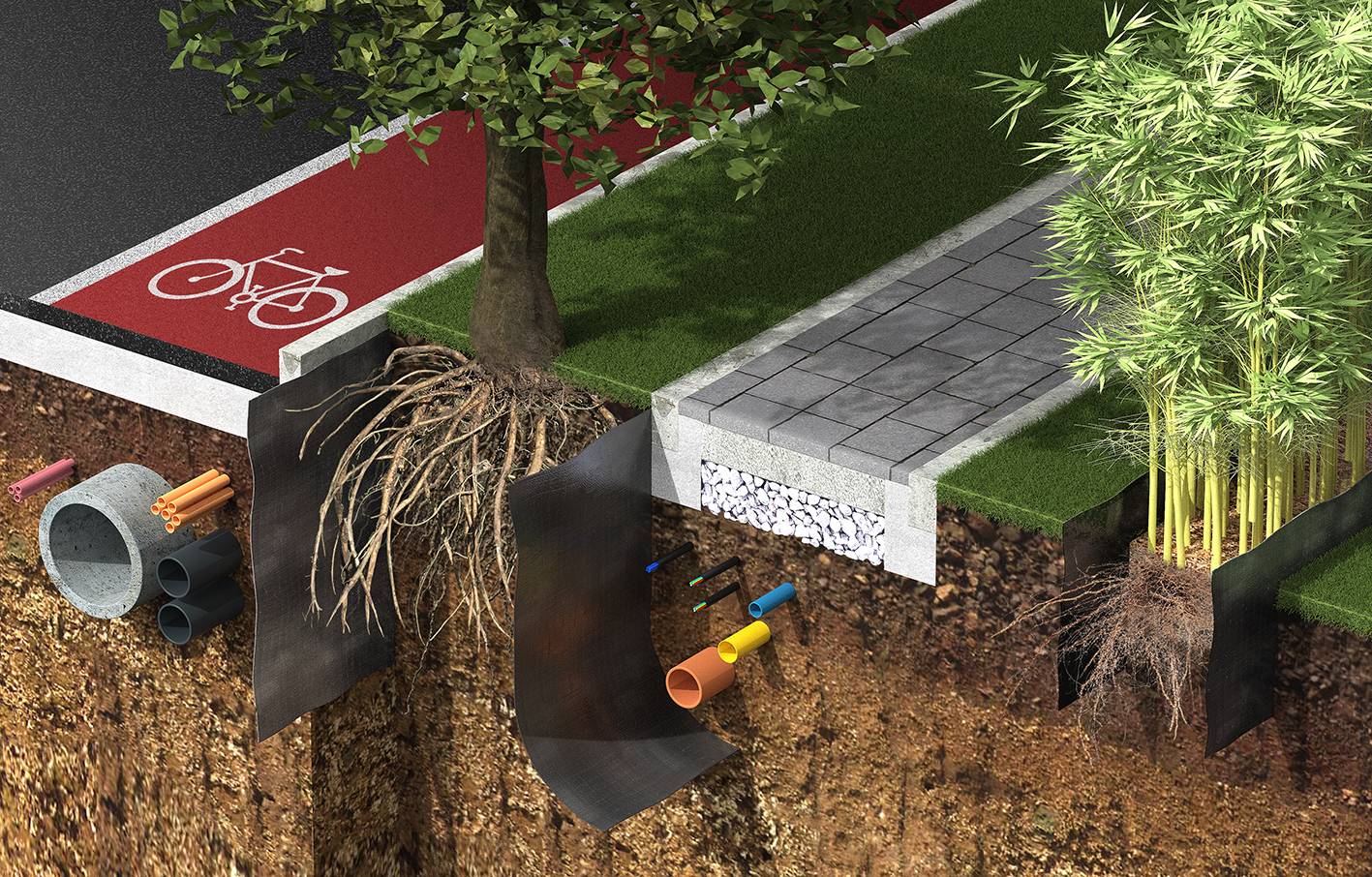
Soil changes its density and bearing capacity under the influence of moisture and load. Water redistributes itself depending on the structure of soil horizons, creating zones of saturation and relief. Plant root systems gradually transform the physico-mechanical properties of the soil, forming new pathways for moisture migration and altering local stability. Engineering utilities, unlike natural components, are static and therefore require protection from these changes.
The absence of a systematic approach to these interactions leads to cumulative deformations that become visible only several years after site operation begins.
Soil as a Structurally Heterogeneous Landscape Foundation
A soil profile is a system of layers with varying physico-mechanical properties, including density, permeability, capillary activity, and bearing capacity. These parameters determine the behavior of the site under load and under changing moisture conditions.
In engineering practice, it is critical to consider not only soil composition but also its spatial heterogeneity. Local variations in density and structure lead to differential settlement, disruption of level grades, and deformation of surface structures.
Within the design process, we perform soil profile analysis followed by modeling of its behavior under seasonal conditions, including cycles of moisture variation, freezing, and mechanical load. This enables the creation of a stable foundation for subsequent drainage and planting systems.
Hydrological Regime and Water Flow Management
Water is the key factor determining the dynamics of the underground environment. Its movement in soil is multi-level and includes surface runoff, infiltration, lateral redistribution, and capillary rise.
Without a controlled hydrological model of the site, zones of uneven moisture formation emerge, leading to soil structure degradation and reduced stability of both vegetation and engineering systems.
A professional approach involves developing a complete water regime model of the site, taking into account topography, soil permeability characteristics, seasonal moisture dynamics, and runoff concentration points. In this system, water is considered not a problem, but a managed resource integrated into the landscape structure.
Drainage Systems as an Element of the Hydrological Model
Drainage, in a professional sense, is not an autonomous engineering system. It is a functional component of the overall hydrological model that ensures controlled redistribution of excess moisture.
The effectiveness of drainage depends not only on pipe configuration and filter layers, but also on correct integration into topography, soil profile, and water flow systems. Disruption of this integration leads to localized waterlogging, system silting, and loss of functionality.
Of particular importance is the long-term stability of drainage solutions, including protection against biological root intrusion and mechanical damage caused by soil deformation.
Root Systems as a Factor in Subsurface Transformation
Plant root systems should be viewed as an active biological mechanism that significantly affects the physico-mechanical properties of soil. During growth, roots alter soil porosity, form water filtration channels, and create localized compaction zones.
A critical aspect of design is forecasting root system development over the long term, including radial spread and depth penetration. Ignoring these parameters leads to conflicts with engineering utilities and destabilization of underground infrastructure.
In professional practice, root zones are designed as pre-structured spaces that eliminate intersections with engineering and drainage systems.
Engineering Utilities in a Geodynamically Active Environment
Underground utilities operate in an environment subject to continuous change, including moisture fluctuations, seasonal soil heave, biological root activity, and mechanical loads.
Therefore, engineering design requires the creation of protected routing corridors, including physical separation from biologically active zones, the use of protective casings, and provision of regulated maintenance access.
Failure to implement these measures leads to gradual degradation of utilities, loss of functionality, and the need for major intervention in an already established landscape.
Systemic Consequences of the Absence of Underground Design
The most characteristic feature of poorly designed underground environments is the delayed manifestation of defects. Initially, a site may appear visually stable; however, over time systemic failures emerge, including differential settlement, disruption of water balance, degradation of plant communities, and failure of engineering systems.
These phenomena are not isolated defects but the result of the absence of a unified underground architecture model at the design stage.
Methodological Approach of Ecolandscape Studio
Martin Palma, founder and CEO of Ecolandscape Studio, formulated a key principle defining the studio’s methodology: landscape stability is determined not by visual composition, but by the quality of underground process organization.
Based on this principle, every project begins with a comprehensive analysis of the soil profile, modeling of the hydrological regime, and structuring of root and engineering zones. Only after this is the above-ground site architecture developed.
Underground site architecture represents a fundamental level of landscape design, integrating geotechnical, hydrological, biological, and engineering processes into a unified system. Proper design of this layer ensures landscape stability, predictability of behavior, and long-term durability of all site elements.
In the practice of Ecolandscape Studio, this approach is a mandatory standard, as only the integration of subsurface processes enables the creation of landscapes that maintain functional and structural stability over the long term.