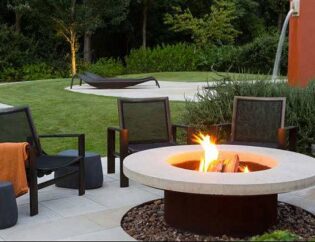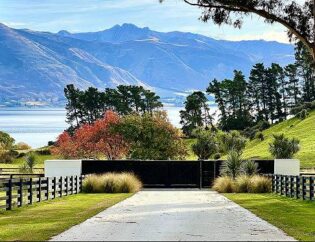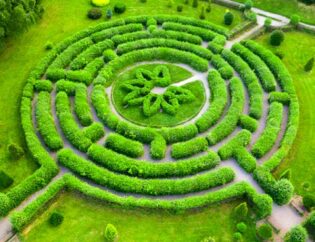
In landscape architecture, material never exists in a fixed state. Any surface is not a finished object, but an open system that interacts with climate, water, biology, and patterns of use. Therefore, in design it is important to consider not only the initial aesthetic, but also how the material will look and “behave” over the years.
In the practice of Ecolandscape Studio, we treat materials as dynamic components of the environment. Their aging is not degradation in the classical sense, but the formation of a new aesthetic and tactile reality, which is often more valuable than the original appearance.
Time as a Hidden Design Layer
Any exterior material goes through several stages of transformation. The first is “architectural novelty,” when the surface is at its most legible and high-contrast. The second is adaptation, when the material begins to interact with the environment: absorbing moisture, collecting dust, responding to sunlight and temperature fluctuations. The third stage is stabilization, when patina forms and a new visual balance is established.
It is important to understand that patina is not just a change in color. It is a complex process that includes microstructural surface changes, biological colonization (for example, microalgae in shaded areas), as well as mechanical smoothing through use.
Stone: Geological Inertia and Surface Evolution
Natural stone has high structural stability, but its surface actively responds to the external environment. This is especially visible in climates with high humidity and seasonal variations.
Initial changes are related to the contamination of pores and microcracks. In urban environments, dust particles, organic matter, and mineral salts penetrate these pores. This gradually darkens the surface and evens out its color spectrum.
The second important process is biological colonization. In shaded and humid areas, mosses and micro-lichens begin to develop. They do not directly damage the stone, but they radically alter its optical perception, making the surface feel more “alive” and heterogeneous.
From an engineering perspective, pore structure is critical. Granite ages slowly and evenly, while limestone and sandstone do so faster and with deeper visual transformation. Polished surfaces lose their gloss but gain a matte depth that is often perceived as more premium in landscape contexts.
Wood: Photochemistry, Moisture Cycles, and Structural Memory
Wood is one of the most sensitive materials in outdoor environments. Its aging is defined by ultraviolet degradation of lignin, cyclic swelling and shrinkage, and surface erosion.
Under UV exposure, the upper layer of lignin breaks down, leading to gradual discoloration. This process is uneven and depends on surface orientation, creating complex visual heterogeneity.
In conditions of high humidity, capillary water absorption increases, affecting not only color but also surface micro-geometry: fibers rise, increasing tactile roughness.
In one interview, Martin Palma, founder and CEO of Ecolandscape Studio, noted that observing how wood “rewrites” its surface under sun and rain over several seasons became a key professional insight: the material does not lose quality, but changes its mode of expression when the correct structural logic is initially embedded.
From an engineering standpoint, ventilation, water drainage, and the absence of direct ground contact are critical. Without these conditions, wood shifts into a phase of accelerated degradation rather than controlled aging.
After 5-10 years, properly designed wood develops a silver-gray tone, which in professional practice is often considered more valuable than its original decorative appearance.
Concrete: Microcracks, Carbonation, and Architectural Depth
Architectural concrete in outdoor environments undergoes chemical and physical transformation. One of the key mechanisms is carbonation—the reaction of cement stone with carbon dioxide, which changes the surface pH and the structure of the upper layer.
Simultaneously, micro-shrinkage cracks form. These are not structural defects but influence visual perception. Under certain lighting conditions, they create a fine network that enhances textural complexity.
In addition, water migration of dissolved minerals may lead to efflorescence. Even with high-quality mixes, this process cannot be fully eliminated, but it can be controlled through design strategies.
Over time, concrete loses its sterility and acquires a complex optical structure, bringing it closer to natural stone. This makes it especially valuable in minimalist landscape compositions.
Metal: Oxidation as a Controlled Design Process
Metals demonstrate a predictable aging model, but the outcome depends on alloy type and environmental conditions.
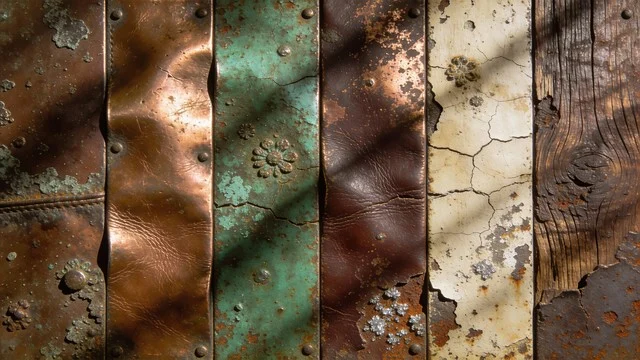
Carbon steel forms an oxide layer which, without stabilization, leads to continued corrosion. In the case of Corten steel, a dense patina forms that slows degradation and creates a stable colored surface.
This layer visually responds to humidity, shifting from dark brown to saturated orange, making the metal a “living” element of the composition.
Stainless steel and aluminum do not degrade structurally, but they lose micro-reflectivity due to abrasive environmental exposure, acquiring a softer matte character.
Gravel: Granular Dynamics and Behavioral Instability
Gravel surfaces represent a granular system rather than a static surface. Their behavior is defined by particle redistribution under mechanical load and water influence.
Over time, the upper layer becomes compacted and fine fractions migrate downward, affecting permeability and tactile characteristics.
Visually, the material loses its decorative “looseness” and becomes closer to natural scree and coastal formations, creating a more stable and natural perception.
Designing Aging as a Professional Tool
Modern landscape architecture increasingly uses the principle of predictable aging. Materials are selected not only for their appearance at completion, but for their development scenario over time.
In Ecolandscape Studio, this approach is fundamental: the landscape is treated as a system designed together with time, not against it. This allows patina to be used as a controlled compositional element rather than a random effect.
Materials in landscape design cannot be evaluated statically. Stone gains depth, wood becomes softer and more tactile, concrete develops structural complexity, metal acquires expressive patina, and gravel achieves natural stability.
It is the temporal dimension that transforms the landscape from a set of objects into a living system, where aging becomes part of architectural language and design intent.