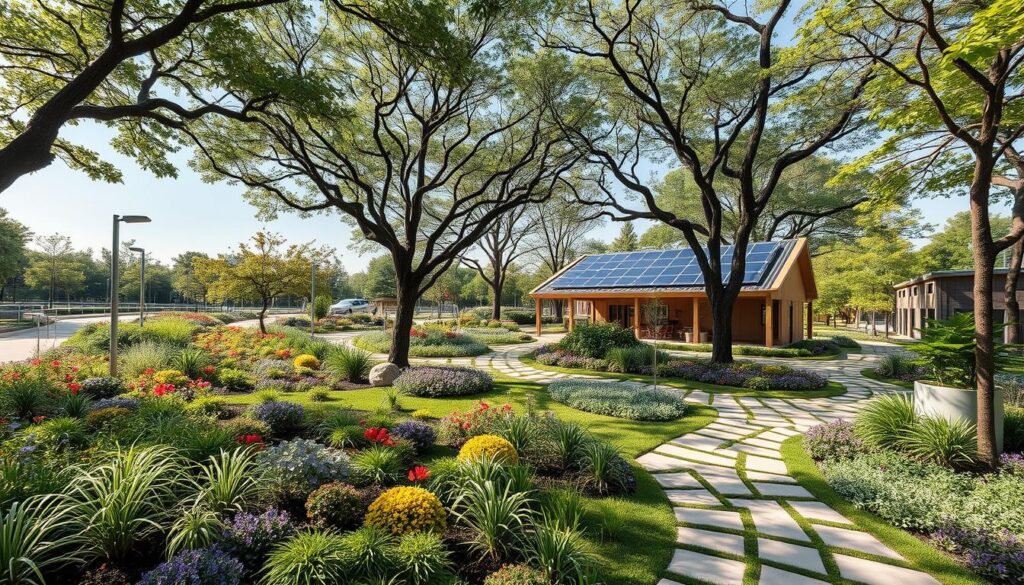
We no longer design the landscape as a stable form. It now becomes part of climate dynamics a system constantly in dialogue with weather, temperature, water, and wind. At Ecolandscape Studio, we call this approach a climate interface: a space that not only resists external influences but transforms them into a sustainable ecological logic.
This is no longer about a “sustainable garden.” It is about a landscape that behaves like a climatic mechanism, adapting in real time.
Landscape as an Active Participant in the Climate System
Classical landscape architecture has long been based on control: defining form, fixing structure, ensuring stability. But climatic reality has changed. Today, a site is not exposed to predictable conditions, but to abrupt and nonlinear scenarios.
A climate interface assumes that the landscape becomes part of climatic exchange itself. It does not only respond it redistributes environmental energy. Heavy rainfall is no longer a threat but becomes a resource. Drought is not a crisis, but a phase of slow release of stored potential.
In this approach, space functions as an adaptive system where soil, vegetation, water, and topography are interconnected within a single regulatory structure.
Extreme Climate Scenarios as the Basis of Design
Modern landscapes are no longer designed for “average yearly temperature.” They are designed for extreme states of the system. The key question is not how a site looks under normal conditions, but how it performs under climatic stress.
In such a system, drought does not collapse the ecosystem, because soil structure is designed to retain moisture through multi-layered organic matter, capillary zones, and plant communities with different root depths. Heavy rainfall does not cause erosion, because topography predefines routes of slow water distribution rather than direct runoff.
Temperature fluctuations are mitigated not by materials, but by biomass architecture vegetation density, shading structures, and natural buffer zones.
Water as a Dynamic Site Infrastructure
Within a climate interface, water is no longer a drainage element. It becomes a strategic resource continuously redistributed within the system.
We treat the water cycle as a living process. Water is not removed from the site as quickly as possible; instead, it is retained across multiple levels: surface, root, and deep storage zones. Slowed movement zones are formed, where water gradually integrates into biological processes.
During rainfall periods, the site is not overloaded because flow energy is dissipated through terrain and vegetation. During droughts, the same system releases moisture back, maintaining microclimatic stability.
This approach transforms the landscape into a local water-regulating system that operates autonomously, without external intervention.
Sensory Ecology and the Role of Artificial Intelligence
The next layer of the climate interface is data. Modern landscapes begin to “sense” their own condition.
Sensor systems measure soil moisture, multi-layer temperature, solar radiation intensity, evaporation rates, and water balance. This creates a continuous picture of site behavior.
Artificial intelligence in such systems does not replace nature it interprets its signals. It can adjust irrigation, manage water distribution, adapt shading structures, and even predict ecosystem stress states.
At Ecolandscape Studio, we see this as a shift from designing form to designing system behavior.
Topography as Climatic Architecture
One of the most underestimated tools in climate design is terrain itself. In a climate interface, topography functions as a primary engineering system.
Even small elevation changes can fundamentally alter the behavior of water, wind, and temperature. Depressions become moisture storage zones. Slopes regulate flow velocity. Elevations form thermal buffers and protected microclimates.
Topography allows not only adaptation to climate but pre-modeling of its local behavior. In effect, it turns a site into a controllable climatic map.
Landscape as a Self-Regulating System
The key transformation within a climate interface is the shift from control to self-regulation.
The landscape no longer requires constant management. It begins to operate through an internal logic where all components are interconnected. Plants support soil, soil regulates water, water shapes microclimate, and microclimate sustains the stability of the entire system.
Over time, such a site becomes less dependent on maintenance and more resilient to external change. This is not static resilience, but dynamic adaptation.
Landscape as a climate interface is not an aesthetic concept or a technological trend. It represents a fundamental shift in the logic of environmental design.
At Ecolandscape Studio, we see these systems as the next stage in the evolution of landscape architecture, where the site ceases to be an object and becomes a process.
It is a space that does not merely record climate it participates in its formation. And this is what makes it resilient in a future where stability no longer exists as a given.