The traditional doctrine of landscape design has historically been based on a static scenario. Country estates were created with ideal weather conditions in mind, which is why on cloudy, rainy, or windy days, spaces inevitably lost their expressiveness, turning into dull gray zones. We at Ecolandscape Studio completely rethink this approach and closely study the radical concept of meteo-art. Within this innovative trend, the landscape is designed in reverse. In fair weather, the site represents a pointedly austere, empty, sterile minimalism, unburdened by details, but with the onset of a downpour, gale-force wind, or dense fog, it instantly transforms into a large-scale kinetic show. The architectural approach turns weather phenomena from an annoying inconvenience into the main co-author of a natural performance, forcing the estate to reveal its true artistic potential precisely during bad weather. Analyzing the principles of meteo-art, we strive to reveal how spaces can surprise in any climatic phase.
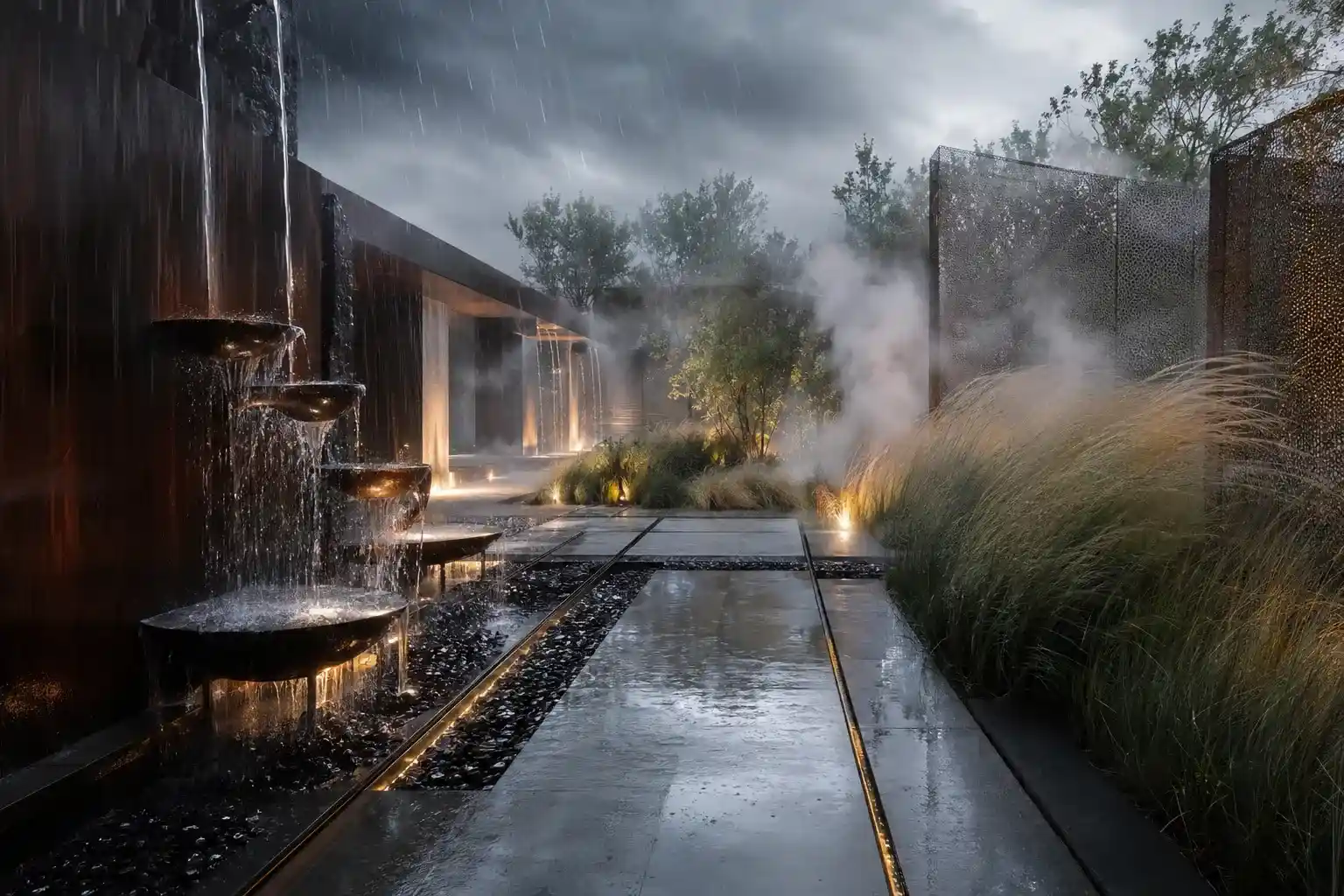
The central element of water management in the structure of meteo-art is the so-called rain strings and sculpture-downspouts, which completely replace standard hidden engineering utilities. Instead of banal plastic or metal drainage pipes hidden behind facades, landscape architects install open installations made of polished stainless steel, architectural copper, titanium, or patinated bronze. During a heavy downpour, these structures capture colossal volumes of water from roofs and terraces, turning chaotic vertical flows into completely controllable, geometrically precise water walls, translucent screens, and cascades of taut strings. Passing through a complex system of calibrated metal bowls, cascading overflows, and gaps of different densities, rainwater generates a unique acoustic accompaniment, the tone and rhythm of which change depending on the intensity of precipitation from the soft patter of drops on metal petals to a powerful, deep roar during a storm. All collected water rushes into open drainage channels lined with dark crushed basalt or shungite, which acquire a deep glossy shine when wet, revealing the hidden texture of the stone and turning streams into graphic black lines that cut through the minimalist terrain. We emphasize that this process of wave damping and redirection of the elements becomes the main aesthetic core of the updated relief.
For interaction with air masses and the design of spatial effects, high-tech fog traps are implanted into the minimalist landscape. This effect is achieved in two ways: by the precision selection of specific botanical cultures with ultra-dense, delicate branching or by installing thin mesh architectural screens made of stainless steel with a special hydrophilic coating. On sunny days, these lightweight metal membranes and openwork shrubs remain practically invisible to the eye, dissolving into the air and maintaining the general concept of empty, clean space. However, with an increase in humidity, a drop in pressure, and a decrease in temperature, the mesh structures and the microstructure of the branches begin to actively condense and retain the smallest droplets of atmospheric moisture. We understand that this physical property forces the morning or evening fog not just to float by chaotically, but to swirl, thicken, and linger in strictly defined, mathematically calculated zones of the estate, forming a mesmerizing visual effect of a mystical garden hovering over the ground and completely erasing the real boundaries of the site. We see how the aerodynamics of these zones, calculated with jewelry precision, creates the illusion of an endless landscape dissolving in space.
The Founder and CEO of Ecolandscape Studio, Martin Palma, based on his many years of experience managing large-scale premium projects, came to an important personal discovery: the true architectural depth of a landscape manifests itself not in static summer blooming, but in its ability to resonate with complex climatic scenarios. Analyzing the behavior of various materials and botanical structures in off-season conditions, Martin Palma determined that meteo-art transfers a country estate from the category of a decorative background to the status of self-sufficient interactive art. In his opinion, designing a space capable of turning a storm, thunderstorm, or heavy fog into an aesthetic spectacle of the highest order requires a deep mental transformation from both the architect and the client. Martin Palma emphasizes that such an approach completely erases the boundaries between the interior of the house and the external environment: the owner of the estate no longer seeks to close the curtains during bad weather, but, on the contrary, becomes the main viewer of an exclusive natural performance whose value is completely independent of the vegetation calendar.
Exploring the intricacies of this complex direction, we at Ecolandscape Studio consider meteo-art as the highest form of synergy between man and pristine nature, completely turning over the idea of premium landscaping. We note that creating a landscape that looks spectacular under standard sunlight is simple enough, but designing a space capable of generating complex drama during a storm or downpour requires colossal engineering, hydrodynamic, and botanical knowledge. We believe that meteo-art deconstructs the very concept of «bad weather,» turning climate extremes into a precious resource for the visual filling of the garden. We think of the integration of architecture and climate as a single whole and are convinced that such an interactive design makes a country property truly alive, since its final visual image is never static and is written by nature itself in real time.
The dynamics of gale-force wind and air currents are revealed on the site through the creation of large-scale wind waves that completely change the plasticity of the garden. To achieve this effect, modern masters completely abandon standard mixed mixborders in favor of creating giant mono-plantings of ornamental grasses of one species from sporobolus, feather reed grass, Mexican feather grass, or tufted hair grass, planted in colossal, continuous uniform masses. The vector and geometry of these planting matrices are calculated based on the long-term wind rose of a specific geographical location. In calm, windless weather, the rigid, orderly structure of the grass fields supports the overall minimalist rigor of the garden geometry, resembling architectural models. But as soon as a storm begins, the elastic, long stems and light, airy panicles come into resonant motion. The garden begins to move in waves, translating the hidden, destructive energy of the wind into a mesmerizing, safe visual spectacle reminiscent of a stormy ocean coast or an endless wild steppe.
We know how important it is to use innovative technologies, so we pay special attention to lighting modeling that emphasizes extreme weather scenarios. Professional lighting systems are programmed by us in such a way as to respond sensitively to humidity, wind, and light sensors. During a thunderstorm or fog, hidden laser projectors and low-frequency LED lines integrated into the folds of geoplasty begin to illuminate clouds of vapor or flying raindrops at a certain angle. This creates three-dimensional light planes and turns flying splashes into shining sparks. As a result, the complex country estate, the features of which we study at Ecolandscape Studio, turns into an interactive theater where nature acts as the main director, and changing climatic conditions become the guarantee of uniqueness and the unsurpassed dynamic luxury of a country residence.