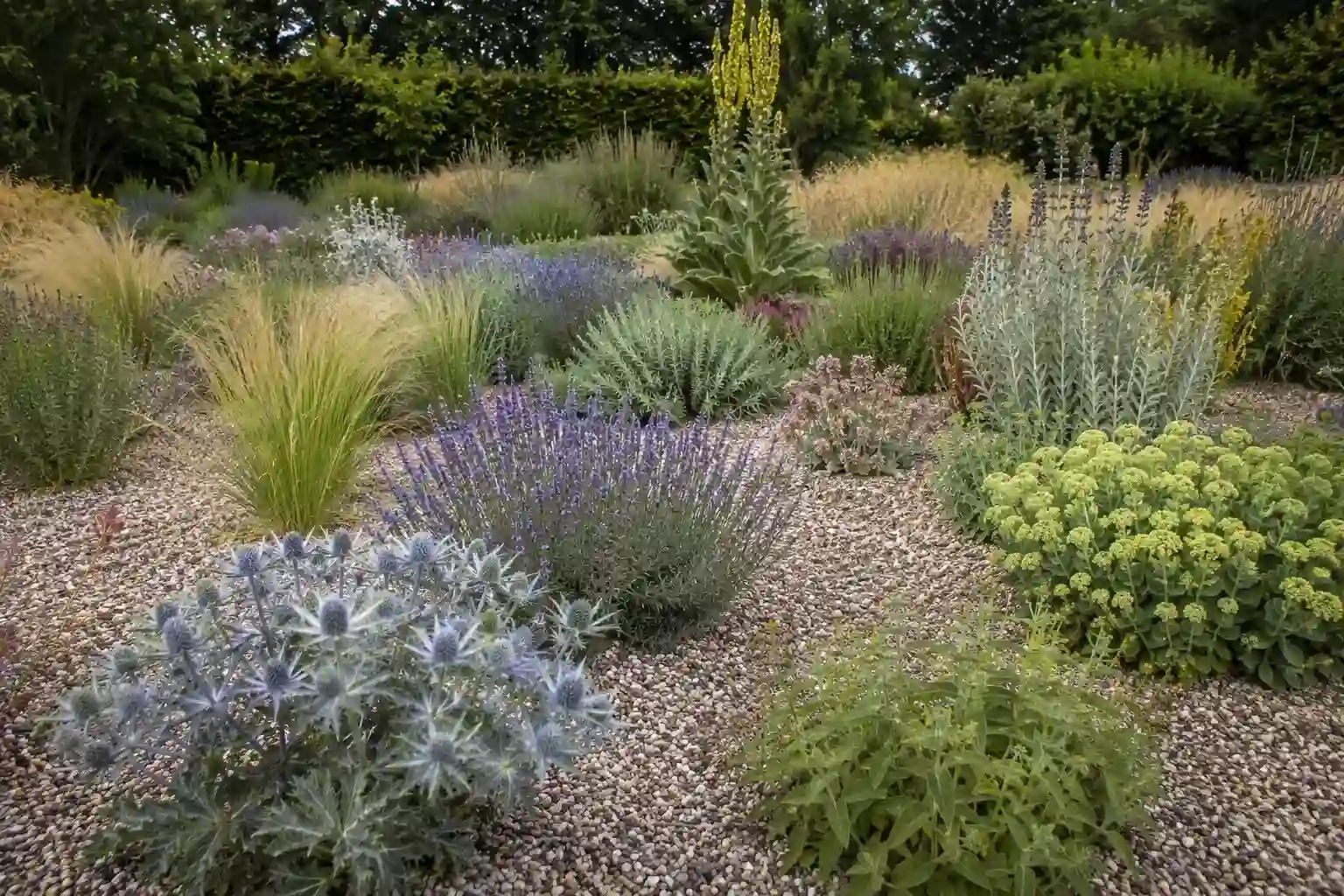
The idea of a garden that requires no regular watering and no exhausting weeding is often dismissed as wishful thinking or a marketing gimmick. Yet in Essex, one of the driest regions of England, there is a living example that proves otherwise. The famous Gravel Garden created by Beth Chatto was established on the site of a former car park with barren, drought-stricken soil. For decades, it has thrived solely on natural rainfall. At Ecolandscape Studio, we view this as a revolutionary British landscaping technique that has proven its effectiveness over many years. For our specialists, this method has become the benchmark for how thoughtful landscape design can create truly autonomous ecosystems.
The secret behind this technology lies in the correct physical structure of the planting system and a complete rejection of artificial materials. Many modern landscape designers make the mistake of placing black landscape fabric beneath gravel in an attempt to suppress weeds. We consider geotextiles to be an absolutely taboo material in projects of this kind. It disrupts natural soil aeration, restricts healthy root development, and eventually becomes an underground trap for organic debris where weed seeds often germinate even more successfully. In Beth Chatto’s approach, fine gravel is applied directly onto soil that has been thoroughly cleared of perennial weeds, forming a dense layer at least 5 to 10 centimeters thick. This substantial stone layer functions as a perfect natural mulch: it allows rainwater to pass through immediately while preventing excessive evaporation, preserving valuable moisture in the lower soil layers and simultaneously blocking sunlight from reaching weed seeds.
The planting process itself deserves special attention from landscape architects because it differs fundamentally from conventional gardening practices. Martin Palma, Founder and CEO of Ecolandscape Studio, made an important discovery while conducting professional research on British gardens: «When we first analyzed plant survival in extremely dry environments, it became clear that the greatest enemy of a drought-resistant garden is commercial peat-based substrate. Once peat dries out in the ground, it becomes a dense hydrophobic mass that simply repels water from the roots. By washing the peat away before planting, we intentionally place the plant under controlled stress, forcing its roots into direct contact with the native soil and encouraging them to grow as deeply as possible in search of alternative moisture sources. This completely changes the plant’s life cycle, making it highly independent of external inputs.»
Plants are installed in holes cut through the gravel layer, after which the root crown is carefully surrounded with stone once again. This protects it from rot during prolonged periods of autumn rainfall.
The long-term viability of such a landscape depends on a strict and uncompromising selection of plant species. At Ecolandscape Studio, we build planting palettes around what we call «survivor plants» that possess specialized anatomical adaptations for water conservation. Architectural sea holly, with its rigid spiny foliage, and majestic mullein, whose woolly leaves capture droplets of night dew, become structural highlights within the composition. Silver-leaved artemisias, lavender, and aromatic sage release essential oils that create a protective microclimate around the plants, reducing moisture loss. As these perennials mature, their canopies merge into a dense, continuous living carpet above the gravel. This green layer leaves weeds virtually no opportunity to establish themselves by shading every remaining patch of exposed ground. Ornamental grasses such as evergreen oat grass, feather grasses, and fescues integrate seamlessly into the planting scheme, minimizing water loss through their narrow leaves. Various sedums and euphorbias further strengthen the composition through their ability to store moisture in thick stems and foliage.
At Ecolandscape Studio, we believe that ecological landscaping based on Beth Chatto’s method represents a manifesto of rational self-interest in modern gardening. A gravel garden frees its owner from the need to consume vast amounts of water and spend countless hours managing hoses, irrigation systems, and relentless weeding. The plants develop exceptional natural resistance to disease thanks to abundant sunlight and the absence of stagnant moisture, while maintenance is reduced to a single annual task: removing the previous year’s growth in early spring. This approach to landscape design demonstrates that by working with nature rather than against it, and by selecting the right plants for the right place, it is possible to create a highly ornamental, self-sustaining ecosystem that becomes more beautiful with each passing year while the gardener remains simply an admiring observer.