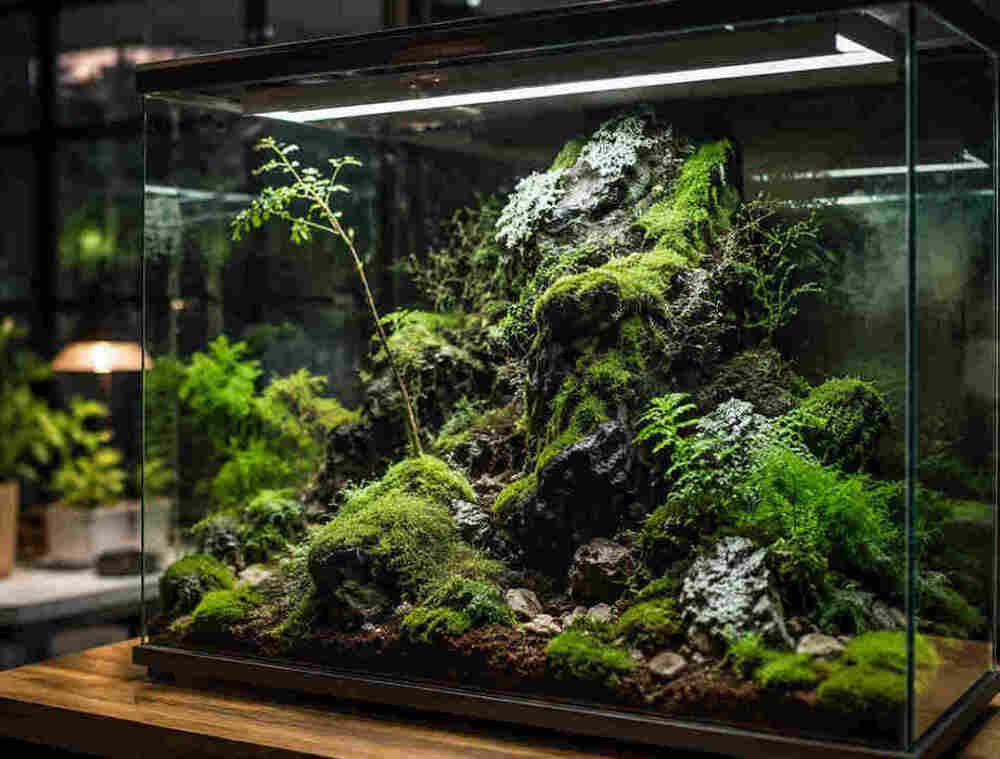
In the modern era of total urbanization, landscape architecture and interior phytodesign are undergoing a profound transformation, as the focus of experts and researchers shifts from macro-forms to the hidden processes of the biosphere. A particularly compelling trend today goes far beyond conventional houseplant care and standard interior plant design: the creation of closed plant spaces inspired by the microcosm. This unique concept of a “garden within a garden” centers on elements such as bryophytes, rare lichens, fungal mycelium, and microbiological communities. Our team at Ecolandscape Studio believes that this approach exists at the intersection of theoretical botany, soil science, and biophilic design, transforming the study and recreation of micro-landscapes into a high-tech art capable of enhancing any modern space.
The life processes within such systems are based on the phenomenon of natural fractality, which allows fundamental trophic relationships of the planet to be reproduced on a limited scale. Unlike traditional terrariums, which serve primarily decorative purposes, an authentic micro-garden functions as a balanced biome, where every detail performs a precise biochemical role. This integrated modeling of the environment materializes processes invisible to the human eye, slows the pace of visual perception, and immerses the observer in a state of deep mindfulness, making this technology highly sought after in progressive urban interiors, commercial spaces, and private residences.
The development of life within an artificial microcosm depends on the precise selection of species and stabilization of the overall biocenosis. Spore-bearing organisms, capable of accumulating moisture across their entire surface, play a key role. Various moss species, such as Leucobryum and Polytrichum, form intricate relief architectures, meticulously imitating centuries-old forests and mountain ridges in miniature. Incorporating foliose lichens into the composition enriches the visual array with unique graphic textures, capturing within the ecosystem a sense of slowed time due to their extremely slow growth rates.
Martin Palma, Founder and CEO of Ecolandscape Studio, shares an expert perspective grounded in years of practical experience and observations of wild nature: “My personal professional revelation occurred during an expedition through relict forests, when I realized that the greatest landscape scenarios of the planet are already written beneath our feet. Observing a tiny moss island on a centuries-old granite boulder, I understood that the viability of vast macro-systems depends entirely on the health of their invisible microbiome. It is this synergistic balance that must be transferred to interior landscaping. For a mini-ecosystem to thrive for years, it is not enough to simply copy the appearance of forest litter one must recreate the exact biochemical logic of its subterranean processes, ensuring the environment’s full autonomy.”
A key factor in the longevity of such phytosystems is modeling “living soil” inhabited by specialized microflora. Experts at Ecolandscape Studio study this in detail: professional substrates are created on a soilless basis with added coconut fiber, lava granules, and activated charcoal, which acts as a natural sorbent. The real magic occurs at the micro-level, where fungal mycelium of mycorrhizae is artificially integrated into the soil mix, ensuring optimal nutrient exchange among components, while colonies of beneficial bacteria regulate the nitrogen cycle and maintain environmental health. An indispensable part of the biocenosis is Collembola, or springtails tiny natural sanitizers that decompose dead organic matter and prevent mold without the use of chemical fungicides, ensuring the system’s full ecological safety.
The life support of a complex micro-garden relies entirely on strict control of external parameters and climate indicators. Automated environmental maintenance includes the installation of specialized LED lighting with a full phyto-spectrum, compensating for the absence of direct sunlight, which is harmful to shade-tolerant forest mosses and lichens. Water balance in these systems is maintained exclusively with distilled or reverse-osmosis water, as regular tap water causes osmotic shock to microorganisms and leaves an unsightly salt deposit on glass and plants. Through the synergy of science, technology, and biophilic design, specialists at Ecolandscape Studio create an autonomous biological simulator capable of thriving harmoniously for years with minimal external intervention, reminding us of the perfection and fragility of the invisible worlds on our planet.