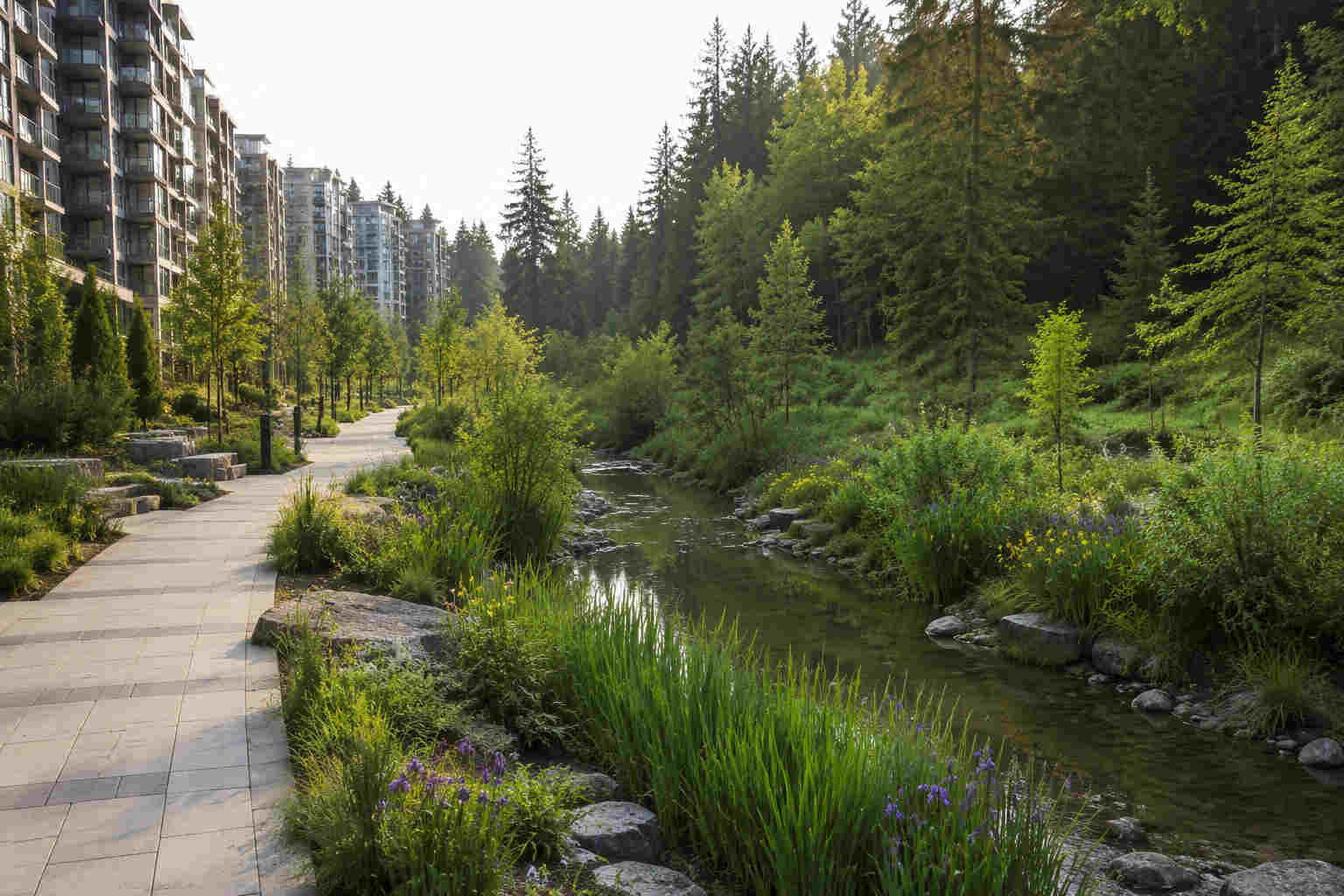
In the era of rapid urban expansion, city planning and professional site development face a fundamentally new challenge: the traditional rigid boundary between urbanized areas and pristine ecosystems is rapidly becoming a thing of the past. Replacing straight-edged fences and harsh asphalt on city outskirts is intelligent eco-greening of dynamic ecotones. These buffer zones are unique spaces where the complex geometry of concrete gently integrates into the natural matrix of the land. Designing such areas requires architects to completely abandon standard park solutions in favor of adaptive, hybrid objects. In these locations, greenery functions as a sophisticated engineering system, capable of mitigating ecological stresses, reducing the negative effects of the urban heat island, and visually linking architectural structures with the natural landscape.
The main challenge of these boundary spaces lies in the constant anthropogenic pressure that a metropolis exerts on adjacent forests or meadows. Wind corridors, sudden changes in soil hydrology, light pollution, and the heat footprint of residential districts can quickly disrupt fragile natural biocenoses. Competent landscape design of transitional zones by the Ecolandscape Studio team is based on the use of local native flora and the creation of resilient, multi-layered green shields. Plantings are always designed in a wave-like pattern from species resilient to anthropogenic load at the street edges to authentic forest edifiers deeper within the territory. This concept forms a flexible biological filter that effectively captures heavy metals, traps dust, and stabilizes air humidity.
The visual and spatial contrast between the ordered street grid and the chaotic texture of wild forest is smoothed through gradual changes in geometry and scale of elements. Closer to residential complexes, the landscape maintains clear lines but is enriched with natural textures: split stone, untreated wood, and natural gravel surfaces. Martin Palma, founder and CEO of Ecolandscape Studio, shares his vision based on personal experience: “For a long time, urbanism treated wild nature as an object to conquer, erecting impermeable concrete barriers between the city and the forest. My personal professional revelation occurred when I realized that landscapes at the interface of environments should not be dividing lines but living membranes. Plants can act as natural shock absorbers, softly absorbing noise, damping gusts of wind, and purifying the air before urban pollutants reach the wild forest. Our task in the studio is to make this invisible ecological work tangible and aesthetic.”
As one moves away from buildings, strict geometric patterns of paths gradually dissolve, and manicured lawns give way to masses of ornamental grasses and perennials that carefully mimic natural meadow communities.
Successful development of transitional spaces is impossible without integrating modern principles of sustainable rainwater collection and filtration. At the boundary between asphalt and open soil, Ecolandscape Studio experts design bioretention ditches and functional rain gardens planted with moisture-loving riparian species such as cattails, yellow iris, or various sedges. These engineered eco-zones are the first to absorb the impact of urban surface runoff, purifying water through natural phytoremediation processes before it reaches natural water bodies or deep groundwater horizons. In this way, boundary landscaping addresses a critical ecological task, transforming a potentially destructive exclusion zone into a flourishing biocorridor that supports local biodiversity and wildlife migration.
Professional design of boundary landscapes by Ecolandscape Studio represents a manifesto of a new ecological aesthetic, where the compromise between urban development and wild nature is achieved through deep analysis of natural processes. Creating such buffer zones allows cities not to encroach on nature but to interact harmoniously with it, forming a sustainable, safe, and comfortable living environment. This kind of landscape design demonstrates that at the intersection of urbanism and biology, a viable ecosystem of the future emerges, where every square meter of green space works for the benefit of planetary balance, making the transitions between man-made and wild worlds imperceptible to humans.