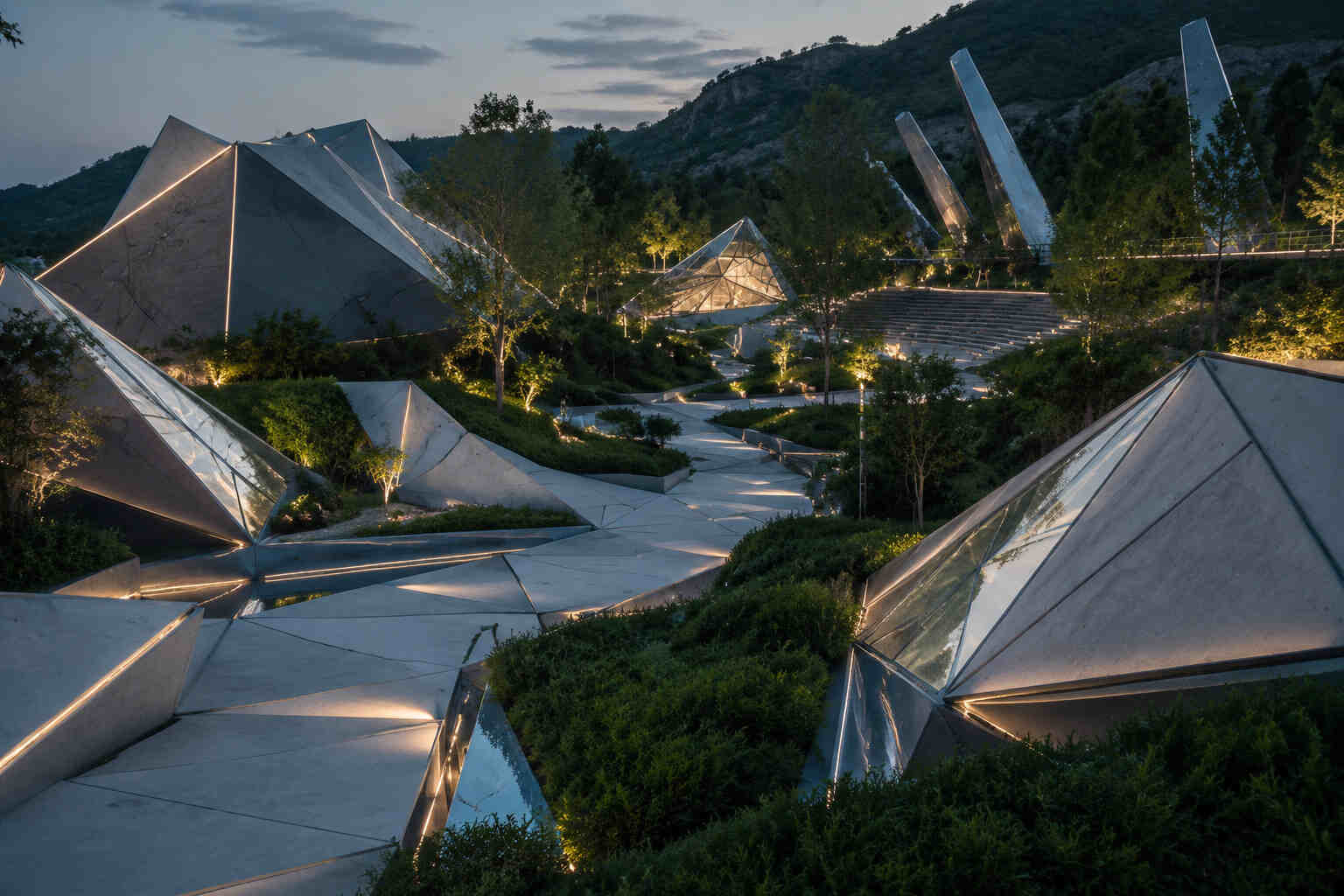
At Ecolandscape Studio, the crystal landscape is seen as one of the most promising directions in contemporary landscape design, where space is conceived as an integrated system of interactions between geometry, light, materials, and human perception. It is not a stylistic expression or a decorative concept, but a method of forming an environment in which a territory becomes an active architectural structure that influences human behavior, emotions, and movement paths. At the core of this approach is a reinterpretation of natural crystal formations and their translation into the language of modern architecture and spatial design.
Geometry in the crystal landscape is not a visual device but the fundamental logic of spatial organization. The environment is shaped through a system of facets, planes, fractures, and multi-sided modules that create a sense of a structured, almost “assembled” nature. Unlike traditional landscapes, where smoothness and organic forms dominate, precision, rhythm, and direction are essential here. Such geometry shapes not only the visual appearance of the territory but also its behavioral structure: it guides human movement, defines focal points of attention, and creates visual corridors. As one moves through the space, the composition continuously changes, producing the effect of a living and dynamic architecture.
The material foundation of the crystal landscape is based on a combination of concrete, metal, glass, and modern composite solutions. Concrete is used to create large architectural masses that form the basis of the composition and ensure its stability. Metal provides geometric precision, emphasizes edges, and enhances the technological character of the structure. Glass and transparent materials add depth, reflections, and internal luminosity, allowing objects to interact with the surrounding environment rather than exist separately from it. Composite materials help reduce the visual weight of structures and create a sense of lightness, which is especially important for achieving the effect of a crystal-like formation.
Light in the crystal landscape functions as a full-fledged architectural material. At Ecolandscape Studio, we design lighting simultaneously with form, treating it as an integral part of the overall composition. Daylight reveals the structure through shadows, reflections, and refractions, creating a complex play of facets. In the evening, the space transforms through integrated lighting scenarios: hidden LED lines, contour lighting, and directional accents. As a result, architectural forms acquire a new state, becoming luminous objects that change the character of the space depending on time of day and lighting scenario.
The crystal landscape is always designed through human movement. The space is not perceived all at once but sequentially, through a route that becomes part of the composition. Geometric structures guide flow, create pauses, open new perspectives, and produce the effect of gradual spatial revelation. The perception of space becomes theatrical: a person moves through a series of visual episodes, each generating a new emotional state and altering the sense of scale.
Special importance is given to interaction with the natural context. Despite its pronounced geometric character, the crystal landscape is always developed in dialogue with the surrounding environment. Relief is used as a foundation for composition, vegetation creates contrast between the organic and the artificial, and water enhances reflections and perceptual depth. This interaction creates the effect of a “second nature,” where architectural forms do not compete with nature but complement it, forming a new spatial reality.
The structure of the crystal landscape is based on the principle of multilayering. Large-scale forms establish architectural dominants and define the overall scale of the territory. The middle level creates rhythm and connects the composition into a unified system. Small elements, textures, and lighting accents generate depth and complexity within the visual field. As a result, the space is perceived as a complex hierarchical system that unfolds gradually and step by step rather than all at once.
The functional aspect of the crystal landscape is no less important than the aesthetic one. Geometric structures help organize navigation, define logical routes, and structure the territory without the need for additional signage. In public spaces, this improves spatial readability and enhances pedestrian flow. In private projects, it enables the creation of clearly defined private and open zones with a strong spatial logic. In commercial developments, it strengthens visual identity and forms a memorable architectural image that becomes part of the site’s brand.
At Ecolandscape Studio, we view the crystal landscape as a system for shaping human experience in space. Founder and CEO Martin Palma notes: “Crystal structures have shown us that landscape is not just the design of territory, but a mechanism for shaping perception and emotional states.”
The crystal landscape is applied across a wide range of projects: from private gardens and residences to public spaces, art parks, and commercial complexes. In private projects, it creates a unique site identity and emphasizes the individuality of the owner. In urban environments, it generates new focal points and visual landmarks. In commercial architecture, it serves as a tool for strengthening branding and creating a powerful emotional spatial identity.
Thus, the crystal landscape represents a comprehensive approach to spatial design in which geometry, materials, light, movement, and nature are unified into a single system. In the practice of Ecolandscape Studio, it is used to create environments of the future, where landscape ceases to be a static object and becomes a living, evolving architectural structure that shapes a new experience of human interaction with the surrounding world.