The global luxury residential development industry is undergoing a profound technological transformation. In 2026, the traditional approach to land improvement has definitively given way to designing adaptive spaces where living nature merges with advanced computing achievements. A modern country estate is no longer perceived as static architecture surrounded by standard flora. Today, it is a highly complex cyber-physical system functioning at the intersection of engineering, the Internet of Things (IoT), and predictive data analysis. Intuitive maintenance and traditional blueprints have been replaced by the concept of end-to-end modeling with the creation of interactive digital twins (Digital Twins). In this material, the Ecolandscape Studio team shares a detailed expert analysis of how turnkey landscape design is transitioning to a level of absolute automation, technological luxury, and autonomy.
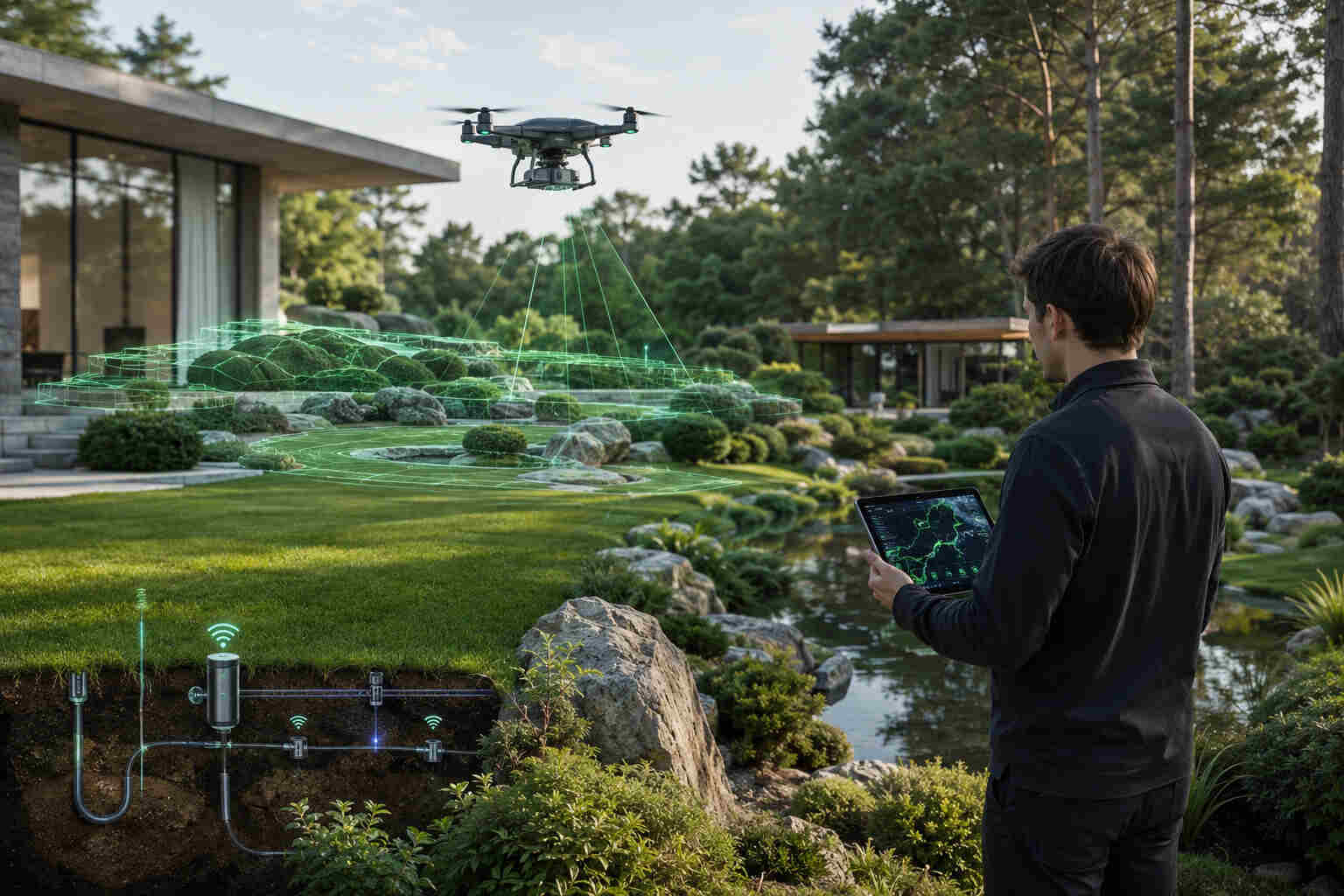
The process of recreating an intelligent natural space is initiated long before heavy construction equipment appears on site or the existing topography is altered. At the pre-design stage, specialists carry out comprehensive three-dimensional scanning of the territory using drone-based multispectral lidars (LiDAR). This allows the collection of gigabytes of precise data on microtopography, insolation maps, wind roses, local thermal contours, and hydrogeological soil strata. Based on the parameters obtained, a virtual eco-twin is deployed — a dynamic digital copy of the site functioning in real time on a cloud platform. Artificial intelligence simulates the ecosystem’s development 10-15 years ahead with centimeter precision, calculating the vegetative expansion of root systems, the emergence of seasonal shading zones from buildings under construction, and the hydrodynamic behavior of soil under critical precipitation rates. This approach completely eliminates design risks, prevents the loss of expensive mature trees, and allows architects to form mathematically flawless spatial patterns.
Upon completion of physical works on site, the virtual prototype transforms into the main proactive node for managing the living environment. A split network of hidden wireless biometric sensors is mounted throughout the garden area, integrated directly into the root zones of plants and completely invisible to the eye. In a continuous mode, these sensors transmit indicators of substrate acidity (pH), electrical conductivity (EC), and moisture and temperature of various soil layers to an analytical neural network. They also measure sap flow velocity in the trunks of specimen trees via non-invasive ultrasonic flowmeters. Artificial intelligence continuously cross-references the internal parameters of the flora with meteorological radar data, allowing the system to work proactively. It locally adapts the ecosystem to any weather anomalies — be it prolonged periods of drought, sharp frosts, or squall wind loads — without involving human resources or maintenance services.
Martin Palma, Founder and CEO of Ecolandscape Studio, is convinced that the integration of artificial intelligence and the Digital Twins concept is not just a passing trend, but the only possible way for the premium landscape industry to evolve in an era of climate instability. Based on years of personal experience in executing luxury properties, Martin discovered that the true viability of a garden lies in the synergy of precise algorithms and the laws of natural xeriscaping. In his view, when a neural network manages drought-tolerant matrix plantings and endemics, turnkey landscape design transforms into a virtually eternal, self-healing ecosystem. Martin Palma emphasizes that such an approach completely relieves the estate owner from operational chaos, guaranteeing the preservation of high-status architectural garden graphics with minimal human intervention.
The digital management platform fundamentally changes the logic of natural resource distribution, shifting premium property development onto the tracks of conscious consumption. A smart AI garden operates in a strict predictive self-optimization mode: algorithms calculate the targeted delivery of moisture and organic macronutrients with milliliter precision, directing them directly to the specific botanical groups experiencing a deficit at that exact second. Through machine learning, the system independently identifies hidden plant stress, forecasts risks of botanical diseases or pest infestations days before their visual manifestation, and automatically adjusts the capacity of underground drainage circuits. Meanwhile, the owner is completely freed from routine monitoring — the intelligent software takes over the entire management of the landscape’s life cycle, generating concise analytical reports, carbon balance charts, and push notifications about the ecosystem’s health status directly to a smartphone.
The integration of artificial intelligence and Digital Twins technologies into landscape architecture in 2026 clearly demonstrates that the prestige of a country property is now determined by the level of intellectualization of its space, rather than the size of the hired maintenance staff. The garden transforms into a self-learning organism capable of accumulating historical data, independently strengthening its own immunity, and increasing the site’s biodiversity. Cyber-ecosystems from Ecolandscape Studio set a new benchmark for residential development, where digital solutions do not suppress living nature but act as its main protector and co-author. By creating autonomous, high-tech landscapes of the future, we grant our clients the ultimate resource — absolute freedom, mental comfort, and the opportunity to contemplate the pure beauty of a nature that stays ahead of its time.