In the modern landscape design industry, the cult of refined, sterile perfection has long dominated. Topiary shearing, perfectly combed parterre lawns, and symmetrical plantings «from the picture» have formed a rigid consumer standard. However, at Ecolandscape Studio, we are witnessing a logical tectonic shift: the sophisticated client is tired of plastic ideality and is looking for authenticity, rootedness, and depth. The response to this demand is the concept of the «ruin garden» — a deep landscape adaptation of the Japanese wabi-sabi philosophy and European romanticism, where time itself, patina, and the aesthetics of controlled decay act as the co-author, key decorative factor, and architect of the space.
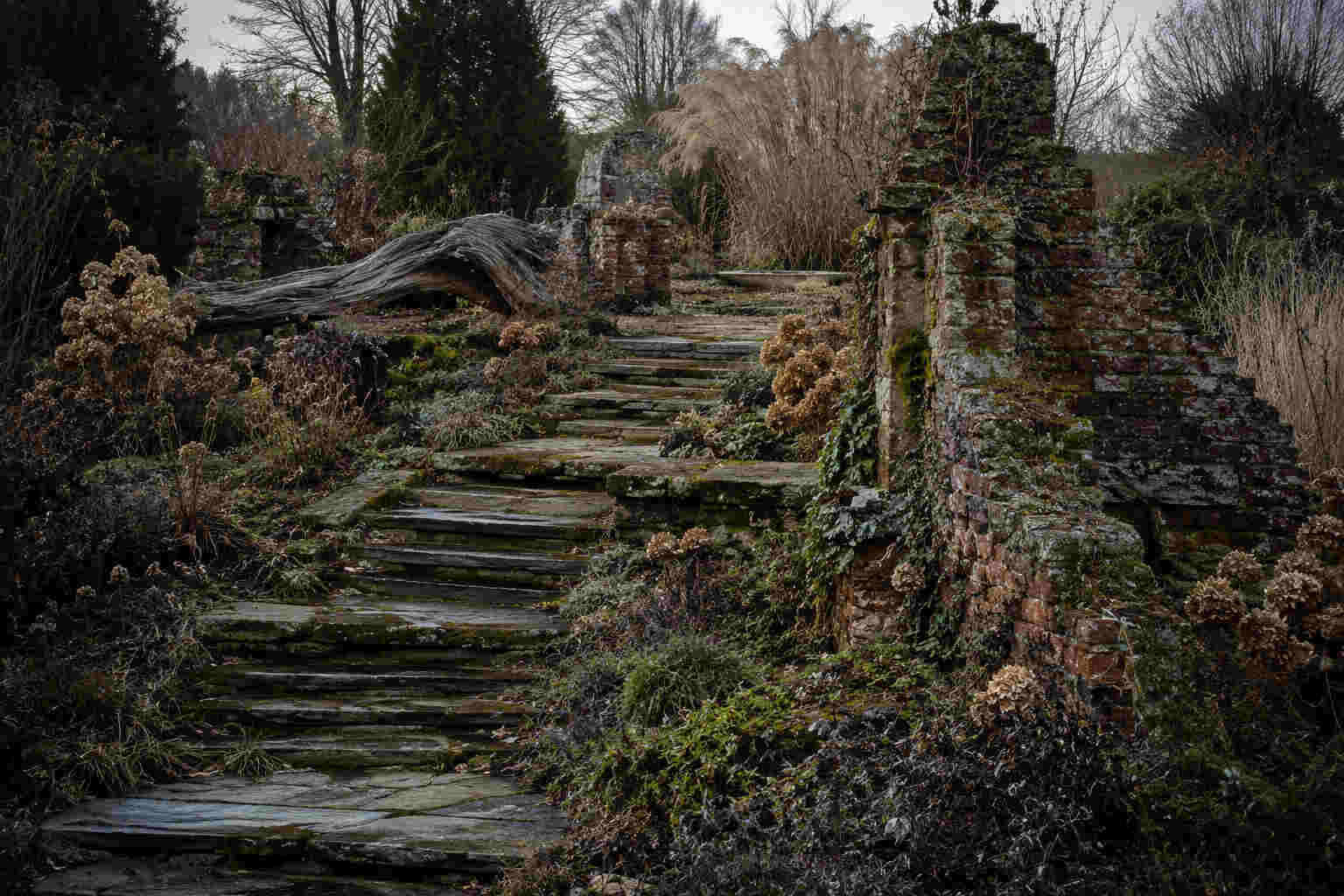
Creating an authentic ruin garden is a subtle direction of a landscape architect, balancing on the verge between high art and chaos. For the space to be read as a conceptual object, rather than an abandoned construction wasteland, the integration of decay elements must obey strict laws of composition and tectonics. Fragments of old, textured handmade brickwork, exposed concrete blocks with rough chips, or massive, sun-and-water-bleached driftwood are exhibited in space as sculptural dominants. Each element is partially embedded into the relief, creating an illusion of an ancient foundation breaking through soil layers. The deliberate incompleteness of lines, semi-ruined retaining walls, and sharp contrasts of textures emphasize the fragility of the handmade world in the face of advancing nature, turning utilitarian materials into artifacts of a bygone era.
A carefully selected floristic matrix translating the spirit of time acts as a living link between man-made tectonics and natural expansion. Instead of bright varietal hybrids, primitive, evolutionarily ancient species dominate here, demonstrating striking viability. Mosses and lichens artificially colonize the shaded surfaces of concrete and brick, smoothing sharp corners and gifting surfaces with a noble velvety patina. Through deliberately widened joints of stone slabs and cracks in the blind area, ferns, bugles, and stonecrops break through, their delicate fronds contrasting with the monolithic stone. Walls and vertical supports are slowly absorbed by ivy and wild grapes, whose graphics of shoots repeat the contours of decaying masonry in details, visually dissolving architecture in the biocenosis.
The true triumph of the ruin garden philosophy is revealed in the autumn-winter period, when the landscape is completely liberated from the dictates of bright summer inflorescences and passes into a graphic phase of withering. For Ecolandscape Studio specialists, the aesthetics of all-seasonality is not just about preserving the structure of the garden in winter, but the culmination of its poetics. Cut off from the usual understanding of decorativeness, dry ochre hydrangea heads, graphic graphite stonecrop umbrellas, and darkened, wind-chiming skeletons of ornamental grasses under caps of frost and wet snow translate a melancholic, deep beauty of dramatic decay. Cleared of coloristic noise, the winter ruin garden exposes its pure architectonics, where fragile frozen stems and snow-covered wall fragments look more monumental and expressive than any summer riot of colors.
The founder and CEO of Ecolandscape Studio, Martin Palma, views the concept of the ruin garden as the pinnacle of landscape hedonism and a tool for mental rebooting: «Over years of designing premium properties, I have noticed that glossy gardens often keep a person in tension, demanding compliance and perfectionism. The ruin garden, on the contrary, translates absolute acceptance of imperfection and the transience of life. When we create a space where time gently emphasizes the texture of stone, and moss softly absorbs concrete, we give a person a rare luxury — the opportunity to slow down and contemplate. This is not just a design, it is pure psychotherapy through natural metaphors, allowing one to feel like a part of an eternal, continuous cycle where withering is just as beautiful as blooming.»
Designing a ruin garden requires immense professional tact and impeccable knowledge of pioneer plant biology from landscape architects. Controlled decay implies that the destruction of materials is preserved at a certain stage and does not threaten the structural safety and functionality of key areas of the plot. Moving away from obsessive gloss in favor of poetic neglect becomes a manifesto of Ecolandscape Studio, taking landscape architecture beyond the framework of banal improvement into the realm of high conceptual art capable of evoking a deep emotional response and giving aesthetic pleasure to true connoisseurs of natural authenticity.