At Ecolandscape Studio, we consider “gravitational gardens” to be one of the most promising directions in contemporary landscape architecture, in which space ceases to be a neutral backdrop and becomes an active system that influences human perception. This concept is based on the synthesis of geoplastic design, water design, optical engineering, and digital environmental modeling, where every element of the landscape participates in shaping an emotional and sensory experience. Unlike traditional premium landscape design, the key object of design here is not form, but perception of space.
At the core of gravitational gardens is the treatment of topography as a tool for cognitive environmental manipulation. We design geoplastic structures not as decorative terrain modeling, but as a precise system of visual and spatial vectors. Slopes, elevation changes, and sightlines are calculated in such a way as to alter a person’s habitual spatial coordinate system. As a result, an effect of “shifted gravity” emerges, in which the horizon loses its stability and space is perceived as a dynamic structure characteristic of innovative landscape solutions and contemporary geoplastic design.
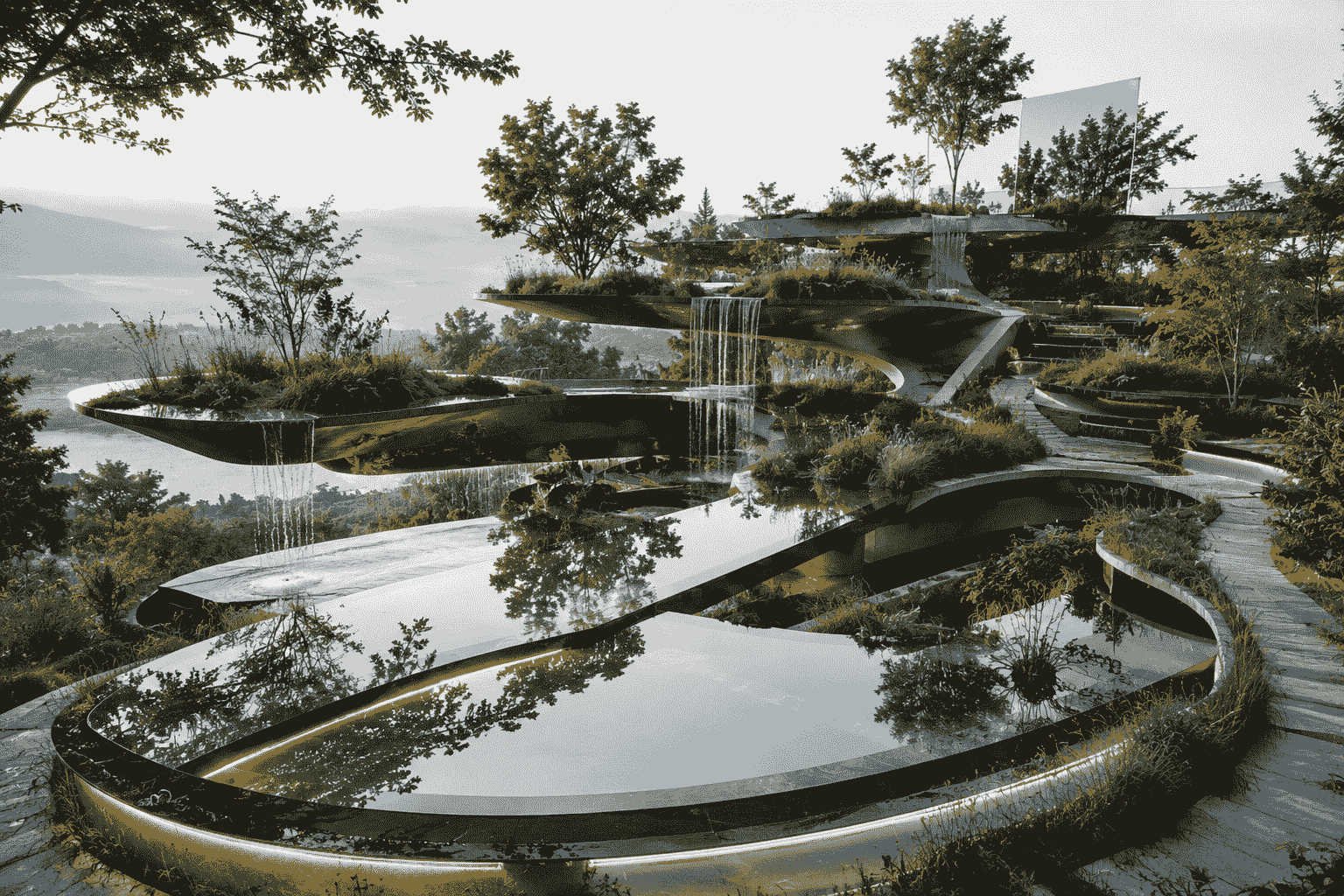
Water plays a particularly important role in such projects, becoming in the concept of Ecolandscape Studio not a decorative, but a meaning-forming element. Water systems are designed as controlled visual scenarios in which flows, reflections, and level changes create complex optical effects. Through precise hydraulic engineering and concealed technical solutions, illusions of “floating” streams, inverted cascades, and unstable mirror surfaces are created. This enhances the effect of spatial uncertainty and forms a unique experience of interaction with landscape architecture of the future.
Vegetation in gravitational gardens is treated as a structural component of architecture rather than a backdrop. We use principles of compositional planting design in which each species is selected based on its visual plasticity and its ability to enhance spatial distortion. Terraced systems, cantilevered platforms, and multi-level planting structures create the effect of a “floating” green mass, in which natural form is subordinated to the overall concept of high-end landscape design.
The optical layer of design plays a key role in forming the visual identity of gravitational gardens. The projects use mirrored surfaces, anamorphic distortions, and controlled reflections, enabling the creation of a multi-layered space in which reality and reflection constantly interact. This produces an effect of visual instability, where object boundaries become ambiguous and the perception of depth is constantly shifting.
The engineering realization of such spaces requires high precision and the use of digital design technologies. At Ecolandscape Studio, we use parametric modeling, BIM systems, and structural load analysis, enabling the creation of complex geoplastic forms without compromising safety and stability. Underground structures and hidden load-bearing systems ensure physical stability despite the visually complex and “impossible” geometry of the landscape.
Light architecture becomes a separate tool for shaping perception within innovative landscape design. In daytime scenarios, we work with natural shadows and reflections that enhance spatial depth, while at night we use directed and linear lighting that transforms the geometry of the garden and alters the perception of scale. Light effectively becomes a tool for managing the emotional narrative of human movement through the space.
The acoustic environment is also integrated into the overall concept of the gravitational garden. Sounds of water, wind, and vegetation are distributed according to topography and surface materials, forming a multilayered sound field. This enhances the effect of full immersion and makes the space not only visually but also sensorially multidimensional.
According to Martin Palma, founder and CEO of Ecolandscape Studio, the idea of gravitational gardens emerged from many years of observing how humans perceive landscapes not objectively, but through a system of internal visual and emotional filters. His personal insight is that the strongest spatial effect does not arise when a space is perfect, but when it introduces a slight disruption in habitual spatial logic, forcing a person to reinterpret the surrounding reality.
Thus, “gravitational gardens” become for Ecolandscape Studio not merely a concept, but a direction in the development of contemporary landscape design, premium geoplastic architecture, and innovative spatial solutions, where architecture, nature, and technology merge into a unified system of controlled perception and create a unique experience of interaction between humans and space.