At Ecolandscape Studio, we approach landscape design as a managed hydro-ecological system in which water is not an external risk factor but a fundamental structural element in shaping a resilient territory. With the increasing intensity of precipitation events and the growing frequency of short-duration, high-volume rainfall loads, traditional approaches based solely on linear drainage and stormwater discharge systems are no longer sufficient to ensure long-term site stability.
By water-sensitive landscape design, we refer to a methodology in which a site is analyzed as part of a local catchment system, taking into account surface runoff dynamics, infiltration processes, soil water retention capacity, and interaction with groundwater systems. This approach allows us not merely to “remove water,” but to actively manage its behavior within the site boundary, establishing a predictable and controlled hydrological regime.
Landscape as a Hydrological Regulation System
The functional foundation of Ecolandscape Studio design approach lies in the creation of a balanced internal water cycle within the site. Unlike conventional engineering models, where water is treated as an excess volume to be removed, we design systems in which precipitation undergoes a sequence of deceleration, redistribution, temporary storage, and infiltration.
From a hydrological perspective, this results in a reduced runoff coefficient, increased time of concentration, and a higher proportion of infiltration within the overall site water balance. In practical terms, this translates into reduced peak surface loading, minimized erosion risk, and improved stability of the soil structure under climatic stress conditions.
Topography as a Tool for Hydrodynamic Control
Topography functions as the primary mechanism of hydrodynamic regulation within our system. It defines flow trajectories, establishes hydraulic gradients, and structures zones of accumulation and discharge.
In our design practice, we apply contour-based grading strategies and microtopographic modeling to manage surface runoff direction without relying solely on conventional engineering barriers. This creates a spatial hydraulic framework in which water gradually loses kinetic energy and transitions into a controlled state of distributed retention across the site.
Water Retention and Infiltration Zones as Functional System Components
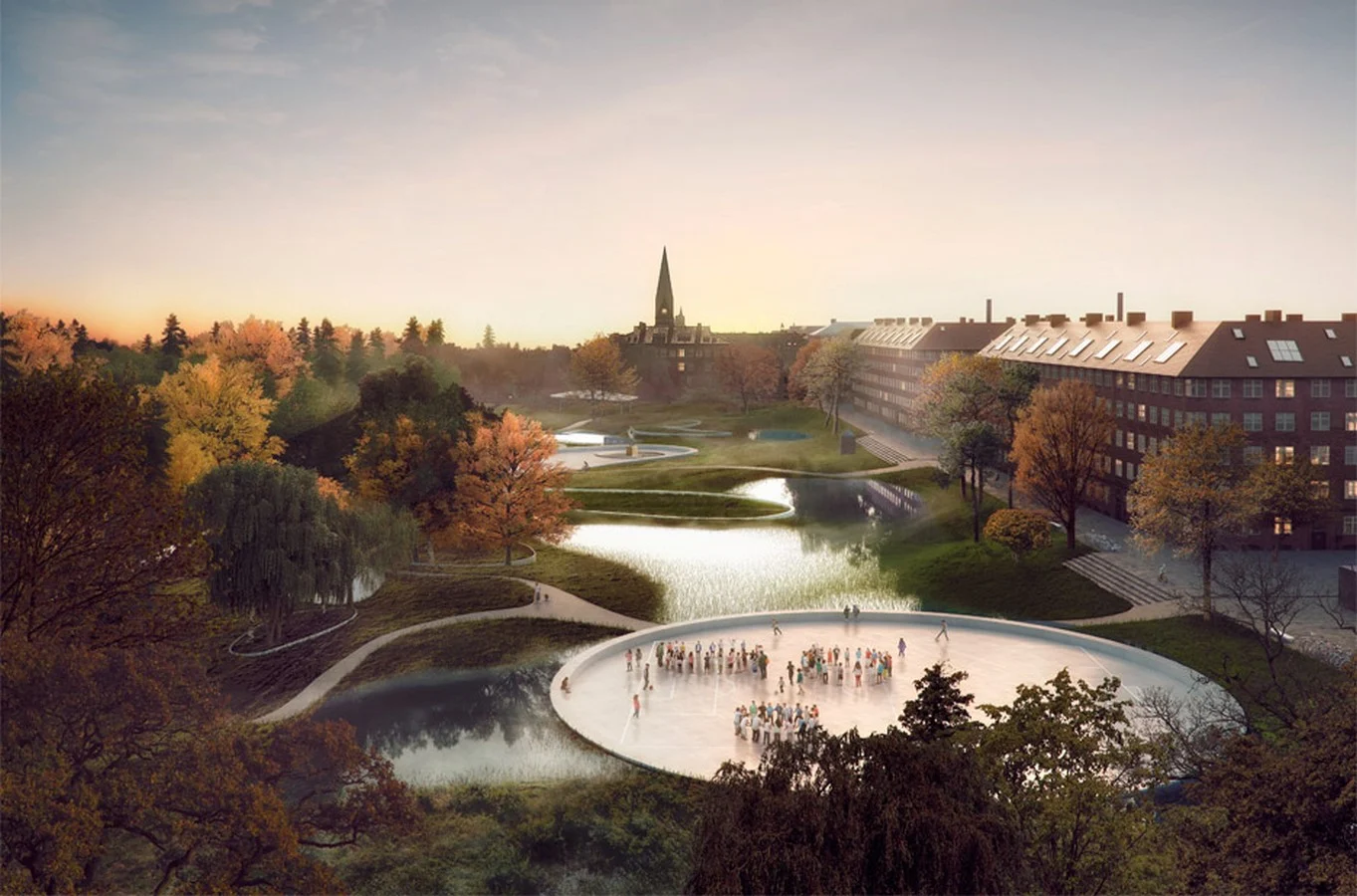
Within the landscape structure, dedicated temporary water retention zones are established. Their function is to accommodate excess precipitation during extreme rainfall events while reducing hydraulic pressure on the remainder of the site.
From an engineering standpoint, these zones operate as surface retention areas designed for short-term storage followed by controlled natural release. Within the landscape framework, they are integrated as dry basins, seasonal depressions, or transformable open spaces that retain functional and spatial value throughout the year.
In parallel, infiltration zones with enhanced soil permeability are developed. Their primary function is vertical water redistribution into deeper soil horizons, supporting groundwater recharge and reducing surface runoff. Key parameters include soil infiltration rate, root-zone structure, and pore connectivity within the soil matrix.
Controlled Hydrodynamics of Extreme Precipitation Events
Ecolandscape Studio applies scenario-based modeling of extreme rainfall events during the design phase. This means the site is not treated as a static system but as a dynamic hydrological model responding to variable precipitation intensities.
Within this framework, a controlled temporary water accumulation system is established, where excess surface runoff is redirected into pre-calculated zones without compromising functional or architectural site elements. Following peak rainfall events, water transitions through infiltration processes and evapotranspiration via vegetation, completing the local hydrological cycle.
Vegetation as a Biotechnical Stabilization System
Vegetation is treated as a functional component of the hydro-ecological system rather than a purely aesthetic layer. It serves as a biotechnical stabilizer of the soil profile and a regulator of surface runoff dynamics.
Plant selection is based on tolerance to periodic waterlogging, root system structure, and its influence on soil hydraulic conductivity. As a result, vegetation becomes an active structural component of site water regulation rather than a visual addition to the landscape.
According to Martin Palma, Founder and CEO of Ecolandscape Studio, one of the key paradigm shifts in contemporary landscape practice is the transition from viewing water as an excess element requiring removal to understanding it as a regulated hydrological resource integrated into the site structure. This shift has enabled a move from localized engineering interventions to systemic landscape hydrological design.
Modern landscape design under conditions of extreme precipitation requires a shift toward integrated hydrological modeling of territory. At Ecolandscape Studio, we develop sites as adaptive water systems in which topography, soil structure, vegetation, and water flows operate as a single interconnected mechanism.
This approach not only enhances resilience to climatic stress but also establishes a stable water balance in which extreme precipitation becomes a regenerative factor rather than a destructive force.