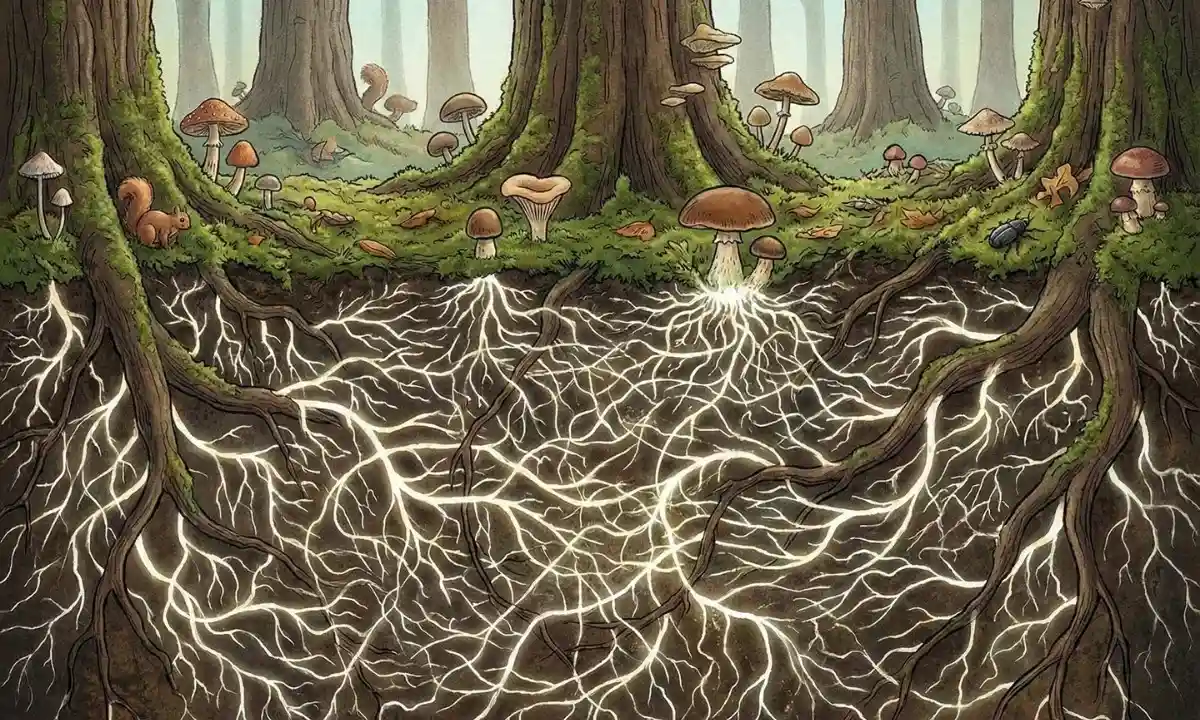
Modern landscape design is rapidly evolving beyond the boundaries of conventional aesthetics and standard landscaping. Today’s cutting edge eco-engineering shifts its focus to the hidden underground layers that contain up to 90% of terrestrial biomass. Plants, traditionally regarded as the primary elements of garden spaces, are in reality only the visible tip of the iceberg. Specialists at Ecolandscape Studio believe that the true architect and driving force behind regenerative design is mycelium. This vast underground network transforms an ordinary residential property into a unified, self-restoring superorganism. Professional mycological design has nothing in common with simply collecting wild mushrooms; it represents an entirely new philosophy of sustainable landscaping in which green technologies merge seamlessly with natural biochemical processes.
The primary challenge in anthropogenic landscapes is often depleted, lifeless soil that has been heavily compacted and degraded during construction. Instead of relying on the costly and environmentally damaging practice of importing hundreds of tons of peat and applying synthetic fertilizers, our studio employs a revolutionary method of mycorrhizal inoculation. By introducing specialized laboratory-cultivated fungal strains into the soil, we establish a strong symbiotic relationship between fungal networks and plant root systems. Fungal hyphae, which are far finer and more extensive than even the smallest root hairs, penetrate soil pores inaccessible to trees and shrubs. They efficiently convert otherwise unavailable reserves of phosphorus, potassium, and essential micronutrients into forms that plants can absorb, receiving surplus carbohydrates from the plants in return.
To achieve optimal results, engineers at Ecolandscape Studio carefully distinguish between two major categories of mycorrhiza: ectomycorrhiza and endomycorrhiza. Ectomycorrhiza forms a protective sheath around root surfaces and is essential for conifers and large broadleaf species such as oaks and beeches, helping prevent chronic chlorosis in compacted soils. Endomycorrhiza penetrates root cells directly, forming microscopic arbuscules that facilitate intensive metabolic exchange, making it critical for ornamental grasses, berry crops, and most perennial garden plants. As a result, even demanding mature trees can successfully establish themselves in poor construction fill. The resulting mycelial framework retains moisture during droughts and protects vegetation from soil-borne pathogens, eliminating the need for chemical pesticides and artificial growth stimulants. Colonization of the substrate is achieved through targeted hydroseeding, liquid spore injections into the rhizosphere, or specialized gel capsules. This network spreads throughout the site, creating a biological communication system known as the Wood Wide Web, through which plants exchange biochemical signals and warn one another about pest threats.
Beyond its invisible underground functions, fungal technology is increasingly emerging above ground, offering unique construction and finishing materials. The growing field of fungal high-tech is transforming conventional approaches to creating outdoor furniture, lighting fixtures, architectural features, and eco-art installations. Instead of environmentally harmful plastics, cold concrete, or chemically treated wood, our designers harness the natural ability of fungal mycelium to colonize agricultural waste materials such as straw, husks, flax shives, and wood chips.
The production of these living outdoor objects follows a precise biotechnological process. First, lignocellulosic material is sterilized and inoculated with a selected fungal species, such as Reishi (Ganoderma lucidum) or oyster mushroom, whose mycelium actively produces chitin, a durable natural polymer. The substrate is placed into custom 3D molds where, under controlled temperature and humidity conditions, the mycelium grows through the material over 5 to 12 days, binding it together with millions of microscopic fibers. During the final stage, the object undergoes gentle thermal treatment at temperatures between +70 and +90°C, completely halting fungal growth and rendering the composite inert. The resulting biomaterial possesses physical and mechanical characteristics similar to dense polystyrene foam or lightweight timber. It absorbs vibrations effectively, maintains structural stability, and offers natural moisture resistance. For outdoor applications, finished products are treated with natural wax and linseed oil formulations, ensuring a service life of five to seven years. Once this period ends and protective coatings are no longer renewed, the material biodegrades naturally under the action of soil microorganisms, enriching the soil with valuable organic matter.
«At the beginning of our company’s journey, many people viewed landscape design purely as decorative packaging: beautiful paving layouts and flawless turf lawns,» says Martin Palma, Founder and CEO of Ecolandscape Studio. «My professional perspective changed completely during a research expedition studying pristine forest ecosystems. There, I witnessed how extensive underground mycelial networks could stabilize slopes against erosion and restore degraded soils more effectively than many engineering solutions. That experience led to a clear realization: if we want to create truly sustainable gardens for the future, we must design not on the land, but together with it. Mycelium is a ready-made natural internet and an extraordinary construction tool that has existed beneath our feet for billions of years. At Ecolandscape Studio, we have learned how to direct this immense biological force for the benefit of private and urban environments.»
Another critical challenge addressed by professional mycological design is local environmental protection and site remediation. Rainwater and snowmelt runoff flowing from rooftops, paved surfaces, and parking areas often carries a hazardous mixture of heavy metals, petroleum residues, fuel traces, surfactants, and harmful microorganisms. Instead of directing these contaminated flows into municipal stormwater systems or drainage wells, regenerative landscapes developed by Ecolandscape Studio utilize an effective process known as mycofiltration.
This approach relies on the remarkable ability of fungi to release powerful enzymes, including laccase, manganese peroxidase, and lignin peroxidase, directly into the environment. These enzymes are capable of breaking down a wide range of complex chemical pollutants. When gasoline or motor oils enter the system, fungal enzymes dismantle stable aromatic compounds, converting toxic substances into water and carbon dioxide. Excess nitrogen and phosphorus originating from fertilizer runoff are absorbed and stored within fungal biomass, protecting nearby water bodies from eutrophication and algal blooms. Heavy metals such as cadmium, zinc, and lead are transformed into chemically stable complexes, preventing their migration into groundwater. In practical applications, this system consists of a series of biofiltration channels filled with hardwood chips colonized by oyster mushroom mycelium (Pleurotus ostreatus). As water moves through these barriers, flow velocity decreases, suspended solids settle out, and dissolved contaminants are degraded, producing clean water suitable for irrigation systems.
The integration of professional mycological solutions fundamentally transforms the paradigm of contemporary landscape architecture. Residential gardens and public parks cease to be artificial decorations requiring constant investment, chemical inputs, and intensive irrigation. Through the expertise of Ecolandscape Studio, landscapes become autonomous, self-sustaining ecosystems in which the byproducts of one process serve as resources for another. A deep understanding of mycelial biology enables us to design unique regenerative environments that not only minimize humanity’s ecological footprint but actively restore and heal the natural world.









