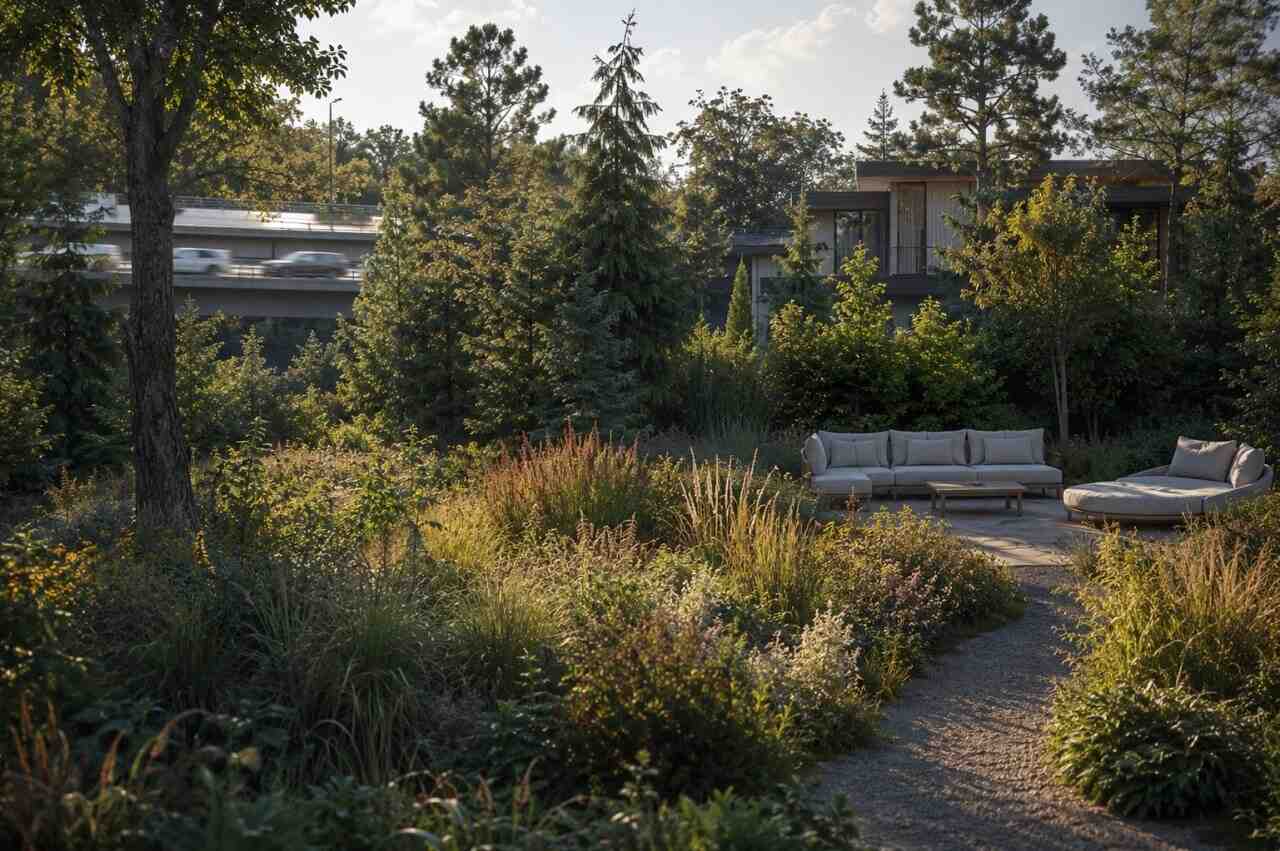
Ecolandscape Studio notes that the architectural concept of country residences in the highest price segment is undergoing a radical mental overhaul. For a long time, landscape design developed exclusively in the plane of visual and tactile perception, leaving the invisible factors of the environment completely ignored. However, in conditions of an avalanche-like growth of urban pressure, the expansion of transport corridors, and continuous anthropogenic noise in the suburbs, the true luxury of a private property is now measured by a scarce criterion: the quality of its acoustic ecology. At the intersection of neurobiology, wave physics, biomechanics, and selective botany, a fundamentally new, interdisciplinary trend has emerged: phyto-acoustics and bioresonant space engineering. This methodology completely abandons the primitive suppression of noise through monotonous hydraulic structures, offering instead the directed management of sound waves through natural frequency filters, the kinematics of plant tissues, and structural geoplasty. The integration of bioresonant technologies opens a new chapter in the landscape industry, making it possible to create isolated private oases with absolute acoustic comfort.
The mathematical basis of phyto-acoustic design is built on studying the nature of interaction between sound waves of various lengths and porous living matter. Technological noise smog is heterogeneous: it combines low-frequency rumble from highways, medium-frequency household sounds, and high-frequency whistling from engineering systems or wind. Standard solid fences and massive retaining walls are unable to solve this problem autonomously due to the physical effect of diffraction, in which a sound wave easily bends around an obstacle from above and penetrates deep into the site. In bioresonant gardens, the barrier function is implemented by means of multi-layered matrix screens where each plant element is calibrated according to strict geometric and biometric parameters, including petiole elasticity, cuticle density, angle of inclination, and microstructure of leaf blades. The wave damping process includes three stages: destructurization, absorption, and regeneration. To neutralize long-wave low-frequency rumble, multi-row buffers made of large-specimen trees with deeply cracked, porous bark and rigid, pubescent foliage are deployed, which convert sound energy into thermal energy due to intercellular friction. Medium and high frequencies are effectively fragmented by small-leaved shrubs and dynamic grass masses, which transform a directed sound strike into safe, chaotic micro-vibrations and form a smooth, natural white noise.
The practical value of phyto-acoustics goes far beyond the passive isolation of the perimeter. The key task of the bioresonant concept lies in the active generation of an individual therapeutic audio landscape. Any botanical form possesses a unique resonant response and its own sound signature when air masses pass through it. Modeling aerodynamic flows and programming local wind corridors allow project authors to create natural frequency orchestras under the open sky. The fluid rustling of large-leaved species generates a refreshing medium-frequency spectrum, the deep roar of coniferous specimens is responsible for soothing low frequencies, and the dry metallic whisper of grass matrices forms a subtle high-frequency shield. The constructed sound patterns override external irritants on a subconscious level, gently stimulating alpha and theta rhythms of the human brain and shifting the nervous system into a state of deep meditation.
Martin Palma, Founder and CEO of Ecolandscape Studio, views phyto-acoustics as the highest point in the evolution of neuro-landscape architecture and a significant milestone in the development of environmental compliance. Drawing on many years of personal experience in creating large-scale premium residences, Martin came to the discovery that any visual aesthetics and high cost of materials are completely negated if the private environment is poisoned by constant acoustic stress. In his view, bioresonant design restores a person’s fundamental right to mental seclusion, turning a private estate into an effective tool for preventive medicine and psychological rehabilitation. Martin Palma emphasizes that the precision use of the laws of physics and botany allows for the complete exclusion of bulky artificial noise screens, replacing them with living, breathing ecosystem barriers that attune the owner’s body to the natural biorhythms of nature.
The progressive improvement of new-generation estates actively transfers the principles of interior acoustics used in concert halls into the open natural environment, where structural geoplasty becomes a key element of sound control. Artificial terrain folds, wave-like hills, and amphitheaters are calculated at the software level not only for zoning the territory, but also as directional passive reflectors. Concave acoustic lenses made of natural high-density stone, such as basalt, granite, or slate, are covertly implanted into the structure of these earthen mounds. The calibrated curvature of the stone bowls allows them to function on the principle of parabolic locators: they capture, focus, and project the purest sounds of the garden into lounge zones, such as birdsong, the rustling of grass, or falling water, while simultaneously cutting off residual noise from the outside.
Ecolandscape Studio notes that the acoustic detox of a country residence is supplemented by the integration of kinetic architectural elements. Special resonant bowls made of patinated metal and hidden cascades with an adjustable drop height of water streams are designed in such a way as to generate vibrations of strictly defined frequencies that neutralize external sound waves on the principle of antiphase. As a result, turnkey landscape design is transformed into an autonomous, protected audio cocoon. Modern bioresonant gardens set an uncompromising standard for country luxury, where computer modeling, the laws of wave physics, and pristine botany work in absolute synergy, granting property owners mental peace and absolute freedom from the noise of the outside world.









