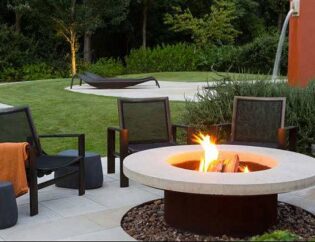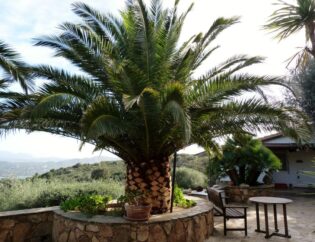
At Ecolandscape Studio, we view the landscape as an eco-sensory system, where human behavior is shaped through a combination of tactile, thermal, acoustic, and kinesthetic stimuli. The tactile ecology of the garden is a professional approach in which surfaces, materials, and their combinations are treated as tools for spatial behavior programming rather than decorative elements.
Modern landscape design is evolving toward sensory-integrated landscape architecture, where material intelligence, haptic feedback systems, and a material hierarchy become central. In this model, the garden is perceived as an experiential system rather than a static composition.
Tactile perception and bodily navigation in space
A person perceives a garden not only visually but through continuous sensorimotor contact with surfaces. A key role is played by proprioception, plantar pressure distribution, surface vibration, and material thermal conductivity response. These parameters form haptic wayfinding an unconscious navigation system in which the body “reads” the space.
In professional design practice, this allows movement to be guided without explicit signage. Smoother and more stable surfaces accelerate movement and reduce cognitive load, while more complex and unstable textures slow it down and increase environmental awareness.
Stone as a lithotectonic spatial framework and rhythm generator
Stone in landscape design belongs to lithotectural hardscape systems and forms the structural framework of space. It establishes movement rhythm and functions as a tool of spatial articulation.
Polished stone surfaces create a sense of accelerated and directed movement, reinforcing linear pathways. Rough and chipped textures increase kinesthetic resistance, causing people to slow down and engage more attentively with the environment. Large modular slabs define axial movement lines and establish spatial structure, which is perceived through the body via step repetition.
Additionally, stone functions as spatial anchoring, creating visual and behavioral pause points, especially at intersections or changes in terrain.
Wood as a thermoactive and emotionally softening material
Wood belongs to bio-based thermally responsive materials and creates zones of reduced sensory load. Its thermal inertia and soft tactile structure generate a sense of comfort and protection within space.
Behaviorally, wood increases dwell time, reduces movement speed, and creates resting and stopping zones. It acts as an emotionally “softening” material, especially in transitions between active and calm areas of the garden.
Different processing techniques thermally modified wood, brushing, sanding allow control over the perceived naturalness or architectural character of the surface.
Gravel as an acoustic-kinetic system
Gravel surfaces are classified as granular acoustic surfaces and create an acoustically active garden environment. Their key characteristic is soundscape feedback the acoustic response to movement.
The crunch underfoot enhances movement awareness and creates a sense of presence, where walking becomes an active perceptual process. This reduces automatic locomotion and increases spatial attention.
Functionally, gravel serves multiple roles. It acts as a permeable drainage layer, ensuring water infiltration. It also forms soft spatial boundaries without visual barriers, creating transitional zones between functional garden areas.
Groundcover plants as a living landscape surface
Groundcover species are considered living ground interface systems a dynamic biological surface integrating architectural and natural elements.
They provide ecological surface continuity, reducing spatial fragmentation and connecting different garden zones into a unified system. They also contribute to microclimatic regulation by reducing soil overheating and retaining moisture.
Additionally, groundcover plants stabilize soil layers and protect against erosion, forming a resilient softscape layer that changes seasonally and responds to environmental conditions.
Material contrast as a behavioral programming system
One of the key principles of tactile ecology is material contrast logic a system of contrasts between surfaces that shapes behavioral scenarios.
These contrasts operate on multiple levels simultaneously. Kinetic contrast defines differences in movement speed between surfaces. Thermal contrast shapes perceived surface temperature on contact. Acoustic contrast creates variation in soundscape. Textural contrast governs differences in grip and roughness.
Together, these parameters enable behavioral zoning without physical barriers spatial differentiation without walls, fences, or rigid architectural separation.
Landscape as sensory architecture of experience
At Ecolandscape Studio, we consider the garden a sensory-integrated behavioral system, where the ground surface functions as the primary interface between humans and the environment.
Within this approach, materials become carriers of behavioral scripts, and human movement becomes the result of interaction with the material logic of space. This allows the creation of sustainable, ecologically balanced, and deeply sensory landscapes in which every step is shaped not by external signage, but by the inherent structure of the environment itself.