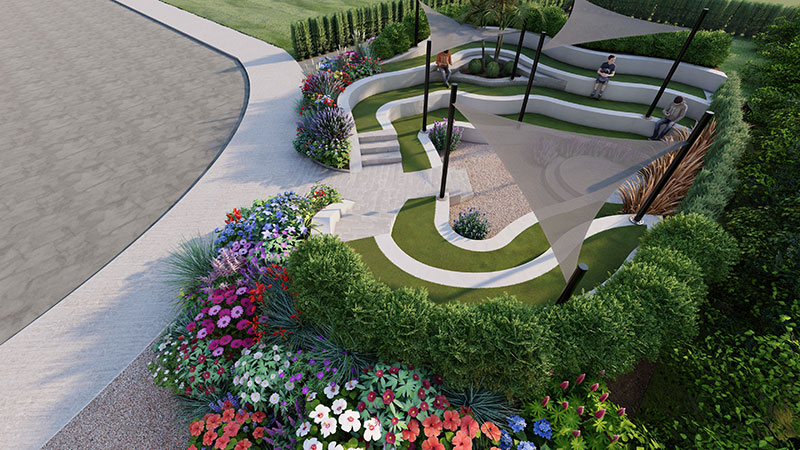
Today, landscape is no longer understood solely as a spatial composition or the aesthetic shell of a site. Increasingly, it is seen as an environment that directly interacts with the human nervous system. The focus shifts from the form of space to how it influences attention, stress, recovery, and the depth of perception.
The neurosensory landscape is a professional field at the intersection of neuroscience, environmental psychology, sensory ecology, and landscape architecture. Its goal is to design spaces as systems of controlled natural stimuli that generate predictable cognitive and emotional states.
At Ecolandscape Studio, we view landscape as a living sensory feedback system in which every element of the environment participates in shaping a person’s internal state.
Landscape as a System of Perceptual Processing
The human brain does not perceive space as an image. It continuously reads it as a flow of sensory signals that form a cognitive model of the environment.
Geometry influences the type of neural activity. Hard-edged and high-contrast structures enhance focused attention and activate states of concentrated effort. Organic forms, typical of natural systems, shift the brain toward soft, diffuse attention associated with cognitive restoration.
Texture amplifies this effect. Multilayered natural surfaces create a rich sensory environment that stabilizes perception. Uniform and artificially smooth materials reduce sensory depth and, over time, contribute to cognitive fatigue.
Space as a Tool for Attention Restoration
Modern environments overload the nervous system with constant visual, auditory, and informational stimuli. As a result, sustained concentration weakens and cognitive exhaustion increases.
The neurosensory landscape functions as a decompression system. It reduces stimulus density and returns attention to a natural, effortless mode of perception.
Such spaces do not require intentional focus. Instead, they create conditions in which attention restores itself through the nervous system’s transition into a more stable state.
Architecture of States: Active, Transitional, and Restorative Zones
A neurosensory landscape is not built as a single scene but as a sequence of cognitive states.
Active zones establish an initial level of stimulation and support alert attention. Transitional zones provide smooth adaptation between different levels of sensory load. Restorative zones create minimal-stimulus conditions in which the nervous system returns to balance.
Importantly, these zones do not have sharp boundaries. They are connected through gradients of perception, where state changes occur gradually and naturally.
Light as a Regulator of Biological Rhythms
In the neurosensory landscape, light is treated as a tool for tuning physiological states.
Diffused natural light filtered through vegetation reduces sensory overload and helps stabilize attention. In contrast, high-contrast lighting increases arousal and activates cognitive performance.
A key factor is the daily dynamics of light. A space can shift in perception throughout the day, supporting natural circadian rhythms and reducing internal desynchronization.
The Acoustic Structure of Natural Environments
Sound in such landscapes is not added artificially but emerges from the organization of the environment itself.
Wind passing through vegetation of varying density creates a soft, irregular acoustic field. It does not require attentional filtering and is perceived by the nervous system as a safe and stable background.
Unlike urban noise, this type of acoustic environment does not generate cognitive strain. Instead, it supports the reduction of internal activity and emotional stabilization.
Water as a Multisensory Regulator
Water acts across multiple levels of perception: auditory, visual, tactile, and climatic.
Its movement creates a rhythm that the nervous system interprets as predictable and calming. This reduces internal tension and helps stabilize attention.
Additionally, water forms localized microclimatic zones, improving comfort and strengthening the effect of sensory restoration.
Olfaction as a Direct Channel to Emotional Memory
Scents in the landscape act directly on the limbic system of the brain, bypassing rational processing. This makes them one of the most powerful tools for influencing emotional states.
Plant communities can generate different aromatic scenarios that change throughout the day and seasons. As a result, the space gains not only visual and acoustic structure but also an emotional dimension.
Landscape as a Cognitive System
The neurosensory approach forms a new understanding of landscape as a cognitive environment.
Space is no longer seen as a passive backdrop for life, but as an active participant in processes of attention, restoration, and emotional regulation. It influences how people think, perceive, and recover.
At Ecolandscape Studio, we consider this approach the next stage in the evolution of landscape architecture where not only the form of the environment is designed, but also the internal state of the human within it.
The neurosensory landscape represents a shift from visual design to the design of perception and the human nervous system.
It integrates ecology, neuroscience, and spatial architecture into a unified system in which nature becomes a tool for cognitive regulation.
At Ecolandscape Studio, we see this direction as the foundation of the future of landscape architecture environments that do not merely surround humans, but actively participate in shaping their internal states and quality of life.