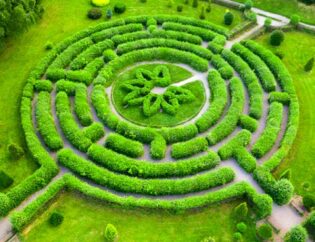
Modern landscape architecture is gradually shifting from a decorative approach toward a systemic one. A garden is no longer seen as a composition of plants where form, color, and seasonal ornamentation are the main focus. It is increasingly understood as a complex living system, where the key processes are not what is visible above the surface, but what happens within the soil.
A symbiotic landscape is an approach in which design extends beyond visual logic and incorporates biological processes as the foundation of environmental architecture. Soil, plant root systems, fungal networks, and the microbiome are considered a single interconnected structure that determines the resilience of the entire site.
Within the practice of Ecolandscape Studio, this approach becomes not a theoretical concept but an operational methodology that influences plant selection, planting structure, and the long-term dynamics of the garden.
The Landscape as a Multilayered Biological System
To understand a symbiotic landscape, it is important to see it not as a flat surface but as a vertical ecosystem composed of several interrelated layers.
The above-ground layer forms the visual and climatic structure of the space. It regulates shade, wind flow, air humidity, and human perception of the environment.
The underground layer is more complex and less visible. This is where the main biological activity occurs: fungal networks form, the microbiome develops, organic matter is processed, and nutrient exchange between plants takes place.
These two levels are in constant interaction. Changes in the soil environment are reflected in plant appearance, while planting structure influences the activity of underground processes.
Mycorrhizal Networks as an Intelligent Soil Structure
Ecolandscape Studio considers mycorrhiza not merely as a biological connection between fungi and roots. Within the symbiotic landscape context, it is seen as a distributed system of resource and signal exchange.
Fungal hyphae form an extensive network that connects plants. Through it, water and mineral redistribution occurs, along with chemical signaling related to stress, damage, or environmental change.
In such systems, plants are no longer fully autonomous entities. They become part of a collective network where the resilience of each element is supported by the entire system.
This is especially important in dense plantings and complex landscape compositions, where competition for resources is replaced by mechanisms of mutual support.
Soil Microbiome and the Formation of a “Living Substrate”
The soil microbiome plays the role of a biochemical regulator of the entire system. It includes bacteria, actinomycetes, fungi, and many other microorganisms, each performing specific ecological functions.
In a symbiotic landscape, soil ceases to be an inert medium. It becomes a living substrate capable of self-regulation and regeneration.
Microorganisms participate in organic matter decomposition, humus formation, and the creation of stable soil structure. They also influence the availability of nitrogen, phosphorus, and other key plant nutrients.
A crucial aspect is that microbiome diversity is directly linked to landscape resilience. The more complex the biological soil system, the higher its ability to withstand external stress.
The Role of Root Architecture in Landscape Design
In the symbiotic approach, plant root systems are no longer hidden elements but part of the design logic. Different plant species develop different root architectures: shallow, deep, branched, or tap-root systems.
These differences create vertical resource distribution in the soil. Some plants extract moisture from upper layers, others access deep reserves, while others stabilize soil structure.
This results in a spatial organization of the underground environment that directly influences the stability of the entire system.
Water Cycle and Natural Moisture Regulation
One of the key effects of a symbiotic landscape is the transformation of soil water behavior.
A developed fungal network and active microbiome increase the soil’s capacity to retain and redistribute moisture within the system. Water is no longer simply absorbed and evaporated but becomes part of a biological cycle.
Mycorrhizal structures contribute to a more even distribution of moisture between plants, reducing localized dry zones. This is particularly important in conditions of climate instability and irregular precipitation.
As a result, a landscape emerges that partially regulates its own water balance, reducing dependence on artificial irrigation.
Symbiotic Landscape as a Tool for Climate Resilience
From a sustainable design perspective, the symbiotic approach significantly enhances site adaptability to external change.
Such systems are more drought-resistant because root and fungal networks increase plant access to water. They are also more resistant to excessive moisture, as biologically structured soil improves drainage and oxygenation.
In addition, resilience to temperature fluctuations increases, since biologically active soil stabilizes the root-zone microclimate.
The Evolution of the Garden Over Time
Unlike traditional landscapes that aim for a fixed visual composition, a symbiotic garden evolves.
In the first years after planting, the focus is on developing soil conditions and establishing symbiotic relationships. Gradually, the system strengthens, and plants transition from an adaptation phase to a self-sustaining phase.
Over time, the landscape becomes less dependent on human intervention. It begins to function as a mature ecosystem where changes occur naturally through seasonal and climatic cycles.
Ecolandscape Studio’s Approach to Symbiotic Design
In the practice of Ecolandscape Studio, the symbiotic landscape is considered a fundamental model of the future.
Design begins with an analysis of soil biology, moisture structure, and potential symbiotic relationships between plant species. Only then is the visual and spatial composition developed.
This approach allows the creation of spaces that are not only aesthetically refined but also biologically resilient.
As Martin Palma, founder and CEO of Ecolandscape Studio, notes: “We do not design an image of a garden. We design the conditions under which a garden can sustain itself and evolve as a living system.”
A symbiotic landscape is not a trend or a style. It represents a shift toward a new understanding of environment, where the primary value is not appearance but internal resilience.
It unites soil, plants, and microorganisms into a single system capable of self-regulation, regeneration, and evolution.
Such approaches define the next phase of landscape architecture biologically aware, adaptive, and long-lasting.