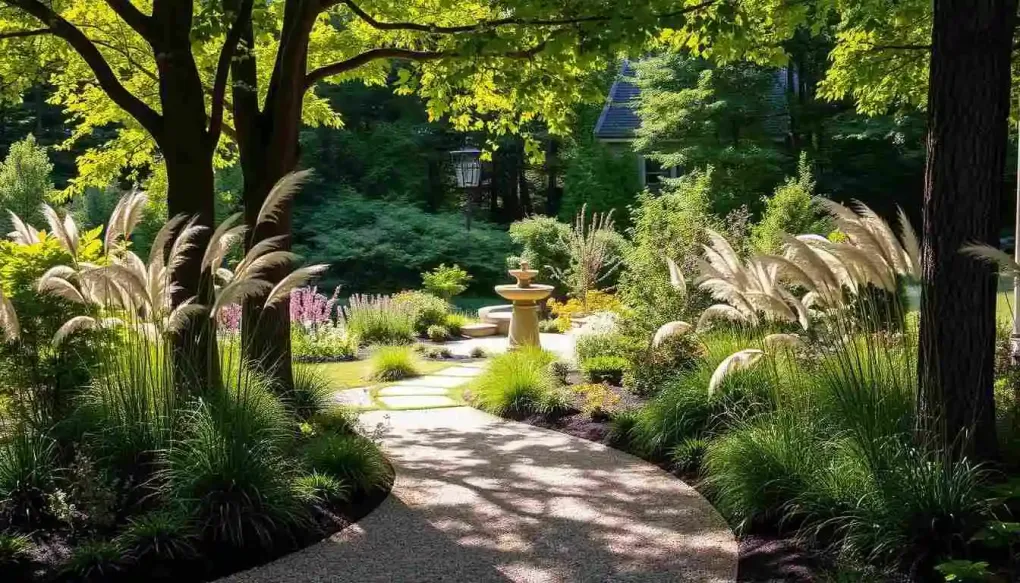
The post-irrigation landscape is not about optimizing irrigation or attempting to reduce water costs, but rather about a fundamental shift in the logic of site design. In this model, water ceases to be a resource regularly supplied through engineering systems and instead becomes part of the site’s internal climatic cycle, where air, soil, topography, and vegetation begin to play a key role.
Ecolandscape Studio views this approach as a transition from the managed exploitation of landscapes to the creation of self-regulating ecosystems capable of maintaining their water balance without constant external intervention.
The essence of the post-irrigation landscape
At the core of this approach is the idea of a closed water cycle at the level of a single site. Unlike traditional landscaping, where water is supplied externally and quickly leaves the system through evaporation and runoff, here the environment is designed to retain moisture for as long as possible and repeatedly reuse it within its own structure. Precipitation, atmospheric humidity, and condensation become the primary water sources, and the designer’s task is not only to preserve this moisture but also to transform the site into a system of continuous recirculation. As a result, a landscape is formed that gradually requires less intervention as it maintains its own water balance.
System principle
The functioning of a post-irrigation landscape is based on the interaction of several natural mechanisms that reinforce one another. Atmospheric moisture becomes a hidden yet constant water source: even without precipitation, air contains significant humidity, which under properly organized microclimatic conditions condenses on plants, soil, and architectural surfaces as dew and condensation. This process is enhanced by lowering surface temperatures and managing airflows.
Site topography acts as a hydrological framework, determining how water moves and where it is retained. Even minor elevation changes create zones of moisture accumulation and slow infiltration, allowing water to remain within the system rather than leaving it. Soil functions as an active reservoir, where water is not merely stored but gradually transferred to plants through capillary and biological processes. Mulch and organic matter play a key role by reducing evaporation and stabilizing the temperature of the upper soil layer.
The role of microclimate
In a post-irrigation landscape, microclimate is not a secondary effect but the primary water management tool. Air and surface temperature directly affect evaporation rates; therefore, one of the main design goals is the creation of stable cool zones where soil does not overheat and retains moisture for much longer. Wind becomes both a factor of loss and redistribution of moisture, so spatial structures are designed either to slow air movement or to channel it into specific zones for condensation.
Ecolandscape Studio notes that solar exposure is used not only for plant illumination but also as a tool for water balance management. Different site areas receive varying levels of heat, creating multiple microclimatic zones within a single landscape, each with different evaporation rates and moisture retention capacities. This allows plants to be distributed according to their water needs without artificial irrigation.
Vegetation as a climatic system
In a post-irrigation landscape, plants cease to be isolated landscaping elements and become part of a unified climatic system. Trees stabilize the microclimate by creating shade and reducing surface temperatures, which directly decreases evaporation. Shrub layers act as filters of humid air, retaining moisture in the near-ground layer and slowing its movement. Groundcover plants protect the soil, forming a living protective layer that minimizes moisture loss through evaporation and overheating.
Root systems play a strategic role, as different plant species create varying depths of moisture penetration, forming a vertical structure of water exchange. This allows water to move not only horizontally across the surface but also deeply into the soil profile, where it is retained for much longer periods.
Soil as an engineered medium
In a post-irrigation system, soil is considered an active engineered structure rather than a passive substrate. Its function is to accumulate, retain, and gradually release moisture. This is achieved through a multilayer organization, where each layer serves a specific role: the organic layer retains water through high porosity and biological activity; mineral components provide structural stability and capillary movement; and the surface mulch layer protects the system from overheating and excessive evaporation.
Such a structure significantly extends the time cycle of water availability for plants, turning soil into a long-term reservoir rather than a temporary medium.
Design process
Designing a post-irrigation landscape begins with a deep analysis of the site’s water behavior, considering not only precipitation levels but the entire water dynamic: how water enters, how it is distributed, how it evaporates, and where it is lost. Based on this analysis, a water map of the site is created, identifying all zones of potential accumulation, loss, and condensation.
Next, a microrelief is formed to control water movement across the site, creating natural pathways for its distribution and retention. After that, the soil structure is designed according to different moisture levels and capillary properties. The next stage involves developing the vegetation system, where plants are selected not only for aesthetics but also for their functional role in the water cycle. The final stage is microclimate modeling, where interactions between wind, sun, and humidity are analyzed and adjusted so the system functions as a unified climatic organism.
Implementation errors
In practice, the main mistake lies in attempting to implement the post-irrigation approach without changing the fundamental structure of the site. In such cases, the system continues to function as a conventional landscape with irrigation simply turned off, leading to rapid moisture loss and plant degradation. Wind is often underestimated, despite its ability to significantly accelerate evaporation and disrupt local humidity zones. Another common issue is the lack of treating soil as an engineered system, which makes long-term water retention impossible.
Results of implementation
When correctly designed, a post-irrigation landscape can, after its establishment phase, almost completely eliminate the need for regular irrigation. The site becomes resilient to seasonal droughts, temperature fluctuations, and climatic stress, while its microclimate stabilizes, creating conditions for the long-term development of plant communities with minimal intervention.
At Ecolandscape Studio, the post-irrigation landscape is considered a new foundational model of sustainable design, where the goal is not to manage water supply but to create conditions in which water becomes an internal resource of the ecosystem. This approach enables the design of landscapes that gradually transition from human dependency to autonomous functioning.
According to Martin Palma, founder and CEO of Ecolandscape Studio, a key professional insight gained through practice is that landscape resilience is determined not by the number of engineering systems, but by the site’s ability to “hold climate within itself”and this shift in thinking forms the foundation of all the studio’s contemporary projects.
The post-irrigation landscape represents a paradigm shift in landscape architecture. Water ceases to be an external resource and becomes part of the site’s internal dynamics, while the landscape itself transforms into a self-regulating system capable of retaining, redistributing, and regenerating moisture without continuous irrigation. This principle forms the foundation of future sustainable landscape solutions.









