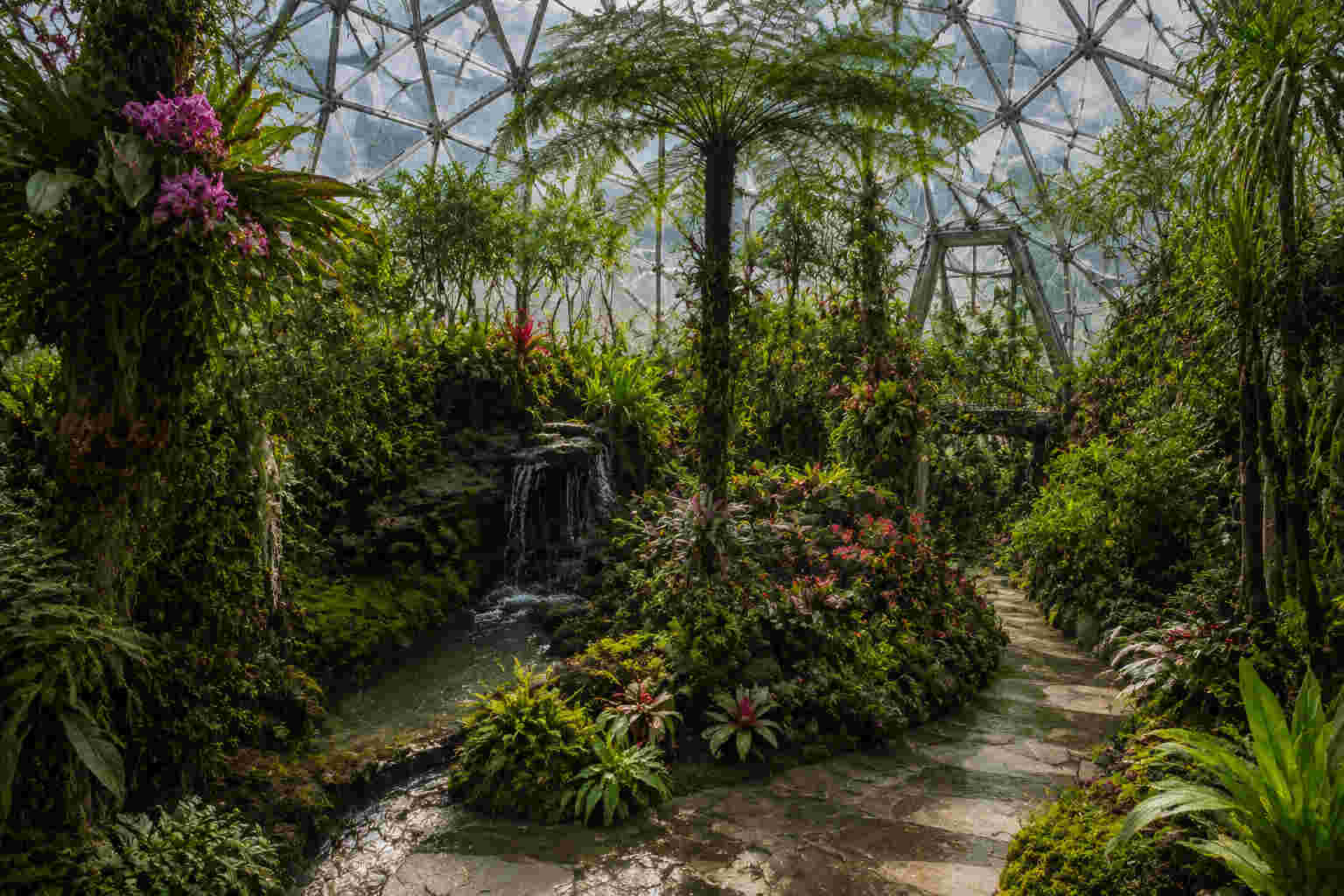
At Ecolandscape Studio, we view landscape design as an integration of science, technology, and ecology. One of the most innovative tools in our practice has become microclimatic domes and pavilions, which make it possible to create mini-ecosystems with fully controlled conditions. These structures provide a stable environment for rare and exotic plants that cannot adapt to outdoor climates. They are used in botanical gardens, private collections, and urban parks, providing optimal growth conditions for plants while also serving as educational spaces for visitors.
Creating a sustainable mini-ecosystem requires a comprehensive approach to microclimate management. Controlling temperature, humidity, lighting, ventilation, and air composition ensures plant growth according to their physiological and ecological needs. For example, tropical species such as orchids, ferns, and bromeliads require high relative humidity (70-95%), a stable temperature of 22-28 °C, and even lighting with adjustable spectral properties. Mountain and alpine species need cooler environments, high ventilation, and moderate lighting, while desert plants and succulents thrive in low humidity and intense light with a controlled water regime.
Engineering solutions for microclimatic domes include the use of modern materials and structural forms. Geodesic structures made of glass or polycarbonate provide maximum light transmission, load resistance, and long service life. Polycarbonate panels offer additional thermal insulation, reducing energy costs for maintaining temperature, and provide UV protection, which is important for tropical species.
Inside the pavilions, comprehensive climate control systems are applied. Drip irrigation and rainfall sprinklers maintain consistent humidity levels. Ultrasonic humidifiers create atmospheric mist necessary for simulating tropical microclimates. Infrared and convective heating, combined with passive cooling methods, maintain temperature balance. Full-spectrum LED systems allow control over photoperiod, light intensity, and spectral characteristics, directly affecting photosynthesis and flowering.
Microclimate control is ensured through advanced sensor networks and programmable controllers. Sensors for temperature, humidity, light, CO₂ concentration, and substrate pH collect real-time data, while intelligent management systems analyze it and automatically adjust climatic parameters. This approach allows the creation of autonomous mini-ecosystems, where plants develop under stable and optimal conditions with minimal human intervention.
The biological component of micro-ecosystems requires careful planning. At Ecolandscape Studio, we consider species compatibility in terms of microclimatic and ecological requirements, as well as their interactions within a closed space. Principles of biomimicry help replicate natural stratification: understory, mid-layer, and canopy. In tropical pavilions, humid zones are formed with water features and decorative substrates, while desert and alpine biomes include rocky areas with controlled lighting and minimal humidity.
The experience of Martin Palma, founder and CEO of Ecolandscape Studio, shows that successful project implementation requires attention to detail and constant monitoring. “We observe how rare plants adapt in a created environment and even develop new forms of flowering and growth. This inspires us to experiment with microclimates and create unique collections for our clients.”
Architectural integration of domes into the landscape enhances both their functionality and aesthetic value. Domes blend organically into garden design, becoming visual focal points. Water features, decorative substrates, terrain variations, and vertical plantings create a sense of immersion in the ecosystem. For visitors, this provides an educational space to observe plant interactions and study the characteristics of rare species.
The prospects for microclimatic domes are tied to digitalization and automation. Sensor systems, the Internet of Things, and artificial intelligence enable autonomous ecosystems that adapt independently to changing external conditions. In the future, such solutions will be applied in urban eco-projects, botanical gardens, and private collections, where the sustainability and conservation of rare plant species become a priority.
At Ecolandscape Studio, we share our knowledge and experience in implementing microclimatic pavilions, revealing the intricacies of working with rare plants, engineering solutions, and principles for integrating mini-ecosystems into landscapes. Microclimatic domes allow the combination of science, technology, and creativity, creating a space for biodiversity conservation and inspiration.