At Ecolandscape Studio, we see every urban garden as a living system that can serve as a safe habitat for nocturnal wildlife while also providing a comfortable space for people. Nocturnal animals – bats, owls, hedgehogs, frogs, and night-active insects – play an important role in maintaining ecological balance. They control insect populations, contribute to pollination, and help disperse seeds, creating natural processes that often go unnoticed by most city dwellers. However, urbanization, light and noise pollution, and the destruction of natural habitats make nocturnal wildlife vulnerable.
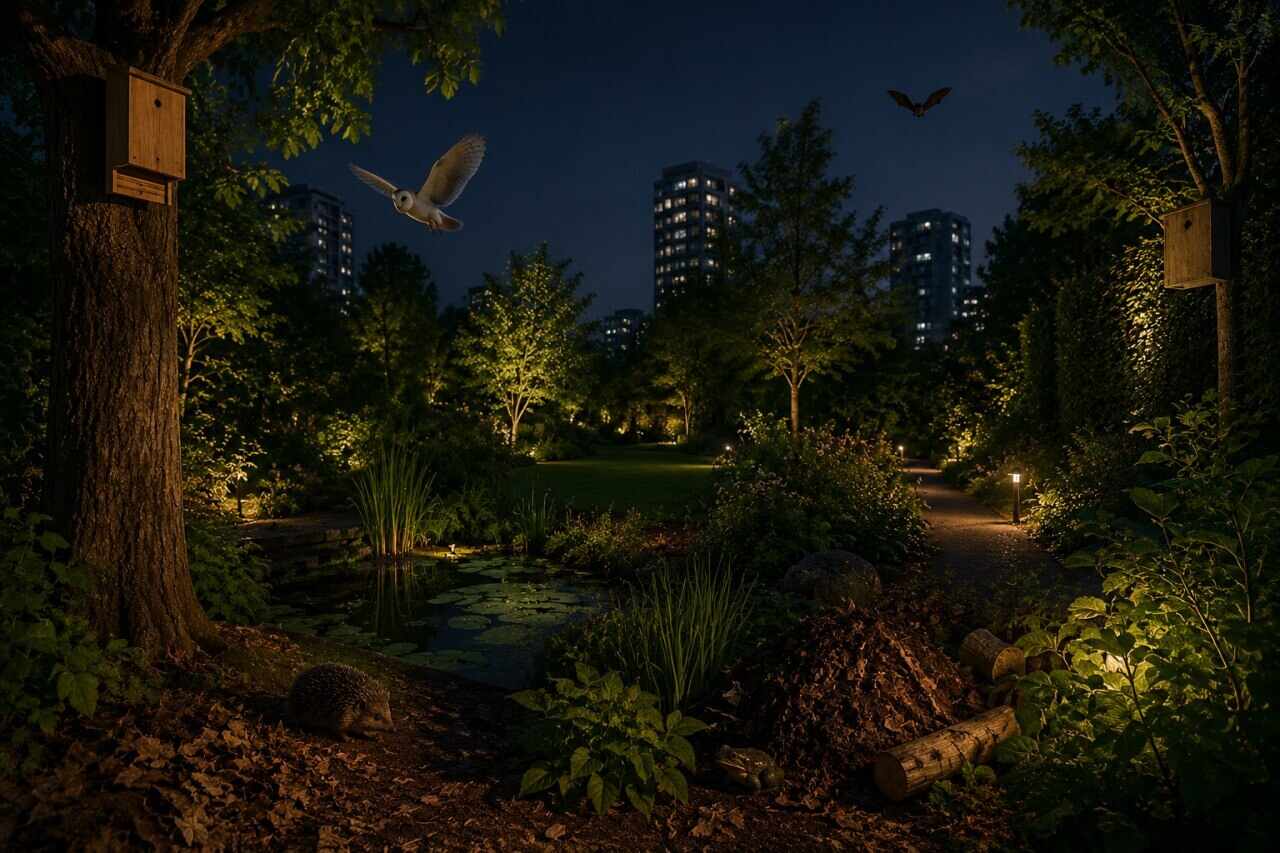
Designing a garden for nocturnal animals requires a comprehensive approach. At Ecolandscape Studio, we create continuous green corridors that connect parks, squares, and forested areas, allowing animals to move safely through the city. Layered vegetation provides diverse shelters and food resources: tall trees form the upper layer, shrubs create the middle layer, and grasses and groundcover plants provide the lower layer with a microclimate for small animals. Open central areas are used by owls and bats to hunt insects, while the garden perimeter is filled with tree cavities, compost heaps, and leaf piles that serve as safe spaces for nocturnal wildlife.
Light pollution remains one of the main threats to night-active animals. In our projects, we use soft, warm lighting with low intensity, directed downward, and equipped with motion sensors. Most of the garden remains in natural darkness, supporting nocturnal wildlife activity, while central pathways are illuminated for visitor safety. Water also plays a key role. Small ponds, fountains, and wet areas provide drinking sources and hunting grounds for insects, with gently sloping banks and floating vegetation making water bodies safe for animals.
Using native plants increases the garden’s resilience and reduces maintenance needs. Tall trees such as oak, ash, linden, and maple provide shelter for owls and bats; shrubs such as rosehip, rowan, and elderberry form the middle layer and serve as a food source; and herbaceous plants and moss create safe zones for small animals and insects. We also use specialized structures for nocturnal wildlife: bat boxes, owl boxes, compost heaps, and leaf piles that provide safe nesting, shelter, and microclimates.
Monitoring animals is an important aspect of garden design. Observing nocturnal wildlife with ultrasonic detectors and night-vision cameras allows us to assess the effectiveness of the created conditions and make adjustments. We also pay attention to seasonal activity patterns: for example, bats use water sources more frequently in summer, while hedgehogs seek denser shelters and protection from the cold in winter.
Martin Palma, founder and CEO of Ecolandscape Studio, emphasizes that attention to detail is crucial when working with urban green spaces: “Over the years, I have realized that small changes – soft lighting, the placement of shrubs or water features – can drastically affect nocturnal wildlife activity. I remember a project where, after installing bat boxes and properly organizing green corridors, the number of bats doubled, which was a real revelation for me.”
We recommend combining professional knowledge with on-site observation, using native plants, planning continuous green corridors, and properly placing water features and shelters. This approach allows an urban garden to become a fully functioning ecosystem, where every element – tree, shrub, pond, or compost heap – actively supports nocturnal wildlife.
Gardens for nocturnal animals help improve the ecological quality of urban environments, create recreational spaces, and foster a harmonious environment where humans and nature coexist.