Climate-adaptive biocorridors today are shaping a new direction in landscape architecture, where green spaces cease to be static compositions and instead become functional climate systems. At Ecolandscape Studio, this approach is viewed as the foundation of future ecological infrastructure not as decorative landscaping, but as a living network capable of redistributing heat, moisture, and air flows both within a site and beyond its boundaries.
The essence of a biocorridor lies in creating a continuous natural structure that operates as a unified microclimate regulator. Unlike fragmented plantings, such systems are designed with consideration of air flows, solar radiation, water balance, and seasonal dynamics. In this context, the landscape is no longer a backdrop but an active participant in climatic processes, forming a more stable and predictable environment.
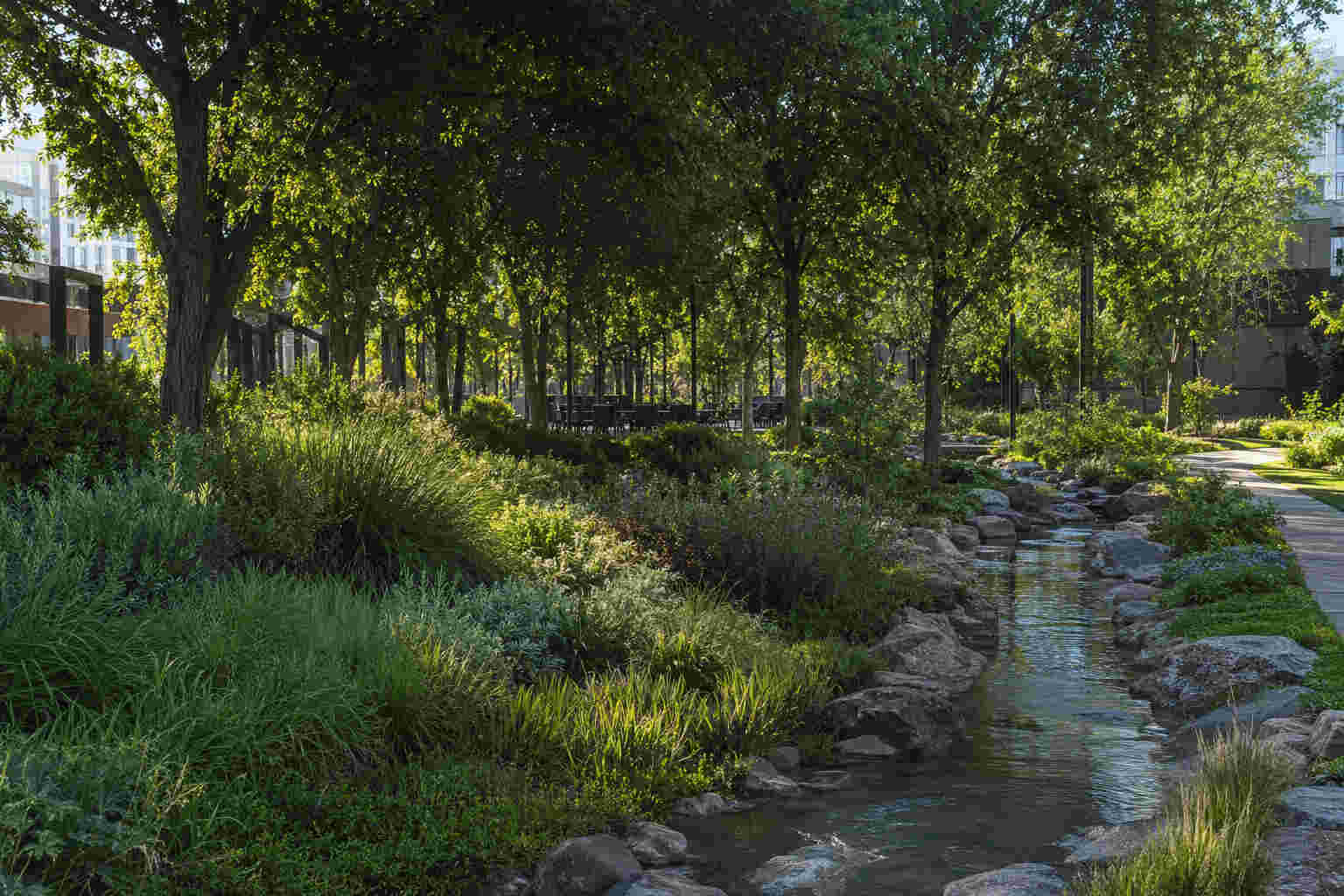
The system is based on a multilayer ecosystem. The upper tree layer acts as a climatic filter: it reduces surface overheating, disperses solar radiation, and forms a protective shade structure. The middle shrub layer stabilizes wind movement, preventing the formation of sharp turbulent flows, while the lower layer of grasses and groundcovers functions as a moisture-regulating layer, reducing evaporation and protecting the soil from degradation. This vertical organization transforms the site into a self-regulating climatic structure.
Water cycle management is of particular importance. In climate-adaptive biocorridors, water is considered not a consumable resource but a circulating element of the ecosystem. High-moisture-retention soils, organic layers, bio-mulch, and infiltration zones are used to capture precipitation and gradually return moisture to the system. This reduces dependence on artificial irrigation and creates a localized closed water balance closer to natural ecosystems.
Equally important is the functional selection of vegetation. In such systems, plants are chosen not only for their aesthetic qualities but primarily for their climatic functions: transpiration capacity, solar radiation reflectance, root depth, and resistance to temperature fluctuations. As a result, zones of natural cooling and thermal stabilization are formed, operating without energy consumption or mechanical systems.
Relief becomes a separate tool of climatic design. Gentle terrain modeling allows designers to direct air flows, reduce wind speed, and redistribute moisture. Terracing, berms, and naturalistic forms create micro-level climates where each zone has its own temperature and humidity regime. As a result, the landscape functions as a three-dimensional climatic system.
In contemporary projects by Ecolandscape Studio, ecological monitoring systems are increasingly integrated. Sensor networks measure air temperature, soil moisture, and vegetation health, enabling real-time analysis of ecosystem behavior. This enables a shift toward adaptive landscapes that not only exist under changing conditions but actively respond to them by modifying their structure and functional regimes.
An additional key factor is the biological foundation of the soil. Living microbiomes, organic compounds, and natural decomposition layers provide resilience against climatic stress. The richer the soil biology, the greater the ecosystem’s capacity for self-recovery and climatic stabilization. Thus, system stability is determined not only by planting architecture but also by deep biological processes.
According to Martin Palma, Founder and CEO of Ecolandscape Studio, the key insight in working with such systems is that “the landscape ceases to be an object of design and becomes a process that evolves over time, gradually acquiring the ability for self-regulation and climatic influence on the surrounding environment.” This approach reflects a shift from traditional design toward next-generation ecological engineering.
Climate-adaptive biocorridors form the foundation of future green spaces, where aesthetics are inseparable from function. They integrate ecology, climatology, and landscape architecture into a unified system, creating environments capable of reducing urban heat island effects, enhancing biodiversity, and forming stable microclimates. In the long term, such solutions become not an addition to urban development, but a mandatory element of climate-responsible territorial design.