At Ecolandscape Studio we create landscape projects where every element has meaning and functional purpose, and the space is perceived as a single living whole. One of our most expressive approaches is the “Valley of Contrast” concept, where lowlands, hills, and terraces form the basis of visual rhythm, emotional impact, and practical site organization. This design allows for gardens where elevation changes not only decorate the area but also shape its structure, define functional zones, and create a sense of dynamic, living space.
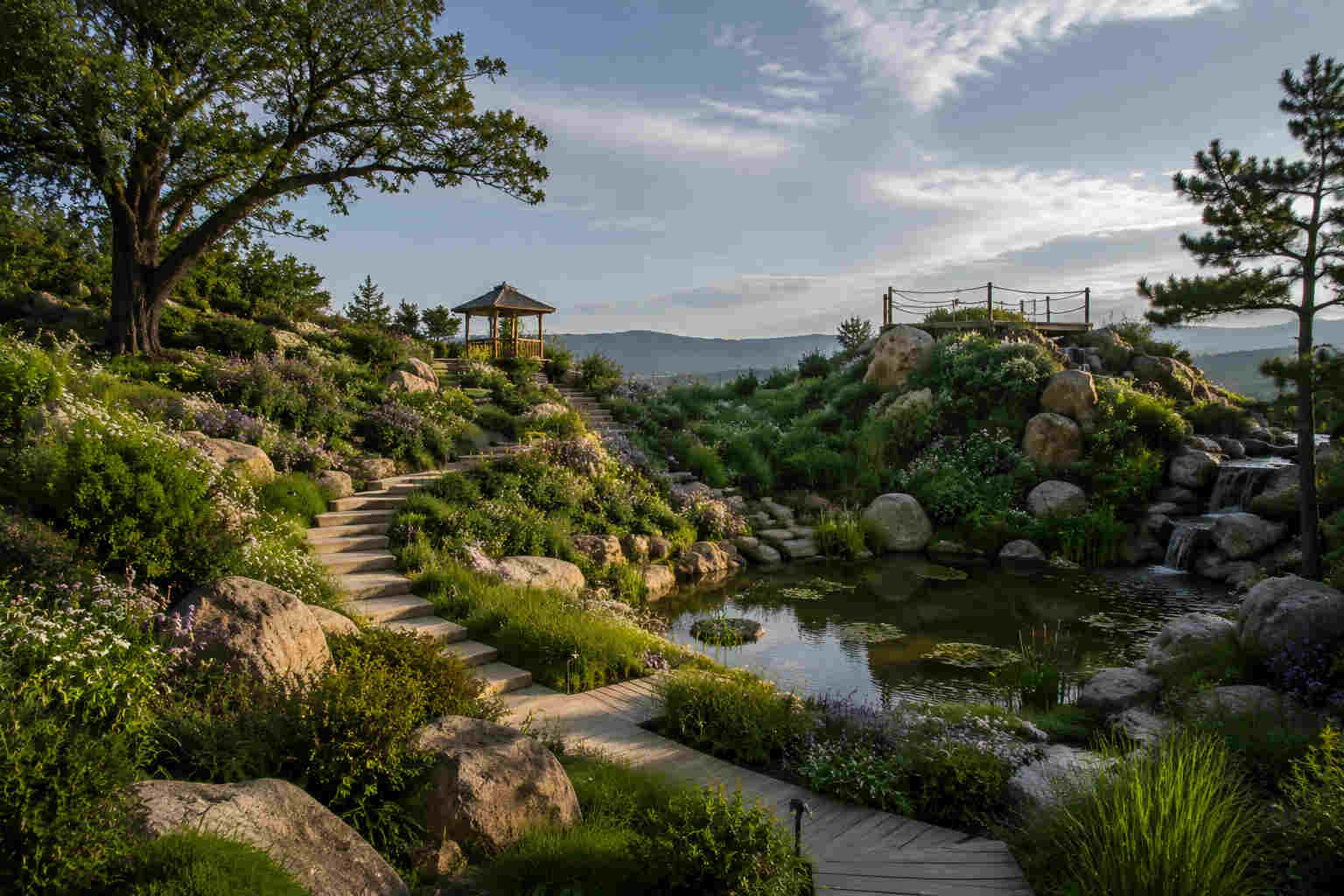
Lowlands in the “Valley of Contrast” garden play a key role in creating coziness and intimacy. These depressions in the terrain create naturally sheltered areas where people can feel calm and at peace. Lowlands accumulate moisture, forming a cooler microclimate, which is ideal for shade-loving plants, ornamental shrubs, and water features. Small ponds, streams, or decorative water elements are naturally placed in such areas, not only enhancing the garden visually but also regulating water balance, creating a living ecosystem where plants support each other and form comfortable conditions for relaxation.
Hills are the opposite of lowlands and create a sense of perspective, expanding the visual boundaries of the site. They become natural focal points, where ornamental trees, flower beds, and observation platforms look especially impressive. Hills form spatial dynamics, attract the visitor’s gaze, and encourage movement through the garden. Moving from a lowland to a hill, a person experiences level changes, explores the space from different viewpoints, and enjoys the emotional satisfaction of the unfolding views. Such elevation changes make the garden alive rather than static, with each zone having its own mood and character.
Terraces unite lowlands and hills into a harmonious space. They create smooth transitions between levels and ensure convenient movement through the garden. Terraces become spaces for ornamental plants, flower beds, paths, and architectural elements such as gazebos, benches, or sculptural accents. In this approach, elevation changes are not perceived as obstacles but as tools for forming visual rhythm, convenient navigation, and a structured, organized space.
Plant selection in the “Valley of Contrast” garden is dictated by terrain features and microclimate. Moisture-loving and shade-tolerant species, including ornamental shrubs, grasses, and aquatic plants, are best placed in lowlands. Hills are adorned with sun-loving trees, ornamental shrubs, and flower beds capable of withstanding direct sunlight and wind exposure. Terraces become zones for combining perennials, seasonal flower beds, and structural plants, ensuring dynamism and visual diversity throughout the year. This approach creates a sustainable ecosystem, where plants not only beautify the space but also support its ecological stability.
This approach to working with terrain is not an abstract concept — examples of its application can be seen in global landscape design. For instance, the famous Kenroku-en garden in Kanazawa, Japan, features artificially modeled terrain with small hills, lowlands, and terraces, creating a sense of depth and expanded space. Here, each elevation reveals a new panoramic view, while depressions serve as cozy corners with water features and vegetation, establishing rhythm and harmony across the site. This approach inspires modern design practices, demonstrating how mastery of elevations can create emotionally rich and visually expressive spaces, where each terrain level has a specific function and enhances the garden experience.
In addition to plant composition, elevation changes allow the use of diverse materials and architectural elements to enhance the terrain effect. Stone or wooden terraces create smooth transitions, while paths made of flagstone, gravel, or wood emphasize spatial rhythm and guide visitors’ movement. Observation platforms, decorative elements, and sculptures look especially impressive on hills and terraces, becoming visual focal points and creating emotional attraction points. The right combination of materials and plants enhances spatial harmony and makes each area unique, functional, and aesthetically expressive.
Martin Palma, founder and CEO of Ecolandscape Studio, shares his professional experience: “Working with elevation changes is an opportunity to create emotional depth and dynamism in a garden. Every lowland, hill, or terrace is not just a terrain element, but a tool for human interaction with the space. The garden becomes a living, exploratory environment, where visual accents, microclimatic features, and plant composition create harmony with nature and elicit a unique emotional response.” His approach reflects the studio’s philosophy: terrain is not a backdrop for plantings, but an active element that sets the tone and character of the entire site.
The “Valley of Contrast” garden is simultaneously beautiful, functional, and ecologically sustainable. Lowlands accumulate rainwater, creating moist microzones for plants; hills regulate water drainage and protect the soil from erosion; terraces provide convenient movement and space for diverse plantings. This design helps conserve resources: plants are selected according to microclimate, reducing the need for irrigation or artificial protection from sun and wind. The site remains resilient to weather changes and maintains its decorative effect for many years.
The “Valley of Contrast” concept is applicable to a wide range of projects: from private yards and gardens to public parks and cottage settlements. It allows natural elements to be organically integrated into site architecture, creates functional zones, and gives a sense of depth and perspective. Such a garden becomes not just a place for relaxation, but a space that encourages exploration, interaction with nature, and emotional engagement from visitors.
Using lowlands, hills, and terraces allows Ecolandscape Studio to form visual rhythm and emotional richness across the site. Each zone has its function: lowlands create intimate corners for rest and relaxation; hills reveal panoramic views and highlight key compositional elements; terraces connect the entire site into a harmonious, organized space. This approach makes each studio project unique, expressive, and functionally complete.
Gardens designed with the “Valley of Contrast” principle not only impress visually but also provide psychological comfort, giving visitors a sense of freedom, coziness, and connection with nature. The alternation of elevations and zones stimulates exploration, attention to detail, and emotional engagement. Such a design becomes part of people’s lives, allowing them to rest, observe, study, and enjoy nature.
Ecolandscape Studio’s approach combines aesthetics, functionality, and ecological sustainability. At the core of our projects is a philosophy in which terrain, plant composition, and architectural elements create a unified space where every detail is deliberate and meaningful. The “Valley of Contrast” garden demonstrates how skillful use of elevation changes and natural site features transforms an area into a living, harmonious, and emotionally rich landscape that remains attractive for many years.
Such a garden is not just landscape design but an environment that interacts with people, unfolds through exploration, and forms a unique experience where aesthetics, ecology, and functionality are in complete harmony. At Ecolandscape Studio, we are convinced that this approach allows us to create spaces that inspire, relax, and connect people with nature. The “Valley of Contrast” becomes a design philosophy where every terrain form, hill, and terrace matters, and the site lives its own expressive life.