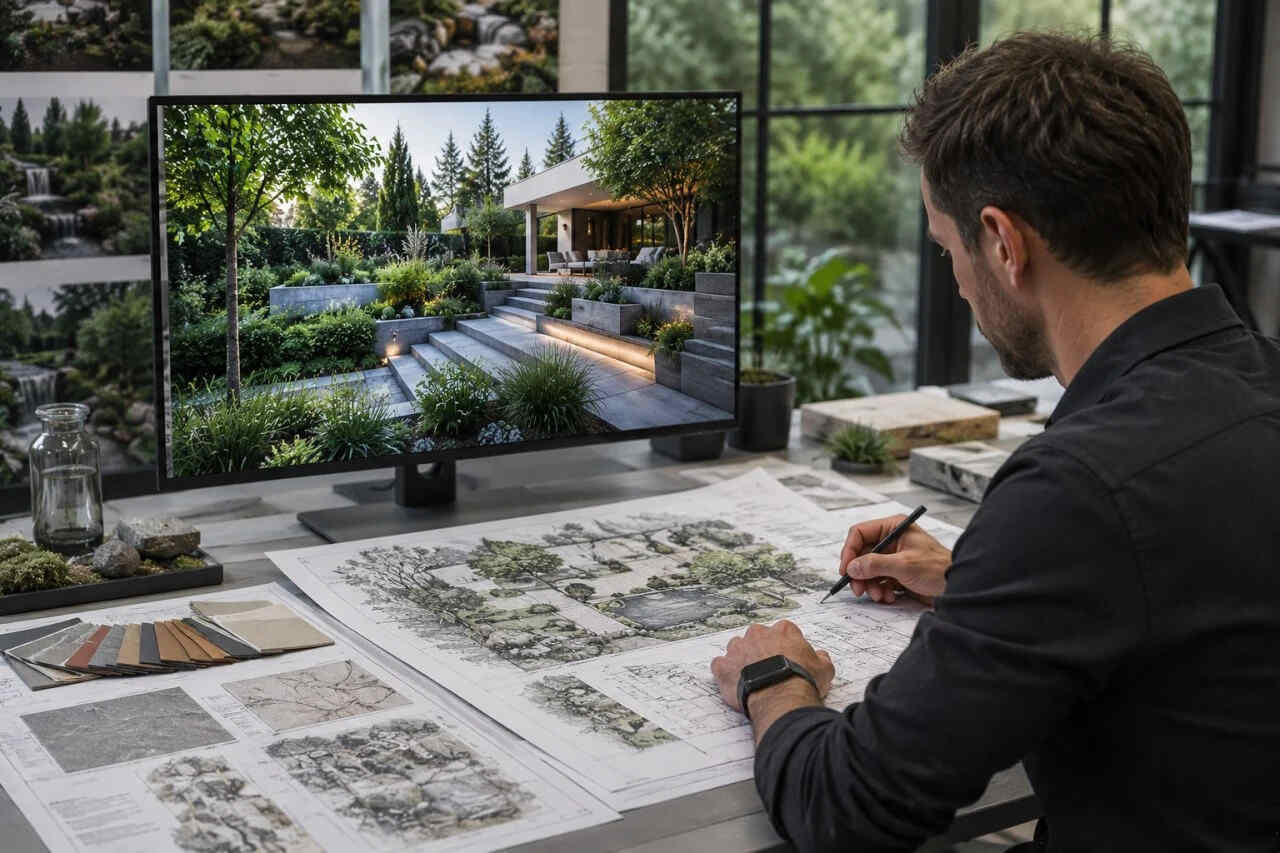
Ecolandscape Studio notes that the industry of suburban improvement and professional landscaping of territories is undergoing a massive technological transformation caused by the widespread use of neural network images. Generative artificial intelligence algorithms have made a true mental revolution in the field of visualizing creative ideas, creating detailed oases, futuristic gazebos, and cascading terraces in a matter of seconds based on short text prompts. Such content provides impressive graphics, the manual drawing of which would take weeks of painstaking work for a classic design bureau. However, when trying to transfer these digital sketches to a real landscape, the perfect picture clashes with the harsh laws of physics, soil science, hydraulics, and botany. AI design has become a powerful stimulus for the development of spatial imagination, but as a technological process, it requires a deep understanding of the adaptation mechanisms and radical manual reworking.
The main flaw of generated virtual spaces lies in the so called perfect picture syndrome, behind the flawless facade of which lies the complete botanical and engineering blindness of mathematical models. Artificial intelligence does not understand biological processes, the laws of gravity, or soil mechanics, it operates exclusively with pixels and visual patterns from its training database. As a result, within the boundaries of a single neural network flower bed, the algorithm combines moisture loving tropical monstera, blooming Japanese sakura, a desert succulent, and a European ancient spruce. The neural network easily forces shade loving forest ferns to bloom luxuriantly under the scorching rays of the sun on a dry alpine slide and draws cascades of overhanging water reservoirs where in reality sandy soil will absorb all the water in a second, and a heavy retaining wall will collapse under its own weight.
Moreover, digital models completely ignore time factors and seasonality, producing a static frame in which spring tulips, summer hydrangeas, peonies, and autumn asters bloom simultaneously at full strength, which is biologically impossible in living nature. AI is also unaware of the existence of aggressive root systems that pierce monolithic concrete or float in the air in its projects, and completely ignores engineering communications: gas pipelines, power cables, and drainage routes. The neural network does not know that shrubs grow, trees cast dense shade that distorts the original light balance, and soil tends to become depleted and require a certain level of acidity (pH).
We at Ecolandscape Studio warn that for generative art to bring real benefits, it must be used exclusively as a digital muse, a conceptual conversationalist, and a generator of visual metaphors, rather than as a ready made engineer draftsman. Proper, complex prompting (the creation of text queries) allows professionals to find unique color combinations, unexpected shapes of small architectural objects, and futuristic concepts of night lighting. Instead of abstract and ineffective phrases, the neural networks are given strict parameters: textures of specific materials (for example, architectural concrete, coarsely chopped travertine, charred larch wood), the geometry of falling shadows, the temperature step of LEDs, and the volumetric density of plantings.
The algorithms cope excellently with generating bold ideas at the intersection of styles, for example, creating parametric pergolas, futuristic retaining walls with integrated illumination, or art objects made of rusty corten steel, which then become the starting point for real engineering design. A breakthrough solution in modern practice has been the use of artificial intelligence to simulate texture contrasts, when a neural network is capable of producing hundreds of options for how the matte surface of large format limestone will visually interact with glossy foliage or the airy haze of decorative grasses.
The process of materializing a digital fantasy and turning pixels into a living ecosystem is built on the strict principle of reverse engineering. This is a step by step, meticulous algorithm during which a specialist breaks down a wild concept from the web into its components and adapts it to the realities of a specific climate, terrain, and budget. First, the visual volumes, the architectonics of shrubs, the density of crowns, and the color palette generated by the neural network are analyzed. Then the manual magic of botanical substitution begins: non viable exotics are replaced with resilient local analogues with a similar crown shape, texture, and leaf color. Instead of heat loving monstera, huge textured leaves of leopard plant or giant dense bushes of hostas are selected, whimsical southern trees are replaced with frost resistant decorative apple trees or weeping willows, and instead of impossible purple bushes, wood sage or Faassen’s catmint is planted.
The most important part of reverse engineering is checking the insolation map. A landscape architect manually recalculates which zones of the virtual garden will end up in the real deep shadow from a fence or a house, and completely changes the species composition of plants in these areas. In parallel, engineers calculate the real geoplastics of the relief, groundwater levels, calculate the loads on retaining structures, and lay down real construction nodes, foundations, and hidden automatic irrigation systems under fantasy floating terraces.
«Neural networks have given us an unprecedented speed in searching for associations and visual metaphors, but they have also created the illusion that landscape architecture is just a beautiful postcard,» says Martin Palma, the founder and CEO of Ecolandscape Studio. «Our personal experience working with generative graphics has shown that behind each spectacular image lie weeks of painstaking manual labor by engineers, hydraulic engineers, and dendrologists. A picture created by AI is just a beautiful, chaotic dream that is translated into the strict language of working drawings, vertical planning plans, detailed sections, and real planting sheets. Only after such a deep engineering transformation does digital chaos become a tangible, viable, and long lasting luxury.»
In the final analysis, the concept of Generative Landscape does not replace humans, but only sharply raises the bar of professionalism and requirements for landscape designers. Artificial intelligence is capable of expanding the boundaries of human imagination, breaking familiar patterns, and offering a bold, daring visual concept. But only an experienced specialist can breathe life into it, make plants grow, water circulate in a closed loop, and drainage work effectively during peak downpours. Tamed AI in the hands of experts turns from a generator of beautiful illusions and botanical phantoms into a powerful working tool, allowing the creation of unique, high tech, and personalized gardens of the future that stand firmly on real ground and develop according to the laws of living nature.