Traditional rules of suburban landscaping based on familiar hardiness zone maps have completely lost their relevance. Modern weather conditions no longer guarantee a smooth transition between seasons. Property owners now regularly face unpredictable temperature swings, where prolonged summer heat with anomalous figures near +40°C is instantly replaced by roaring gales, intense torrential downpours, and snowless winter frosts that deeply freeze unprotected soil. In these harsh realities, the experts of our team at Ecolandscape Studio are introducing a progressive ecological trend: the landscape design of a Climate-Resilient Garden. This involves creating a complex, flexible, and self-regulating ecosystem capable of adapting to any weather anomalies and maintaining a flawless appearance without constant artificial intervention.
The viability of such projects is based on the implementation of a flexible landscape, which completely changes traditional principles of selecting decorative flora. Instead of whimsical exotic hybrids and highly specialized crops, so called generalist plants are used in Ecolandscape Studio projects. These botanical Spartans are endowed with immense ecological plasticity, allowing them to equally successfully tolerate both critical waterlogging of the root system and long air droughts. A solid foundation of the green framework is formed by purple loosestrife, joe pye weed, Siberian irises, selected miscanthus cultivars, and tufted hair grass. During periods of floods or lingering cyclones, their roots can briefly remain in an anaerobic environment without the risk of rotting. With the onset of extreme heat, these same crops activate internal moisture saving reserves, reduce transpiration, and utilize a deep taproot system, protecting the suburban plot from burning out and seasonal death of plantations.
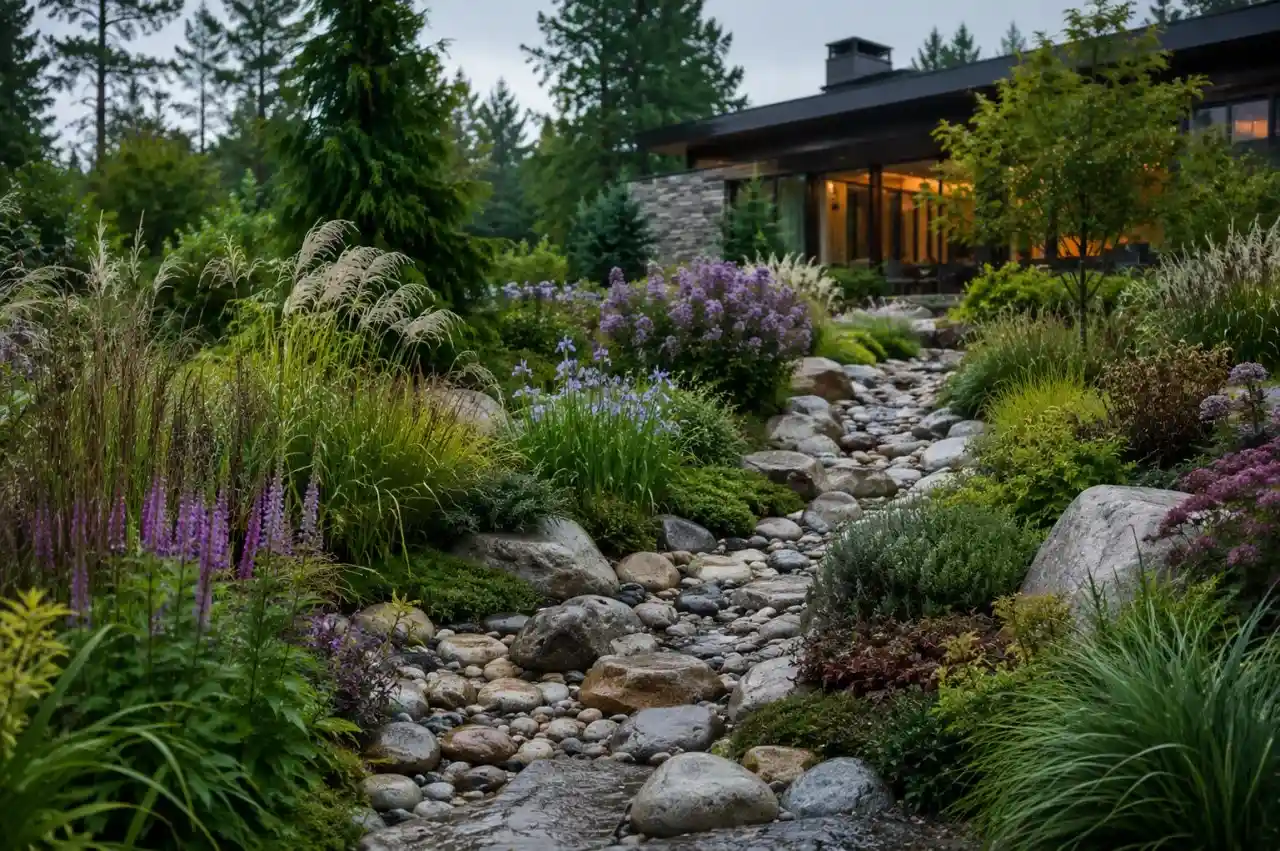
A key engineering element of a climate resilient territory is surface Drainage 3.0. Standard underground utilities, stormwater collectors, and perforated pipes often fail to cope with the tropical volumes of modern precipitation, instantly clogging with silt and requiring regular expensive service. Our studio offers an alternative eco solution: moving water drainage contours to the ground surface and turning them into natural open biotopes. In the process of landscaping and relief modeling, functional dry creek beds and rain gardens are created, which are picturesque geometric lowlands decorated with natural stone, river pebbles, and fractional gravel. During a storm or flood, these elements instantly transform into rushing streams that intercept, filter, and gradually guide excess moisture into the deep layers of the soil, protecting the foundation of the house. In dry periods, such creek beds remain an ultra stylish, graphic element of Scandinavian design that imitates a dried up mountain river.
«Over the years of managing large scale landscape projects, I realized that trying to subordinate nature to the strict framework of a formal park in an era of global climate change is a dead end and economically unprofitable path,» shares Martin Palma, the founder and CEO of Ecolandscape Studio. «The architecture of the future must be adaptive. When we first integrated the principles of a Climate-Resilient Garden and completely replaced hidden utility networks with a system of open dry creek beds, the property not only flawlessly withstood a record peak flood, but also began to look much more monumental. Smart design should not fight the elements, but use their natural dynamics for the self renewal of the garden.»
Another vulnerable zone of a classic plot in the face of weather anomalies is unprotected soil. The usual pine bark, wood chips, or open ground in conditions of gale force winds are subjected to total erosion, washing away by water streams onto the paving of paths, while gravel mulch under direct sunlight heats up, overheating the root zone. Ecolandscape Studio solves this problem with the help of progressive living mulch technology, in which the soil is completely isolated by a dense multi tiered carpet of groundcover perennials. Bugleweed, selected stonecrops, spotted deadnettle, European wild ginger, and Irish moss form a monolithic breathing shield. This green armor acts as an ideal temperature regulator: in summer it retains moisture in the ground and protects roots from thermal shock, in winter it minimizes the risks of plant freezing in the absence of a stable snow cover, and during strong winds it securely holds the humus layer from erosion.
The creation of a climate resilient garden represents a long term investment in the environmental friendliness, safety, and autonomy of a suburban space. Giving up total control over the ecosystem in favor of flexible engineering and botanical solutions, the specialists at Ecolandscape Studio form a strong, self sufficient landscape. Such a garden not only copes with any vagaries of the climate, but also completely frees you from the need to spend weekends with a watering can and cultivator, proving that natural aesthetics can be absolutely resilient.