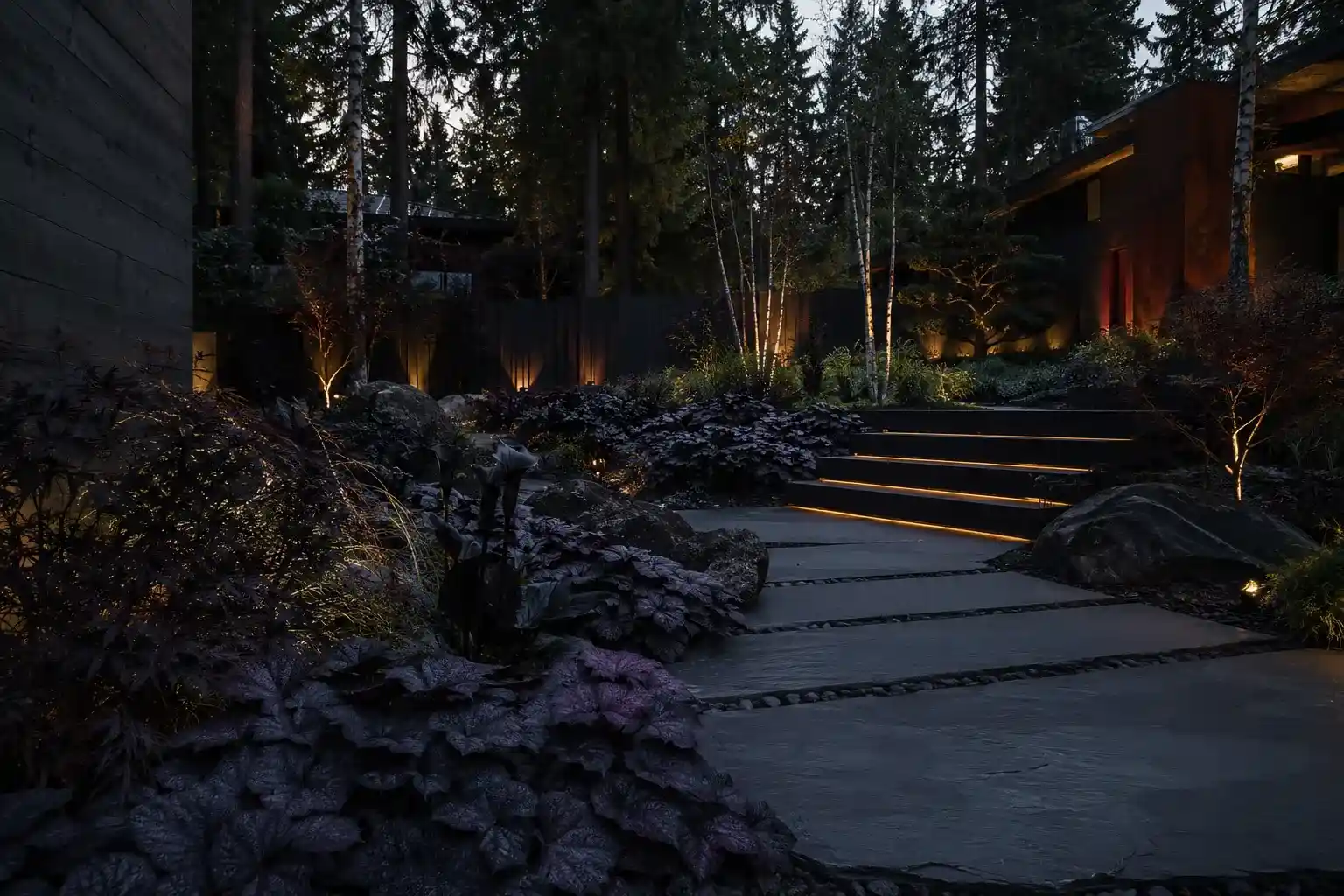
Ecolandscape Studio notes that after many years of developing elite country residences, we have observed a tectonic shift in the aesthetic preferences of our clients. Traditional alpine rock gardens, chaotic explosions of color in flowerbeds, and formulaic suburban landscaping have been completely replaced by conceptual maturity. Today, modern garden landscape design has evolved beyond the role of a decorative backdrop. It has become a seamless, tectonic continuation of interior architecture, acquiring a profound philosophy and the status of true visual luxury. “Black aesthetics,” combined with gothic minimalism in landscape improvement, is not a temporary fascination with dark imagery, but a deliberate manifesto of refined taste. Within this paradigm, exclusive landscape design communicates status not through colorful floral combinations, but through monumental silhouette graphics, impeccable geometry, sophisticated lighting dramaturgy, and the honesty of noble materials. We create private spaces that refuse to shout about luxury, choosing instead to express it through a confident, hypnotic whisper.
The foundation of this direction is the concept of “botanical noir,” which has completely overturned the classical laws of garden color composition. Instead of the traditional dominance of bright green vegetation, the team at Ecolandscape Studio creates multidimensional monochrome panoramas, focusing on flora with graphite, deep purple, blueberry, and charcoal foliage textures. Such landscape planning radically transforms human perception of the environment: the eye no longer wanders chaotically across patches of color and instead concentrates on the architecture of shrubs, the contours of leaves, the density of crowns, and the subtle nuances of branch graphics. Dense carpets of selective Ajuga or Heuchera varieties such as ‘Obsidian,’ ‘Midnight Rose,’ and ‘Black Pearl’ almost completely absorb light waves, creating the optical illusion of a bottomless velvet surface beneath one’s feet. Dramatic vertical dynamics and a rigid rhythm are introduced by charcoal calla lilies, dark Ligularia, the theatrical ‘Queen of Night’ tulips, and the glossy black blades of Ophiopogon planiscapus ‘Nigrescens.’ To enrich the middle layer, we integrate woody plants with dark charisma, such as Physocarpus opulifolius ‘Diabolo’ or Sambucus nigra ‘Black Lace,’ whose lace-like cosmic foliage creates a hypnotic interplay of light and shadow. The practical meaning behind this plant selection lies in pure physics: dark tones conceal perspective and visually erase the physical boundaries of a property, pushing the background into infinity. As a result, comprehensive site landscaping gives the space unprecedented depth, transforming the estate into a protected, intimate oasis.
However, plant compositions in gothic minimalism cannot exist without a monumental architectural framework. It is impossible to simply plant dark perennials against a standard lawn. They require a rigid, tectonic setting. The greatest sense of weight and prestige comes from elements with pronounced textures carrying the scars of natural or man-made influence. One of the signature features of the style is the authentic Japanese Shou Sugi Ban technique: cladding retaining walls, tall fences, facades, and terraces with deeply charred wood. The carbonized layer not only preserves the wood for generations, protecting it from moisture and pests, but also creates a unique relief reminiscent of frozen volcanic lava. Depending on the angle of sunlight, the material changes its appearance from muted matte black to noble silver metallic. This radicalism is harmoniously balanced by other premium materials. We use split anthracite slate and shungite for textured pathways, large-format architectural concrete with rough wooden formwork imprints, and the famous weathering steel known as Corten. The velvety rust patina of Corten stabilizes over time and introduces a warm copper accent into the overall dark palette. The value of these textures lies in their absolute honesty: they age beautifully under the influence of climate, acquiring a noble patina of time and conveying the impression that this landscape was shaped over centuries by the forces of nature themselves.
“For a long time, the premium segment of country real estate was associated exclusively with perfect emerald lawns and an abundance of flashy exotic plants,” shares Martin Palma, founder and CEO of Ecolandscape Studio. “But one evening, while working on a complex forested property in deep twilight, I realized how standard greenery flattened the real volumes of the landscape, turning it into a featureless mass. The true magic, depth, and spatial relief emerged only when we consciously removed all this visual noise and replaced it with charred wood, anthracite slate, and deep purple textures. Black in landscape design is not emptiness. It is an infinite canvas that allows nature to sound monumental, luxurious, and filled with absolute mental silence.”
The main phenomenon behind the attraction of gothic gardens lies in the masterful orchestration of contrasts. Within a monochromatic environment, even the slightest appearance of pure color, an unusual shape, or a beam of light is instantly elevated to the level of fine art. The dark background functions like velvet lining inside a jewelry case. Against the deep anthracite backdrop of charred wood, the graphic form of a solitary emerald fern such as Matteuccia or Asplenium, the elegant calligraphic silhouette of a Japanese maple ‘Dissectum,’ or the luminous white trunk of a multi-stem Betula utilis ‘Doorenbos’ begin to resemble priceless exhibits in a contemporary art gallery. Plant anatomy reveals itself differently: one starts to notice the curve of every branch, the veins of each leaf, and the rhythm of internodes. Black acts as the perfect accumulator of atmospheric phenomena. It captures diffused daylight with extraordinary effect, emphasizes the whiteness of minimalist sculptural forms in marble or white concrete, and makes every drop of morning dew or summer rain sparkle like a cut diamond. When dusk arrives, the stage belongs to professional lighting design. Carefully focused hidden beams from landscape spotlights isolate only the most expressive lines and textures from the darkness: tree bark, the matte sheen of stone, the contours of foliage. This allows landscape lighting to reveal its full potential, transforming the night garden into a mystical theater of shadows and silhouettes entirely free from any sense of suburban banality.
Ecolandscape Studio believes that this radical form of landscape minimalism is chosen by people who are genuinely exhausted by the aggressive visual environment of modern megacities, endless neon signs, and digital noise. They seek mental silence, absolute calm, psychological safety, and privacy. Gothic minimalism in the garden is a rigorous engineering, architectural, and artistic approach to nature, where every element serves a precise function and randomness is eliminated at the sketch and landscape planning stage. The high cost and exclusivity of such a garden are measured not by the number of rare exotic plants requiring difficult maintenance, but by the complexity of spatial design, uncompromising quality of execution, meticulous selection of textures, and profound philosophy. This landscape does not attempt to impress or entertain guests with fleeting seasonal brightness. Its impact is far deeper and more enduring: the professional interior and exterior design created by our studio communicates timeless, monumental luxury that remains completely indifferent to the whims of changing trends and will retain its relevance for decades.