Professional turnkey landscape design and the creation of sustainable ecosystems on private estates now extend far beyond aesthetics alone. If you are planning to commission comprehensive site development, it is important to understand that modern rocky garden design by Ecolandscape Studio lies at the intersection of engineering geology, climatology, soil microbiology, and botany. An advanced rock garden functions as a complex, artificially created biotope capable of reproducing, on a miniature scale, the harsh conditions of a specific geographical zone, from the high Alps to arid canyons or shaded forest ravines. Our studio develops such landscape features as autonomous, climate optimized ecosystems capable of transforming challenging terrain and becoming the primary visual focal point of a premium garden.
Every long lasting rock garden begins with an invisible yet critically important underground infrastructure, where earthworks determine the viability of all plantings. Since most specialized alpine plants cannot tolerate stagnant groundwater, professional drainage installation is the first priority during site preparation. During the construction of rocky compositions, specialists excavate the soil to a depth of 30 to 50 centimeters and install a multilayer filtration base consisting of coarse gravel, crushed brick, or expanded clay aggregate, covered with dense geotextile fabric. Ecolandscape Studio approaches this process as the creation of a stable, self contained biotope in which every component, from the drainage core to the final decorative layer, serves a precise engineering and biological purpose, preventing the settlement of heavy boulders and terrain deformation.
Selecting natural stone for a rock garden requires careful consideration of the physicochemical interaction between the rock and the surrounding flora. Our landscape architects choose materials based on their petrographic characteristics. Limestone, dolomite, and tuff, for example, are rich in calcium and gradually increase soil alkalinity, creating ideal conditions for calciphilous plants such as edelweiss, saxifrages, and alpine carnations. However, planting heathers, rhododendrons, or conifers in such substrates inevitably leads to chlorosis and decline due to restricted iron uptake. For acid loving species, we select granite, quartzite, basalt, or porphyry, as these rocks are chemically inert. The physical properties of stone also influence garden development. Porous tuff and sandstone absorb moisture and release it gradually to plant roots, encouraging the establishment of mosses, while dense granite serves as a powerful thermal stabilizer, storing daytime heat and reducing the impact of sudden nighttime frosts. The team at Ecolandscape Studio considers this the only way to move beyond standardized landscaping and recreate the authentic tectonics of wild nature within a private estate.
Martin Palma, Founder and CEO of Ecolandscape Studio, notes that true mastery in creating a rocky garden lies in understanding the inherent energy and tectonic character of stone. During his expeditions through wild mountain ranges, he discovered that nature never arranges stones randomly. Instead, they always follow the directional forces of geological formation, and this underlying logic of landform structure should be transferred to private landscapes. According to Martin Palma, a professionally designed rock garden should appear not as an artificial landscaping feature but as an ancient rocky outcrop that existed long before the construction of the house itself. Achieving this effect requires exceptional precision when integrating boulders into the natural terrain.
Standard garden soil or commercial planting mixes are unsuitable for alpine gardens and rockeries. Instead, a specialized soil blend is created to replicate nutrient poor mountain humus. It consists of turf soil, leaf compost, and coarse washed sand with the addition of fine granite or limestone chips in a ratio of 1:1:2. The high mineral content ensures excellent capillary porosity and aeration, encouraging plant roots to penetrate deeply through narrow rock crevices where temperatures remain stable. Low organic content limits excessive vegetative growth, allowing plants to maintain compact cushion like forms and abundant flowering rather than producing excessive foliage. Under such conditions, mycorrhizal fungi play a critical role, forming symbiotic relationships with shrub roots and helping them extract difficult to access minerals directly from the crystalline structure of rocks.
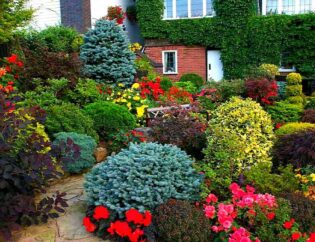
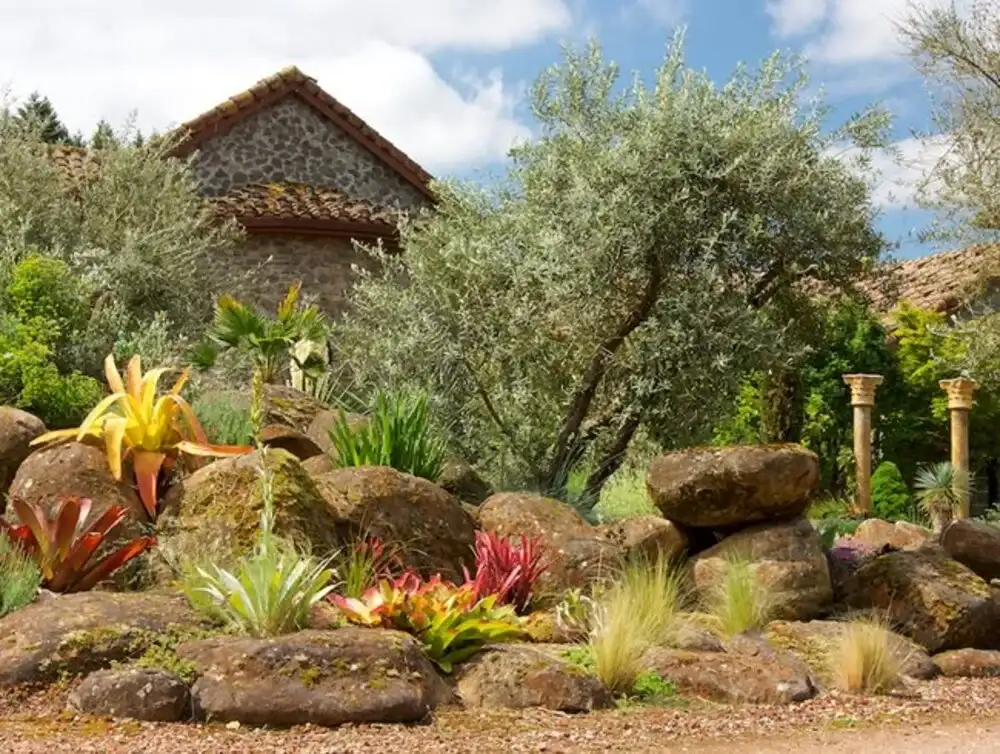
When selecting plants, our dendrologists follow the principles of phytocoenology, carefully avoiding random combinations and organizing the rock garden according to distinct microclimatic zones. South and southwest facing slopes of large boulders, where reflected heat can increase temperatures by several degrees, are planted with xerophytes such as houseleeks, spurges, drought tolerant sedums, pussytoes, and thyme. At the base of stones on the northern and eastern sides, where partial shade and moisture retention are more consistent, entirely different plant communities are established, including miniature hostas, dwarf ferns, primroses, and liverworts. Seasonal dynamics are also carefully considered. To ensure the rock garden remains visually attractive after the spring display of crocuses and other small bulbs, perennial plants with diverse architectural forms are incorporated into the design. Vertical accents are created with columnar junipers, graphic structure is provided by blue fescue, and visual softness is achieved through dense cushions of sea thrift and Irish moss. At Ecolandscape Studio, we view this as a long term investment in the site’s ecosystem, capable of maintaining architectural clarity and structural volume for decades.
A high quality turnkey rock garden is a living organism that evolves over time and progresses through several stages of ecological succession. During the first two years after installation, maintenance focuses on controlling invasive species and aggressive groundcovers such as snow in summer and aubrieta, which can quickly overwhelm slower growing alpine plants if left unchecked. The use of underground stone barriers during planting helps restrict root expansion and prevent these issues before they arise. Around the fourth year, a natural patina of crustose lichens and pioneer mosses begins to develop on the stones, indicating that the ecosystem has reached maturity. At this stage, irrigation is reduced to a minimum and is required only during extended drought periods. Winter maintenance concentrates on protecting delicate conifers from snow damage and preventing the formation of ice crusts that can cause crown rot in rosette forming perennials during early spring thaws.