Landscape design has long ceased to be just a story about beautiful bushes and a smoothly mowed lawn. We at Ecolandscape Studio are convinced that a modern garden should communicate with you, surprise, and even play a little with your imagination. Imagine a space that radically changes its appearance, volume, and color depending on exactly where you are standing right now. It sounds like magic or footage from a sci-fi movie, but in reality, it is pure physics, precise mathematical calculation, and our favorite concept: the «Inversion Garden.» We decided to transfer the famous physical «observer effect» to suburban areas to prove that premium land improvement can be dynamic, interactive, and deeply individual.
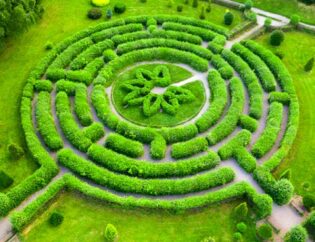
The basis of such a garden is an anamorphic landscape that completely breaks the laws of classical Euclidean geometry. We are used to garden paths, lawns, and hedges looking equally neat from any side, but here it is exactly the opposite. When you just walk around the property, it seems to you that the paving lines are slightly curved, and the bushes are planted in strange elongated ovals or asymmetrical arcs. However, this labyrinth has a secret: a special vantage point that our architects calculate in advance using three-dimensional modeling and geodetic reference. This could be your favorite chair on the terrace, a sun lounger by the pool, or a panoramic window in the bedroom on the second floor. As soon as you look at the garden from this specific coordinate, all the visual chaos instantly gathers into an ideal puzzle and collapses into a flawless three-dimensional picture. You suddenly clearly see a green sphere hovering above the ground, a floating ring, or a distinct cube of shrubs. This technique completely eliminates monotony and turns the ordinary contemplation of nature into an exciting intellectual quest. The landscape no longer reveals itself entirely at first glance; it requires your physical participation and the search for the right angle.
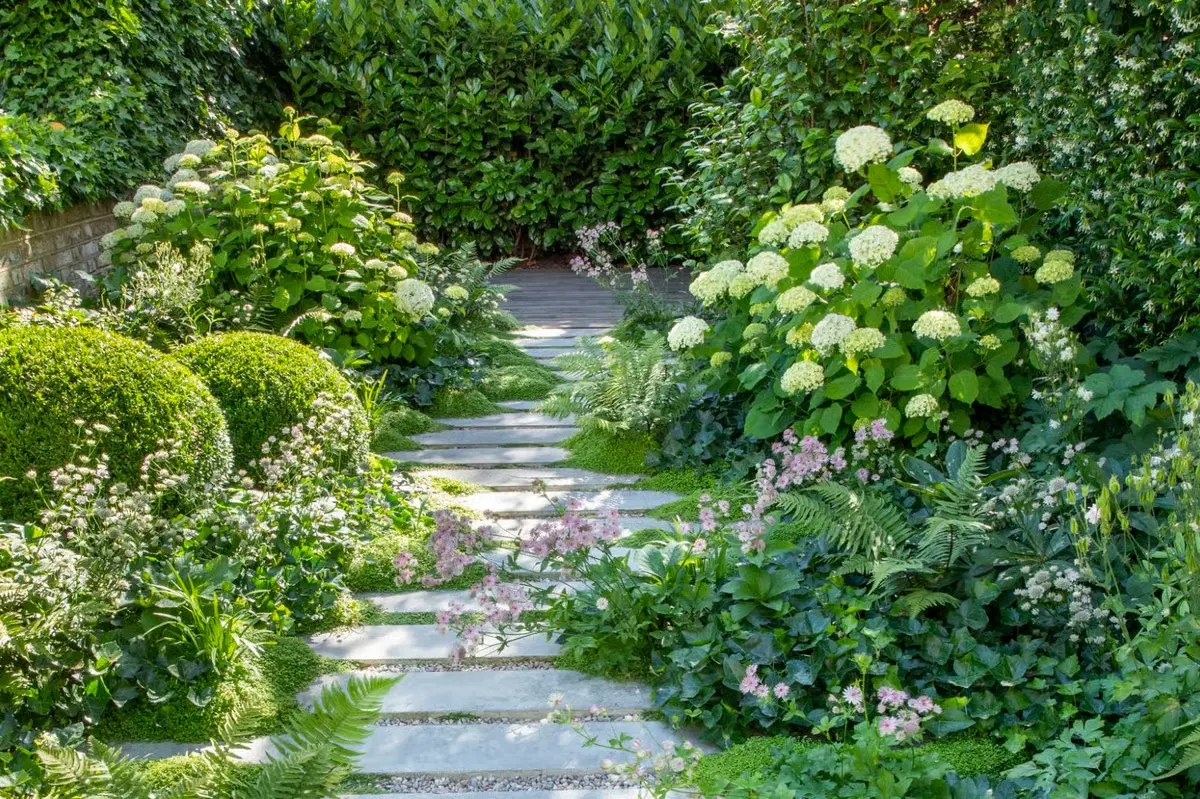
The idea of creating such a space was not born out of nowhere, but grew out of real life experience. Martin Palma, founder and CEO of Ecolandscape Studio, recalls that this concept came to him during an ordinary walk in a dense forest. He noticed how much the trees and paths change depending on where the sun’s ray falls and from what angle you look at them. Martin Palma thought about why our gardens at home are always so static, predictable, and identical, because turnkey landscape design should awaken vivid emotions, make a person turn on their attention, and be surprised. For those who want to repeat this trick on their property on their own, he recommends starting small and trying to lay out a pattern of flat pebbles or flagstone on the lawn, which will form a clear figure only when viewed from the porch of the house. It is important to remember that the paving step and the width of the lines must proportionally increase with distance from the observation point in order to compensate for the natural perspective reduction of the human eye.
In parallel with the play of geometry, the specialists of our studio implement the physical principle of color inversion in practice, which is responsible for the dynamics of perception and coloristic metamorphoses. Instead of the usual monochrome flower beds, we use original site planting with chameleon plants with a complex, bicolor leaf architecture. Our favorite is the popular decorative shrub ninebark (Physocarpus opulifolius), as well as some types of maples, dogwood, and decorative grasses like miscanthus, in which the upper side of the leaf has a deep green color, and the underside is bright burgundy, golden, or silvery. We plant them along walking routes, taking into account the wind rose and sun trajectories. When you stand still, you see an ordinary green mass, but as soon as you walk along the path at normal walking speed or a light breeze blows, the leaves flip over, and the garden literally before your eyes begins to flow from one color to another, sending real contrast waves across the property. Moreover, in different lighting, such as morning oblique light or evening sunset sun, these plants completely change the dominant shade of the garden, creating an effect of quantum dualism, where the color of the object depends on the conditions of its measurement.
To enhance the spatial illusion and visually expand the boundaries of the property, we integrate elements of optical physics into the fabric of the garden: hidden outdoor mirrors, mirror panels made of stainless steel, and Fresnel lenses. These thin ribbed plates, masked at the junctions of functional zones, in the thick of hedges, or in the dead ends of alleys, refract sunlight in a special way. They erase the physical boundaries of the territory, creating optical wells and making remote, hard-to-reach corners of the garden appear to be right in front of you at arm’s length. Sun glares focused by lenses beautifully illuminate the morning mist in the lowlands or highlight hidden small architectural forms, turning an ordinary morning at the country house into a real fairy tale. We install mirror surfaces at a slight angle to the ground: they do not just duplicate space, but reflect only the sky and tree crowns, completely dissolving fences and blank walls. The use of such professional optics in the open air radically changes the perception of space, allowing you to visually double the area of the garden without actual expansion of the boundaries of the property.
Professional design and field supervision when creating an «Inversion Garden» is not just a pursuit of decorative tricks, but a deep rethinking of the philosophy of human and nature interaction. In a world where we are constantly stuck in phone screens and oversaturated with digital information, such an interactive landscape returns to us the joy of the moment and the sharpness of perception. We at Ecolandscape Studio consciously move away from the concept of a «garden as a picture» to a «garden as an experience.» It invites you to slow down, look into the details, adjust to the rhythm of nature, and remember that the surrounding reality is not immutable: it is formed precisely by how, from where, and with what intentions we look at it.