Contemporary trends in premium country property improvement are moving further away from usual polar extremes. We at Ecolandscape Studio observe a natural rejection of boring, predictable regular symmetry, as well as its opposite, a chaotic, intentionally «wild» natural style. Instead, a fundamentally new philosophy of spatial modeling comes to the fore: designing gardens based on fractal theory and the laws of chaos geometry. This concept explores how to use mathematical algorithms of self-similar figures, where each small part exactly repeats the structure of the whole, to recreate that deep, hidden orderliness in the landscape that the human brain subconsciously reads as absolute harmony and perfect visual balance. Applying the principles of non-Euclidean geometry, landscape architects create spaces that are perceived by humans on a genetic level as a safe, evolutionarily native, and aesthetically perfect living environment.
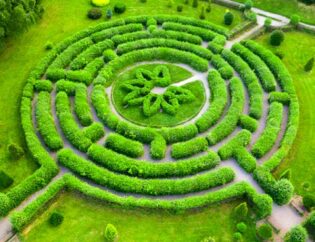
Mathematics in the bushes becomes the central tool for deconstructing familiar shapes. Traditional topiary trimming and classic living hedges give way to complex green labyrinths and multi-tiered plant borders formed according to the principle of the Mandelbrot set, the Koch curve, or the Sierpinski triangle. We understand that the regular repetition and scaling of the same geometric pattern from large specimen trees to medium shrubs and carpet perennials creates a hypnotic spatial effect. A garden designed using a fractal algorithm reveals itself to the observer endlessly: when approaching any element of the structure, the gaze discovers inside it exactly the same complex system of micro-zones that was visible from afar. Tree crowns are pruned in such a way that third- and fourth-order branching mirror-images the silhouette of the main trunk, which completely changes the perception of scale and forces one to study the territory endlessly.
We pay special attention to hard surfaces in the context of chaos geometry, implementing premium-level fractal paving. We completely abandon standard rectangular or radial tiles, replacing them with legendary Penrose paving or complex ornaments made of crushed natural stone like basalt, granite, and quartzite. The peculiarity of this mathematical layout is that the pattern has a quasicrystalline structure: it has an ideal internal order, but at the same time it never completely repeats throughout the entire paving area. Such a covering creates a mesmerizing feeling of endless order and hidden rhythm. The joints between the stones are deliberately filled with fine-fraction grit or planted with mosses resistant to trampling, which visually connects the strict mathematics of paving with the living organics of the earth, forming smooth transitions from one functional area to another without seams and monotonous visual patterns.
The Founder and CEO of Ecolandscape Studio, Martin Palma, based on his many years of experience in designing elite residences, made an important personal discovery: true mental relaxation of a person in a garden occurs when their visual analyzers encounter codes that are familiar to wild nature but mathematically calibrated. Analyzing the architectural plasticity of plants, Martin Palma determined that the fractal design of an estate resonates with the deep mechanisms of human perception, reducing stress levels through the contemplation of ordered chaos. In his opinion, creating a garden of eternal return is not just a tribute to complex geometry, but a subtle tool of preventive psychotherapy that unloads short-term memory and activates parts of the brain responsible for spatial imagination. Martin Palma emphasizes that a fractal landscape erases the feeling of artificiality of a man-made space, offering instead an endless aesthetic game in which geometry and botany merge into a single living organism.
The logical continuation of the concept is the precision selection of fractal plants, which themselves are unsurpassed natural mathematical masterpieces and are used by us as the main accents of the estate. We build compositional nodes around species with a pronounced self-similar geometry: various varieties of ferns whose fronds perfectly reproduce the general shape of the leaf on a micro-level, unique coniferous cultures with tiered branching like Araucaria or larch, as well as specific succulents, for example, Aloe polyphylla with its flawless spiral symmetry of Fibonacci. Plantings of Romanesco broccoli, whose conical buds form a logarithmic spiral, can be used as extravagant art objects in vegetable garden and parterre zones. Collection species of club mosses and horsetails, whose ancient morphology has preserved the pure mathematical structure of prehistoric flora, are integrated here as well. We believe that such living fractals chain attention, serving as natural points of eye attraction.
The mathematical algorithm is transferred to the design of the site’s water systems as well. Instead of rectilinear channels or static ponds, dynamic streams are created in gardens of fractal geometry, the shorelines and bottom cascades of which are calculated using formulas for turbulent flows. Water in such streams moves, forming fractal vortices and spirals that not only saturate the reservoir with oxygen but also create an endlessly changing, mesmerizing pattern on the surface, complemented by sounds of different pitch. Stone boulders on the shores are selected taking into account their natural texture obtained as a result of a fractal split of the rock, which enhances the feeling of the pristine nature of the landscape.
We know how important it is to use innovative technologies, so we supplement fractal gardens with parametric lighting and hidden geoplasty of the relief. Cascading hills and terraces are designed by us according to algorithms of natural weathering of rocks, which allows the landscape to look absolutely natural and mathematically flawless at the same time. Intelligent lighting systems are programmed based on fractal algorithms of lightning branching or the flickering of the starry sky, creating a soft, non-linear play of light and shadow in the evening without harsh light spots. As a result, the complex country estate, the features of which we study at Ecolandscape Studio, turns into a self-contained spatial cocoon where the chaos of nature is subordinated to the laws of higher mathematics, giving property owners an exceptional sense of stability, harmony, and endless return to the origins of natural balance.