Landscape design for high-traffic properties requires a fundamentally different approach from designing a private garden or an intimate residential courtyard. Here, the space must not only look aesthetically impressive at the moment of completion, but also maintain visual strength, comfort, and operational resilience under constant daily use. Hotels, business centers, retail complexes, public areas of residential developments, and entrance zones with heavy pedestrian flow quickly expose any weak design decisions. Martin Palma, founder and CEO of Ecolandscape Studio, notes that the true value of such landscaping is revealed not in a perfect presentation image, but in the environment’s ability to withstand continuous use without losing its premium perception. This is why high-traffic landscape design must be conceived as a system where beauty and durability function simultaneously.
The main mistake in such projects is treating landscape as purely visual decoration. High-traffic spaces exist in constant motion – people shorten routes, gather near entrances, create unexpected congestion points, carry dirt from outside, and continuously place stress on surfaces, planting, and architectural elements. If these behavioral scenarios are not considered in advance, even expensive design solutions quickly begin to deteriorate. Specialists at Ecolandscape Studio analyze user flow patterns and note that resilience begins not with selecting durable materials, but with understanding exactly how people will interact with the environment every day.
Thoughtful route planning is especially critical. In high-traffic environments, people always choose the shortest and most intuitive path. If a design offers visually beautiful but illogical routes, users will naturally create their own movement patterns, damaging lawns, planting beds, or decorative zones. This is why landscape design must work with human behavior rather than against it. At Ecolandscape Studio, we analyze movement patterns and observe that successful spaces anticipate natural flow through wide pathways, intuitive intersections, waiting zones, buffer areas, and smooth transitions between active points. This logic helps preserve aesthetics without constant conflict with real-world use.
Materials in high-traffic projects must be evaluated not only by appearance, but by long-term performance. Paving, curbs, stairs, seating elements, and decorative surfaces face daily abrasion, moisture, temperature fluctuations, and mechanical pressure. A material that looks spectacular in renderings may quickly lose quality under real operational conditions. Specialists at Ecolandscape Studio note that premium quality in such projects is defined not by the rarity of a material, but by its ability to maintain form, texture, safety, and visual cleanliness over time.
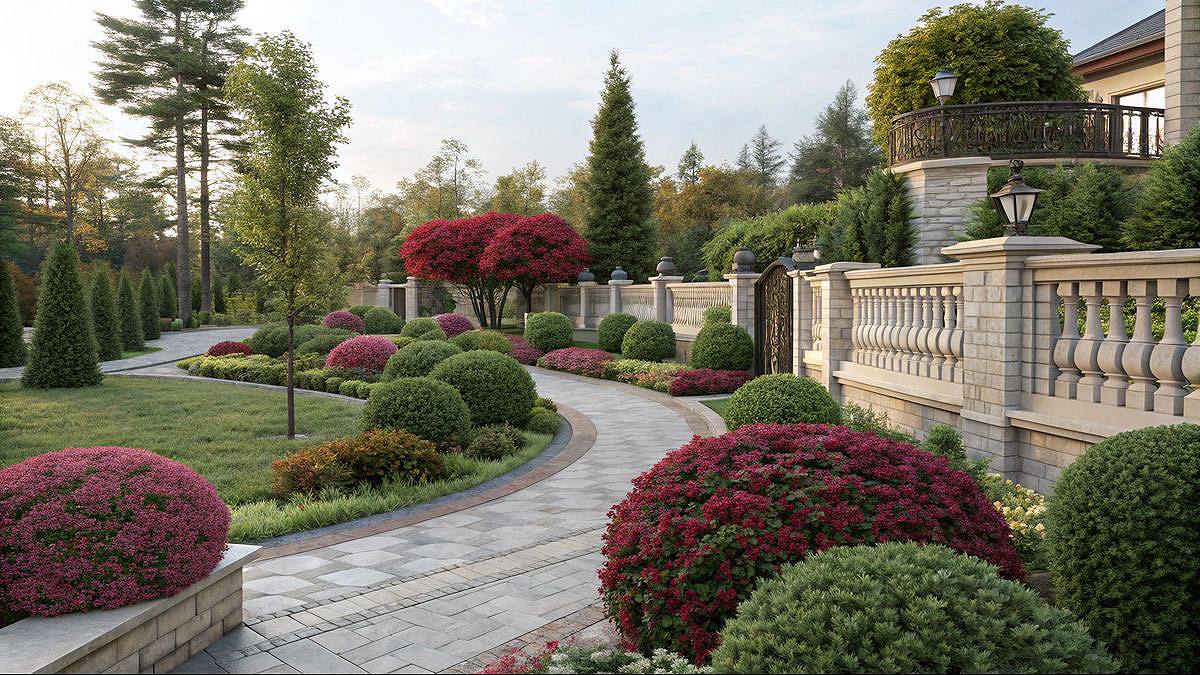
Plant strategy is equally important. Vegetation in active circulation zones must be resistant to dust, wind, limited soil volume, accidental impact, and urban stress. Fragile decorative solutions may look attractive during the first weeks but soon require replacement or constant maintenance. At Ecolandscape Studio, we believe planting for high-traffic projects should be built around resilience, density, proper root-zone protection, and seasonal stability. Strong planting composition not only enhances the visual identity of a property, but also withstands the reality of intense urban rhythm.
From a commercial perspective, landscape design for high-traffic properties directly affects reputation and perceived value. The external environment functions every day as the calling card of a hotel, office center, retail destination, or residential complex. If it deteriorates quickly, users immediately associate the property with weak management and lower quality standards. At Ecolandscape Studio, we see durable landscape design as a strategic tool for long-term capitalization, where beauty does not disappear under operational pressure, but continues to preserve status, order, and trust in the project even under constant daily use.