In the world of garden landscape design, classic principles of harmony, symmetry, and functionality remain important guidelines. However, in today’s era of creative experiments and unconventional solutions, designers increasingly turn to an approach that goes beyond the rules antidesign.
Antidesign is a way to create unusual, emotional, and highly individual spaces that stand out from standard solutions. In this article, Ecolandscape Studio explores the origins of antidesign, how its ideas are applied across different design fields, and what it can mean for your garden landscape design.
What Is Antidesign
The term “antidesign” emerged in the mid-20th century as part of the radical design movement, which rejected established norms of aesthetics and functionality. This radical design trend began in the United Kingdom and Italy in the 1960s and 1970s, when designers and architects aimed to prioritize the social and cultural role of objects rather than merely their visual appeal.
Antidesign challenges the notion that form must follow function and that design should always be neat, orderly, and “beautiful.” Instead, it embraces chaos, asymmetry, contrasting color schemes, and visual tension to create spaces that evoke emotion and remain memorable.
From an aesthetic perspective, antidesign may appear loud, daring, and sometimes even “ugly” by traditional standards. It is a deliberate rejection of standard order to emphasize individuality, provoke thought, and push beyond the ordinary.
Historical Roots and Development of the Idea
The roots of antidesign lie in a radical response to the modernist ideas of the 20th century and the commercialization of design. During the modernist era, designers believed that projects should be rational, simple, and functional. Antidesign opposed this logic, asserting that design could also be a form of self-expression, provocation, and cultural statement.
Groups such as the British Archigram and Italian Archizoom and Superstudio produced radical architectural and design projects, often remaining conceptual collages or ideas rather than practical objects. Their works sought to deconstruct conventional notions of space, function, and visual perception.
Antidesign is not merely an aesthetic rebellion it reflects the cultural, social, and philosophical changes of its time, when artists and designers began questioning the true role of design in society. Its influence is still felt today, as many contemporary designers and studios draw inspiration from these ideas to create innovative projects.
Antidesign and Visual Characteristics
Antidesign can be described as a visual protest against predictability. In modern practice, it manifests in combining seemingly incompatible elements, deliberate asymmetry, shifted visual grids, and unexpected color schemes. In graphic design, this may involve overlapping blocks of text and images, bold confrontational colors, and intentionally “raw” graphics.
In architecture, radical antidesign projects aimed to challenge traditional notions of functionality and form, using collages, experiments with scale, and the concept of “superstructures” that defy conventional perception of urban spaces.
What Antidesign Means for Landscape Design
When we at Ecolandscape Studio talk about antidesign in garden landscape design, we mean applying ideas that break conventional rules of site planning to create emotional, distinctive, and creative spaces.
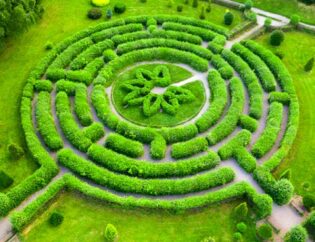
In practice, this may take the form of winding, non-linear paths that tell a story rather than follow a straight line, contrasting plantings with diverse textures and colors that emphasize individuality, or art objects and decorative elements that draw attention and create an emotional focal point.
This approach does not ignore the functional needs of a garden such as seating areas or flower zones but organizes the space so that it functions not only as a well-arranged site but also as an artistic expression of your taste and character.
Why Antidesign Is Relevant Today
Today, antidesign is experiencing a revival not only in graphic or digital design but also in branding, architecture, and artistic practices. This approach is often seen as a response to the uniformity of the visual world and the mainstream “universal design” style familiar to consumers. In an era when standardized solutions can be produced in seconds with tools, designers use antidesign to emphasize authenticity, humanity, and uniqueness.
In garden landscape design, it helps make a project stand out among typical solutions, creating a space that is not only attractive but also memorable, leaving an impression of “story and character.”
When Antidesign Works and When It Doesn’t
Antidesign is particularly appropriate when the goal of a project is to express individuality, create emotional highlights, or implement creative ideas reflecting the personality of the garden owner. It works best where a visual story, unusual impression, and unconventional solution are important.
However, antidesign may be less suitable if the primary objective is a strictly functional space without visual complexity, such as purely practical areas where simplicity and convenience matter more than striking visual impact.
Practical Tips for Implementing Antidesign in Your Garden
For those who want to incorporate elements of antidesign into their garden landscape, it is important to combine bold ideas with thoughtful context. Start by defining the overall concept of the garden, marking key zones you want to highlight, and consider how unconventional solutions can enhance emotion and impression.
Playing with colors, shapes, and textures is not just breaking rules it is a way to create the garden’s visual language that speaks about you. It is important to maintain a balance between experimentation and functionality so that the space remains comfortable, practical, and at the same time unique.
Antidesign is not only a visual rebellion against rules; it is a philosophy that allows space for self-expression, originality, and emotion. In garden landscape design, it helps create a space that reflects the owner’s individuality, provokes thought, and inspires.
At Ecolandscape Studio, we believe that skillful use of antidesign ideas turns a project into more than just a beautiful garden it becomes a true work of art reflecting your character and creativity.