Modern residential landscape design is rapidly moving away from the concept of «humans conquering nature» toward the creation of isolated, highly efficient ecosystems. The inspiration for this shift comes from environments where survival depends on every gram of biomass: space terraforming programs and the design of Martian habitats. At Ecolandscape Studio, we see how technologies originally developed for extreme environments and autonomous life support systems, such as the BIOS-3 closed ecological system and NASA modules for the International Space Station, are now being adapted for private gardens. In an era of unpredictable climate conditions, soil degradation, and water scarcity, the traditional approach of importing topsoil and relying on constant irrigation is giving way to the autonomous capsule garden: a high-tech ecosystem capable of operating in complete or partial isolation from the surrounding environment. Advanced site planning and landscape design are opening entirely new possibilities for sustainable development and responsible environmental stewardship.
The foundation of such a garden is a closed-loop hydrological cycle that mirrors the regenerative systems used on orbital stations. Instead of conventional irrigation from wells that deplete aquifers, the capsule garden relies on a fixed volume of water circulating through a sealed system for years. At the core of this engineering approach is a combination of hydroponics and aeroponics, where plant roots are suspended in air or supplied by a thin layer of nutrient solution. Precision sensors monitor evaporation levels, while intelligent condensation systems, including dehumidifiers and Peltier elements, capture moisture from the atmosphere, morning dew, fog, and even transpiration released by the plants themselves, returning it to filtration reservoirs. Water is purified through multi-stage membrane filters and UV sterilization, eliminating sediment buildup and contamination. This technology removes dependence on municipal infrastructure, prevents soil salinization, and ensures that even during severe droughts the garden remains healthy by recycling the very water it evaporates, reducing overall water consumption by 90 to 95 percent. This energy-efficient irrigation model elevates landscape architecture to a new level of self-sufficiency.
The transition to space-inspired landscaping requires a radical departure from traditional soil. Black earth, peat, and open-ground cultivation are increasingly viewed as inefficient and vulnerable mediums because they are prone to erosion, decay, pathogens, weeds, and the uncontrolled application of fertilizers. Instead, the landscape of the future relies on sterile, ultra-lightweight, and highly porous substrates where volcanic tuff, zeolites, and foamed glass replace conventional soil. These materials possess unique capillary structures and high cation exchange capacity, allowing them to retain precise amounts of water and nutrients and release them gradually through ion exchange processes. Martin Palma, founder and CEO of Ecolandscape Studio, notes that one of his most important discoveries while studying autonomous life support systems was the remarkable stability of porous substrates. They not only replace depleted soils but also eliminate root rot, creating a predictable and clean environment for plant development while maintaining their physical and chemical properties for decades. Owners of such landscapes can permanently forget about weeds, intensive maintenance, underground pests, and seasonal digging.
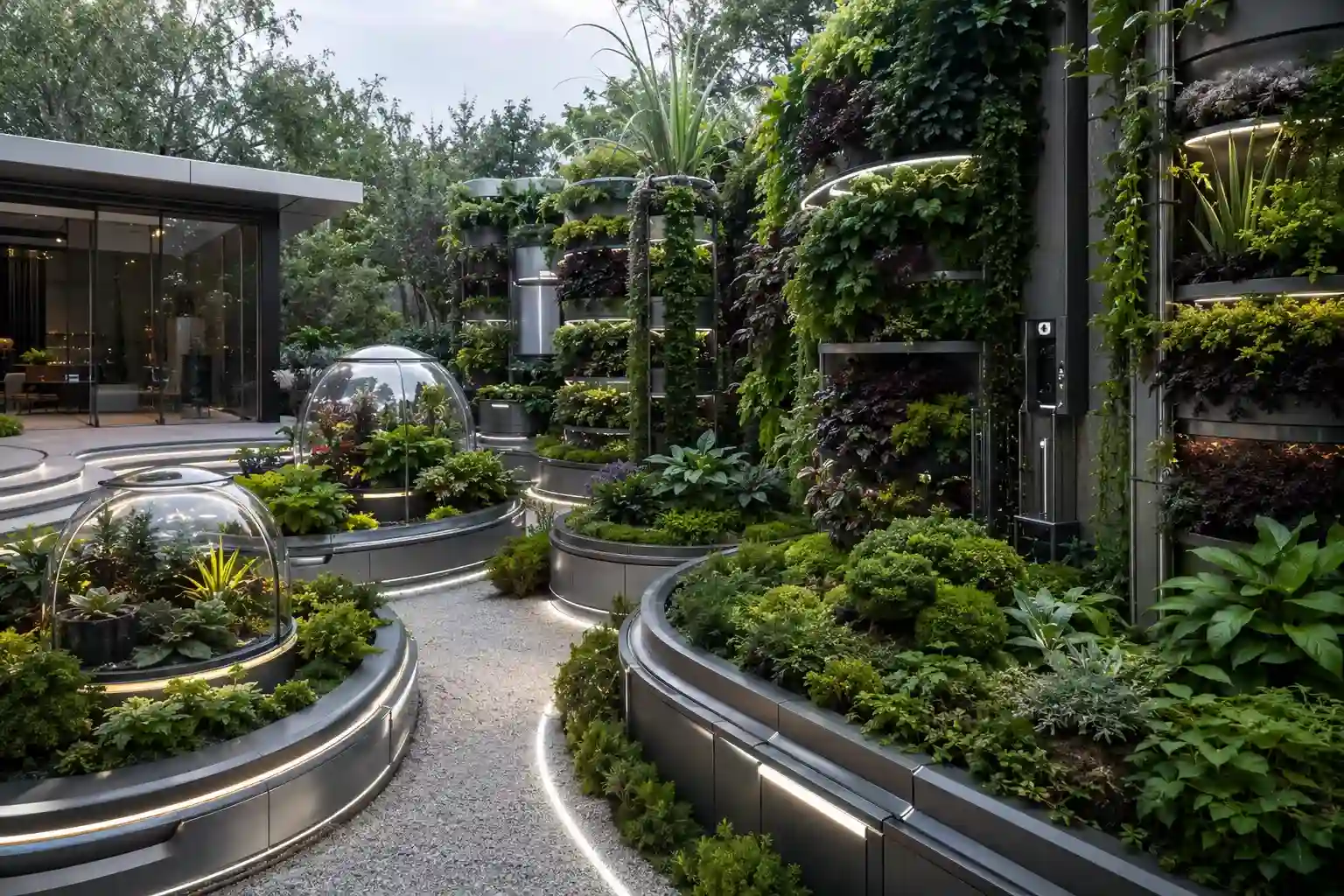
Resource optimization naturally leads to a fundamental transformation of spatial organization through ultra-dense planting and vertical bio-matrices. Inspired by space greenhouses, where every cubic centimeter is valuable, the landscape designers at Ecolandscape Studio have developed methods for extending gardens vertically through controlled phytowalls and modular planting systems. Within an area of just 2 by 2 meters, multi-level structures can be created that deliver the visual impact and biomass production of an entire hundred-square-meter traditional garden. Plants are arranged with mathematical precision at densities of up to 100 root systems per square meter, made possible by the complete elimination of resource competition through individually supplied nutrient channels. The architecture of these bio-matrices follows natural stratification principles: sun-loving succulents occupy the upper tier, absorbing excess solar radiation and shading decorative foliage plants in the middle layer, while ferns and mosses in the lower zone retain moisture and stabilize the microclimate. Advanced dynamic horticultural lighting, shifting from blue wavelengths during growth phases to red wavelengths during flowering, combined with automated ultrasonic mist delivery systems, allows vegetation cycles to be controlled with exceptional accuracy. Plant growth can be accelerated two to three times while achieving a density of coverage that is virtually impossible in natural environments. This approach to vertical landscaping addresses land-use limitations and fundamentally redefines the appearance of contemporary residential properties.
Why does residential development need these Martian-inspired concepts? The answer lies in the growing demand for complete autonomy, environmental responsibility, and innovative aesthetics. The capsule garden is not simply a futuristic statement but a practical model of resource conservation. Closed-loop systems prevent chemical fertilizers from entering groundwater, protecting local ecosystems from anthropogenic impact. Thoughtful site design transforms a property into a self-regulating ecological and artistic installation that requires minimal human intervention, functions as an efficient carbon sink, generates clean oxygen, and resembles an outpost of an advanced extraterrestrial civilization seamlessly integrated into a suburban landscape. Premium turnkey landscape design by Ecolandscape Studio erases the boundary between engineering excellence and natural beauty, transforming the garden from a space of labor-intensive maintenance into an autonomous environment dedicated to relaxation, contemplation, and sustainable living.