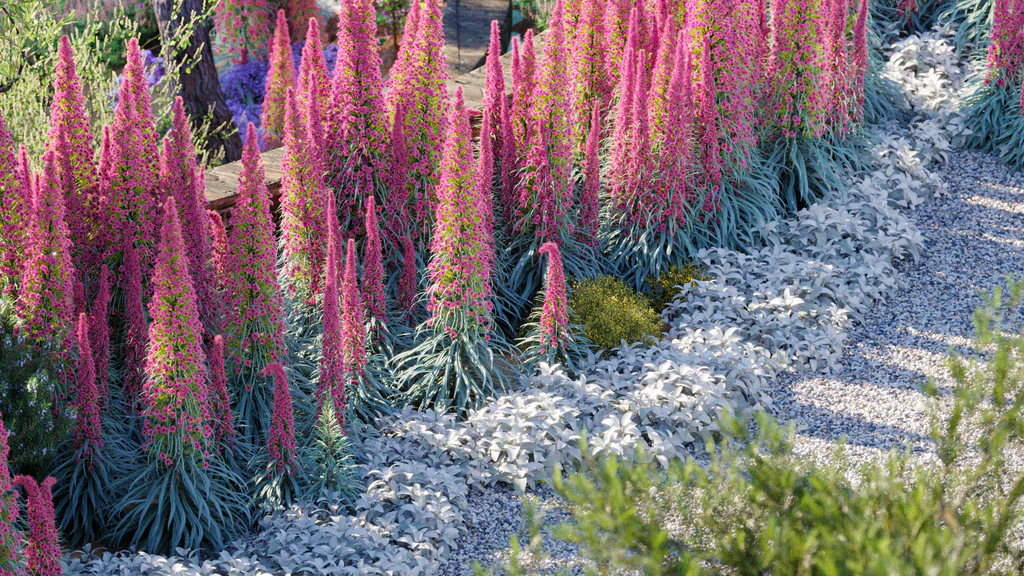
Echium wildpretii is an unusual plant from the Boraginaceae family, native to the volcanic slopes of the Canary Islands. Its massive flower spike, adorned with thousands of small bright flowers, creates a striking vertical form rarely seen in traditional garden compositions. This architectural expressiveness makes Echium wildpretii one of the most impressive choices for landscaping a yard or garden. In landscape design, it is used where a visual focal point is needed, to emphasize perspective, or to enliven a space.
At Ecolandscape Studio, we also note that the plant’s unique feature lies in its two-year growth cycle: in the first year, it forms a rosette of silvery, slightly fuzzy leaves, and in the second year, a tall flower spike grows, often called the “tower of gems” for its sparkling colors in sunlight. After flowering, the plant usually dies but produces numerous seeds, allowing it to serve as a natural element in sustainable landscaping.
Why Echium wildpretii is Interesting for Garden Design
The plant’s tall vertical growth makes Echium wildpretii a strong graphic accent in the garden. It helps create depth and perspective, structure the space, and place compositional highlights.
In yard landscaping, Echium can serve as a focal point in the center of a mixed border or as a backdrop for shorter perennials. Compositionally, it pairs well with ornamental grasses, Mediterranean perennials, and drought-tolerant plants such as lavender, sage, agave, or aloe. This makes it a valuable element when designing Mediterranean-style gardens, rocky slopes, and areas around the house where visual impact is desired with minimal maintenance.
During its flowering period, the tall flower spike of Echium wildpretii creates visual contrast and draws the eye. This is especially useful when an accent is needed in a long border or along a garden path Echium wildpretii directs the gaze upward, creating a sense of space and dynamism.
Practical Value in Landscape Projects
Attracting beneficial insects: The flowers of Echium wildpretii are rich in nectar. This makes it an excellent natural tool for supporting biodiversity in the garden: bees, bumblebees, and butterflies actively visit it during flowering. For landscaping, this is important not only as a decorative element but also as part of ecological design, promoting the pollination of other flowering plants.
Tolerance to conditions: The plant thrives in full sun and dry conditions, which is important when selecting plants for low-maintenance landscaping and water conservation. Good drainage is essential: Echium wildpretii cannot tolerate standing water, so it is important to ensure permeable soil, often by adding sand or small gravel.
Minimal maintenance requirements: Mature plants require little watering or fertilization, making them suitable for areas where manual care is minimized but a strong visual effect is desired.
Planting and Care: Key Considerations
For landscape designers, selecting the right location is half the success. Echium wildpretii prefers fully sunny areas without shade. In shaded locations, growth will be weaker, flowering will be sparse, and the compositional impact will be reduced.
Soil preparation is an important step. Heavy clay soils should be loosened and mixed with coarse sand or gravel to improve drainage. This preparation is especially effective for rock gardens, dry borders, or alpine slopes.
Watering should be moderate. Young plants need regular moisture, but as they mature, they become drought-tolerant. Standing water is critical; when designing drainage around Echium, consider soil slopes or drainage channels if groundwater levels are high.
In colder climates with harsh winters, Echium can be grown in containers and moved indoors during winter. This expands its use beyond warm regions.
Ideas for Use in Landscaping and Yard Design
Echium wildpretii works well in combination with other plants. In a rock garden, it creates a striking vertical accent against the textured backdrop of lavender or rosemary. In mixed borders, it provides structural foundation, setting rhythm and scale.
In yard design, it is often used as a visual anchor at the back of plantings or as a focal point in a central seating area. Its height and bright colors highlight terraces, gazebos, or the entrance area of a home.
In family gardens, it can serve as a natural landmark for children and adults, adding texture and vertical interest without bulky structures or artificial elements. Gardens designed with such plants appear lively, dynamic, and seasonally resilient.
“Echium wildpretii is not just a decorative element. For a landscape designer, it is important to use plants that not only beautify the yard but also contribute to the ecosystem. Echium attracts pollinators, creates a striking vertical line, and supports the garden’s architecture,” says Martín Palma, founder and CEO of Ecolandscape Studio.
His experience shows that thoughtful placement of Echium in a landscape composition turns a garden from a collection of plants into a harmonious, living system.
Echium wildpretii is ideal for those looking to add a dramatic vertical accent to a landscape design project, complementing modern ecological aesthetics. It attracts beneficial insects and remains drought-tolerant, making it a valuable element in low-maintenance yard landscaping.
Correct site selection, soil preparation, attention to drainage, and harmonious combinations with other plants allow Echium to serve as an expressive element in yard design, functioning not only as beauty but also as a part of a living ecosystem.