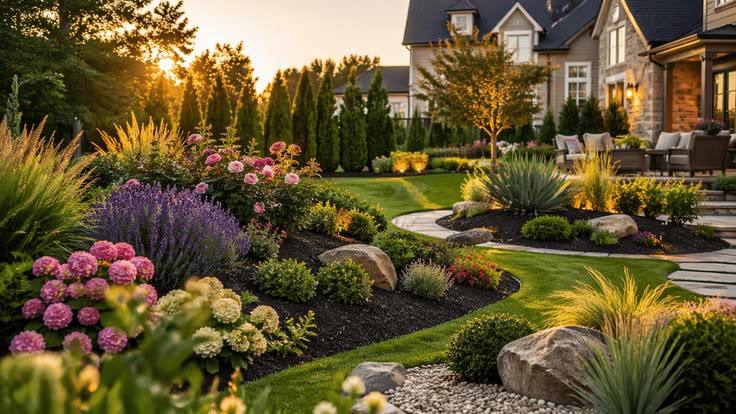
In modern development, project status is no longer defined solely by building architecture, prestigious location, or the cost of finishing materials. Increasingly, one of the key factors shaping the perception of high class is how a property interacts with its surrounding environment. The exterior environment creates the first and often the strongest impression of a project. People subconsciously read the level of a property within seconds, even before entering the building. Martin Palma, founder and CEO of Ecolandscape Studio, believes that strong landscaping has become one of the most accurate indicators of development quality – the level of landscape architecture instantly reveals how deeply the entire project has been designed. This is why landscape design is no longer a decorative addition, but a strategic tool for shaping status.
Status perception works at a subconscious level. People rarely analyze the quality of greenery, paving materials, or spatial composition separately, yet the brain instantly reads the overall standard of an environment through visual signals. Proportions, spatial rhythm, quality of transitions, balance between openness and privacy, the condition of planted areas, and the overall level of visual discipline all contribute to the perception of class. When a space feels chaotic or overloaded, even an expensive project may appear less premium. Specialists at Ecolandscape Studio analyze perception patterns and note that high-status environments are always defined by control, cohesion, and architectural confidence.
Spatial hierarchy is especially important. In high-end projects, a space never feels random. Every route, planting composition, and architectural accent serves a specific purpose within the overall design language. The user’s gaze is guided naturally and sequentially without visual noise. Entrance sequences, focal points, layered greenery, and carefully structured pathways create the feeling of a well-designed movement scenario. The environment seems to guide people intuitively, creating a sense of order and visual clarity. At Ecolandscape Studio, we analyze spatial behavior and observe that thoughtful hierarchy is what makes landscaping feel expensive not only visually, but emotionally as well.
Restraint is equally significant. One of the paradoxes of premium design is that the most expensive projects rarely try to aggressively display their value. On the contrary, strong status is often expressed through confident minimalism. The space is not overloaded with elements, yet every detail feels intentional and precisely positioned. This controlled restraint creates a sense of sophistication. Specialists at Ecolandscape Studio note that luxury is becoming less associated with excess and more associated with precision of decision-making. The ability to remove what is unnecessary has become a defining trait of mature design.
Materials also play a critical role in status perception. However, value is determined not only by cost, but by how materials interact with light, nature, and architecture. Natural stone, premium wood, refined metals, water features, and mature greenery create a deeper sense of quality than decorative complexity designed purely for visual effect. At Ecolandscape Studio, we believe premium landscaping is built around harmony between material quality and environmental context. This is what creates the feeling of a high-level space that does not need to visually prove its own value.
From a commercial perspective, strong landscaping directly influences the market positioning of a property. Projects with high-quality outdoor environments build trust faster, remain more memorable, and create higher perceived value. This is especially important in residential, hospitality, and luxury mixed-use segments, where emotional perception often influences final decisions more strongly than rational calculations. At Ecolandscape Studio, we see landscape architecture as a powerful tool for status creation, where landscaping becomes not a secondary element, but a complete language through which a project communicates its class, level, and long-term value.









