The landscape design industry has long developed within the paradigm of total electrification. Kilometers of cables in HDPE pipes, deep trenches destroying root systems, and powerful in-ground LED luminaires striking upward at tree canopies have become a rigid industry standard. However, at Ecolandscape Studio, we view light not as an isolated decorative element, but as a potent ecological factor that heavily interferes with the life of the local biota. Aggressive artificial lighting, known in urban planning as light pollution, triggers a hidden ecological disaster within the boundaries of private countryside properties. It disrupts the circadian rhythms of birds, disorients nocturnal insect pollinators, and artificially prolongs the growing season of woody species, preventing them from entering dormancy on time and causing them to freeze during the first frosts. The professional task that our studio sets for itself is to restore the ecology of darkness to countryside sites, making night garden design functional, safe, and aesthetic solely through the physical and biological properties of matter itself, without connecting to the power grid.
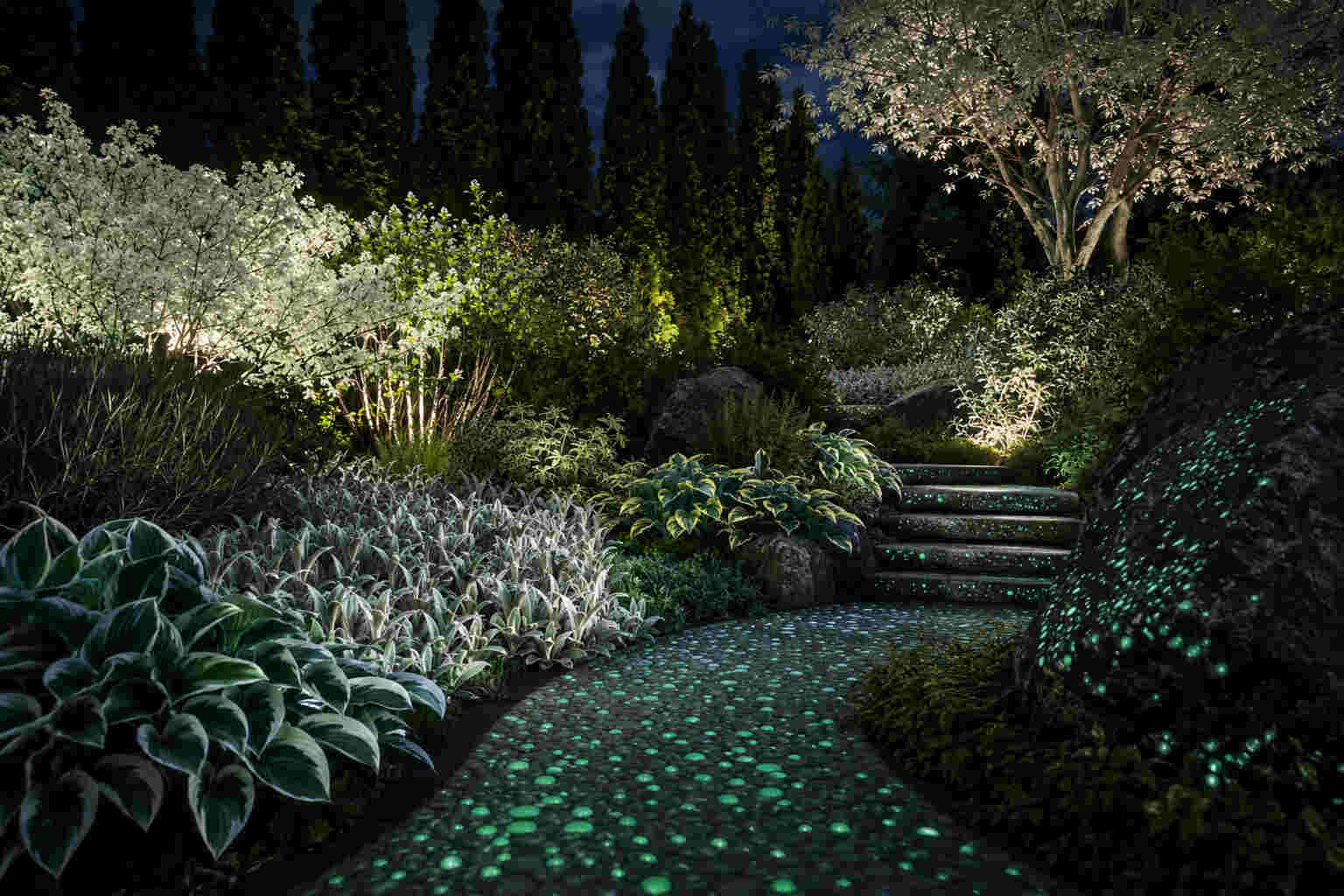
The first and most delicate level on which ecological garden lighting is built involves managing the reflection coefficient of solar and lunar light — plant albedo. Instead of illuminating a shrub with a directed artificial beam, botanical reflectors are introduced into the composition. These are introduced species with a high density of trichomes on the leaf blade, which function as natural microlenses. Under twilight conditions, their foliage takes on a phosphorescent, silvery-white hue. A prime example is the Byzantine lamb’s ear, Silver Carpet cultivar, which forms dense reflective carpets along pathways. In the middle tier, a similar function is performed by pearly everlasting and woolly cerastium, creating voluminous light spots that capture quanta of scattered sky light. Along with pubescent forms, texture markers possess immense contrast — plants with light-reflective foliage and variegated forms whose leaf blades have chlorophyll-deprived, snow-white zones. In the understory, the white dogwood, Elegantissima cultivar, is indispensable, creating the effect of a floating, voluminous cloud in the dark. At path turns, it is professional to use hostas of the Patriot or Night Before Christmas cultivars, whose white edges are literally carved out of the understory darkness, ensuring safe navigation and acting as natural markers.
Where safety requires guaranteed visibility — on steps, retaining walls, or terrain forks — classical integrated optics are replaced with materials featuring an afterglow effect. In modern eco-design by Ecolandscape Studio, chemically and biologically inert pigments based on strontium aluminate, activated by europium, are applied. These safe phosphors absorb ultraviolet radiation during the day and exhibit photoluminescence for eight to ten hours at night. Technologically, this is achieved by integrating luminescent fractional filler into polymer drainage coatings for joints, creating seamless pathways, or applying hydrophobic bio-varnishes to accent solitary boulders. The use of luminescent grit and glowing pebbles for paving makes it possible to entirely abandon electric bollards. In landscape coloristics, we use pigments exclusively from the green spectrum with a wavelength of around 520 nm. This is because under twilight vision conditions, the sensitivity of the human eye shifts precisely into the blue-green region, and the spectrum itself looks organic in a plant environment without creating visual noise.
The founder and CEO of Ecolandscape Studio, Martin Palma, views the transition to electricity-free concepts as a natural evolution of the premium segment of landscape architecture: «Over years of international practice in designing sustainable landscapes, I have come to the conclusion that the true luxury of an outdoor countryside space lies not in the aggressive scaling of engineering networks, but in the synergy of architecture with the natural cycles of the biota. When we first applied a matrix planting of super-reflective variegated plants combined with inert structural phosphors on one of our landmark properties, it transformed our clients’ perception of privacy. We did not simply dismantle kilometers of cable routes and eliminate the anthropogenic load on soil horizons — we restored the space’s pristine tectonic depth. A bioluminescent landscape forces a person to relearn the culture of twilight perception, without disrupting the fragile balance of the local ecosystem and completely resolving the issue of urban light pollution.»
The emergence of the landscape industry into the level of active, yet biologically clean photon generation is linked to the integration of scientific achievements. A glimpse into the future of landscape light reveals genetically modified glowing plants, which have already entered the commercial market and are fundamentally changing the rules of the game. A striking example is the innovative Firefly petunia by Light Bio. In this case, the glow is not the result of a temporary injection of fluorescent markers, but represents an autonomous process at the level of basic metabolism. A metabolic cycle of a bioluminescent mushroom is integrated into the plant’s DNA. The process is completely cyclical and built into the organism’s respiration: caffeic acid undergoes enzymatic oxidation to convert into luciferin, which, after emitting a photon, transforms into oxyluciferin and returns to its original form of caffeic acid. Such plants do not require specific chemical fertilizers, and the intensity of their glow correlates directly with the health of the organism, manifesting most brightly in active growth zones — on apical meristems and young buds. This opens up revolutionary prospects for designing completely autonomous light zones without using utility networks.
Implementing an electricity-free concept requires architects to strictly adhere to a three-tier design structure, where the upper level is occupied by large trees with a light leaf underside or silvery bark that catch the high light of the sky, the middle tier is formed by variegated shrubs and active bioluminescents that provide depth, and the soil tier takes on the navigational function through luminescent paving. An indispensable condition for the viability of such a garden is the elimination of external parasitic glare, which is achieved by planting dense buffer zones of coniferous species along the perimeter of the property to block light from neighboring street lamps. A complete rejection of harsh LED radiation minimizes the carbon footprint of the property and regenerates the population of local fireflies, whose larvae serve as natural regulators of garden pest populations. The integration of bioluminescent technologies is a conscious manifesto of Ecolandscape Studio, marking the transition of landscape architecture into a stage of maturity where human comfort is achieved not by suppressing nature, but through deep and mindful co-authorship with it.