At Ecolandscape Studio, we view landscape design as a comprehensive system in which flower beds are not decorative additions, but a tool for structuring space. Modern landscape flower bed design requires a project-based approach: understanding composition, site ecology, seasonality, and the long-term development of plantings. In a residential environment, a flower bed always operates on three levels simultaneously functional (zoning and screening), compositional (rhythm and accents), and emotional (human perception of space).
Architectural Integration of Flower Beds and Zoning
In landscape practice, a flower bed must always be connected to architecture. It is not “added” after construction but designed as part of the site’s spatial scenario. Entrance areas require accent flower beds that create a first impression. Transitional zones between the house and the garden are best designed using soft mixed borders. Peripheral areas can be composed of more naturalistic, free plantings that create a sense of depth.
To properly integrate a flower bed, it is important to understand a basic rule: rigid architecture requires soft compensation, while open spaces require structuring. Therefore, near façades we use dense plantings with vertical accents, while in open lawns we use more “airy” compositions focused on texture and grasses.
The Mixed Border as the Foundation of Professional Design
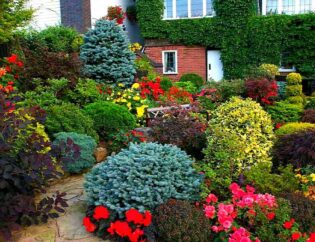
A mixed border is not just a mixed planting, but a system with a clear internal logic. In professional residential landscape design, it is built on functional layers. The first layer consists of structural plants that define the framework of the composition (usually shrubs and tall perennials). The second layer is the main decorative mass that forms color and volume. The third layer consists of low-growing and ground-cover plants that close the soil and unify the composition.
To create a stable mixed border, it is essential to calculate in advance the mature size of plants, their growth rate, and competitive interactions. Mistakes at this stage lead to dominant species suppressing weaker ones, and the composition loses structure within 2–3 seasons. At Ecolandscape Studio, we always design mixed borders with a 5–10 year development perspective.
Flower Beds as Focal Accents and Their Proper Use
Flower beds belong to the formal type of planting and function as visual accents. Their main role is concentration of attention. Unlike mixed borders, flower beds are not meant to evolve as complex ecosystems; their role is more graphic and decorative.
To use them correctly, balance is crucial: they should occupy no more than 10–20% of the total floral mass of the site, otherwise the space becomes visually overloaded. It is best to design flower beds based on a single seasonal scenario spring or summer with a clear color dominant. This creates a strong visual effect without compositional noise.
Spatial Structure: How Flower Bed Volume is Formed
A flower bed must operate in three dimensions. Horizontal structure governs mass distribution, vertical structure defines depth and accents, and temporal structure reflects seasonal and long-term change.
In practice, plants are not placed randomly but arranged into functional zones. The foreground consists of low, stable species; the middle ground contains main decorative masses; and the background includes vertical accents and structural plants. To avoid flatness, repetition of forms and rhythmic grouping is essential rather than random species distribution.
Seasonality as the Basis of a Sustainable Landscape
Seasonal dynamics are the foundation of modern flower bed design. In spring, the garden should feel light and airy, with an emphasis on early bloomers. In summer, it becomes dense and rich, with maximum decorative effect. In autumn, structure becomes dominant, with grasses and textures. In winter, the garden should be graphic, defined by branch architecture and shrub form.
Ecolandscape Studio notes that proper landscape flower bed design always includes a winter scenario, which is often missing in amateur projects. Without winter structure, the garden “disappears” for half the year, losing its architectural integrity.
Color Schemes and Spatial Perception Control
Color in landscape design is a tool for spatial manipulation. Cool tones (blue, violet) visually deepen space and create distance. Warm tones (yellow, orange, red) bring objects forward and strengthen accents. Green and silver act as a stabilizing background.
To build a proper color scheme, it is important not to use pure spectral colors in large quantities. More professional results come from complex, “muted” shades found in natural plant communities. They ensure long-term visual comfort and reduce eye fatigue.
Ecological Logic of Plant Selection
Modern flower bed design is based on the principle of stable plant communities. This means plants are selected not individually, but as an ecosystem. Their ecological requirements, growth rate, ability to regenerate, and competitive behavior are all considered.
For example, moisture-loving species should not be mixed with drought-tolerant ones, even if they appear visually compatible, as this leads to unstable plantings. This approach enables the creation of perennial landscape designs that require minimal maintenance and remain stable without constant replanting.
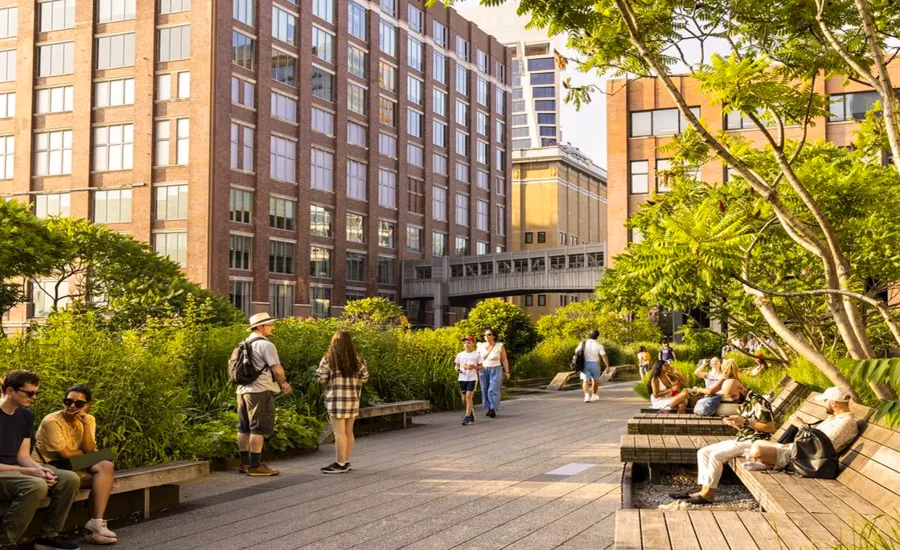
One of the most well-known examples of this approach is New York’s High Line park. This project transformed an abandoned railway line into an elevated linear park using naturalistic plantings.
It uses a principle very close to mixed border systems: plants are selected to mimic natural communities that could develop without human intervention. The composition evolves seasonally and changes over time without strict formal pruning. This example shows that modern landscape design is moving toward natural ecosystems rather than decorative “pictures.”
Mistakes That Destroy Composition
In practice, the most common mistakes include ignoring mature plant size, excessive decorative overload, chaotic species selection without ecological logic, and neglect of seasonality. These errors cause flower beds to lose structure within a few years and require full reconstruction.
Martin Palma, founder and CEO of Ecolandscape Studio, notes: “A good flower bed is not the result of planting, but the result of time. We design not an image, but a process that evolves on its own.” This reflects our approach to designing sustainable landscape systems.
Designing flower beds in residential environments is professional work with space, time, and ecosystems. At Ecolandscape Studio, we create not decorative plantings, but stable landscape structures that evolve, adapt, and remain expressive for decades. This approach allows us to form gardens that do not require constant reconstruction and remain relevant in the long term.