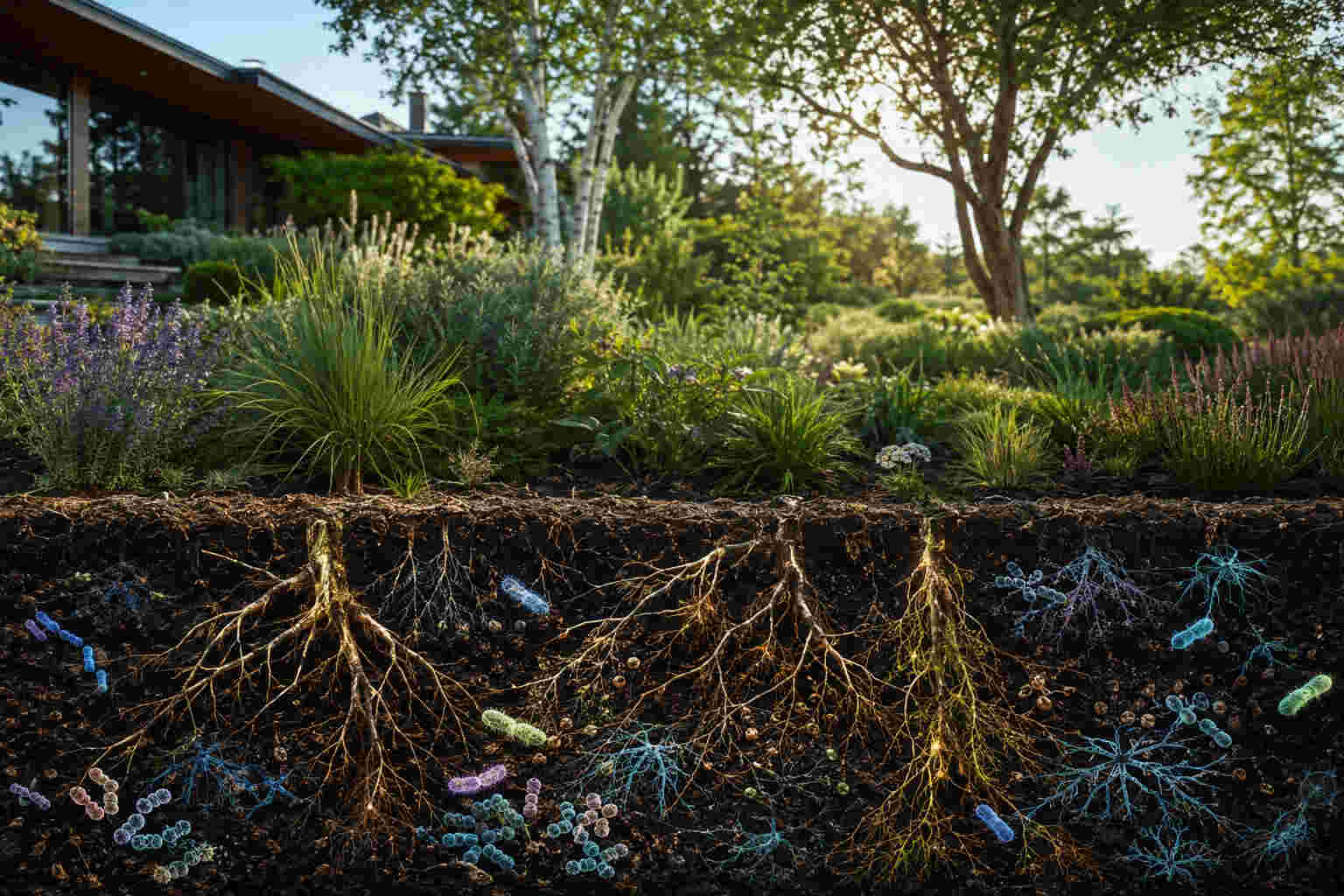
Modern landscape architecture is increasingly shifting its focus from purely visual aesthetics toward the underlying natural processes of a site. At Ecolandscape Studio, we view a garden as a living ecological system in which soil health plays a role just as important as plant composition or spatial architecture. That is why one of the most promising directions in contemporary landscape design is the concept of microbiome landscape laboratories — projects where the sustainability of a territory is based on carefully managed biological soil activity.
Soil is no longer perceived by professionals as merely a planting substrate. Today, it is understood as a complex multi-layered ecosystem containing billions of microorganisms, fungal networks, and biological structures that influence the health of the entire landscape. Within a single gram of fertile soil, thousands of species of bacteria, fungi, and actinomycetes may exist, forming an invisible network responsible for the exchange of nutrients, moisture, and chemical signals between plants. This system ultimately determines a garden’s resistance to drought, disease, temperature fluctuations, and soil degradation.
At Ecolandscape Studio, the development of eco landscape projects places particular emphasis on the biological potential of the site. Before creating a garden concept, we analyze soil structure, organic matter content, aeration levels, and the soil’s ability to support an active microbiome. This approach allows us to create regenerative landscape systems that do not exhaust the land over time but instead gradually increase its ecological resilience.
One of the fundamental elements of a microbiome-based landscape is the rhizosphere — the biologically active zone surrounding plant roots. This is where the primary exchange between plants and microorganisms occurs. Root systems release organic compounds, sugars, and amino acids that serve as nutrients for bacteria and fungi. In return, microorganisms help plants absorb phosphorus, nitrogen, potassium, and micronutrients while also strengthening plant immunity. This natural symbiosis forms the foundation of sustainable ecological landscaping.
A particularly important role in sustainable landscape architecture is played by mycorrhiza — an underground fungal network connecting the roots of different plants into a unified resource-sharing system. In natural ecosystems, mycorrhizal relationships are essential for the stability of forests and meadow communities. In modern gardens, Ecolandscape Studio applies methods that preserve and stimulate mycorrhizal activity through the careful selection of tree species, organic materials, and minimal mechanical disturbance of the soil.
The quality of the organic layer is also critical for maintaining an active soil microbiome. In professional regenerative garden projects, we utilize wood mulch, mature composts, biochar, leaf mold, and fermented organic blends. These materials create favorable conditions for beneficial microorganisms while simultaneously improving soil structure, water retention capacity, and air exchange. Unlike conventional sterile substrates, a living organic environment gradually develops a stable self-regulating biological balance.
Plant selection is another essential component of microbiome gardens. At Ecolandscape Studio, plants are viewed not only as visual elements but also as biological tools. For example, meadow grasses with deep root systems stimulate bacterial activity and naturally loosen compacted soil. Leguminous species encourage nitrogen-fixing microorganisms that improve soil fertility. Tree species including oak, pine, beech, and birch establish stable mycorrhizal relationships and create long-term underground fungal networks.
The founder and CEO of Ecolandscape Studio, Martin Palma, believes that the primary issue affecting many modern landscapes is the destruction of natural soil biology. According to Martin Palma, years of experience working with urban landscape systems have demonstrated that even high-budget projects quickly lose resilience if the soil remains biologically depleted. His study of soil ecology and natural self-regulation mechanisms ultimately led to the integration of microbiological principles into contemporary landscape architecture. Within the philosophy of Ecolandscape Studio, soil is regarded as an intelligent living medium capable of independently maintaining ecological balance when supported by thoughtful environmental design.
One of the key advantages of microbiome gardens is their ability to adapt to climate change. Biologically active soil retains significantly more moisture than degraded soil, which is especially important during prolonged droughts and unstable rainfall patterns. Furthermore, developed microbial communities contribute to the accumulation of organic carbon, transforming landscape ecology projects into natural systems of climate stabilization.
Modern eco garden design projects increasingly incorporate technologies for monitoring soil conditions. Sensor systems allow specialists to track moisture levels, temperature, organic matter content, and microbiological activity. This approach transforms the ecological landscape into part of a high-tech regenerative infrastructure, where environmental management is based on biological data rather than purely visual considerations.
Microbiome landscapes also hold growing importance within wellness landscape architecture. Research in environmental health suggests that human interaction with biodiverse natural environments positively affects immunity, the nervous system, and overall psychological well-being. For this reason, regenerative gardens are increasingly being integrated into private wellness residences, eco resorts, and contemporary biophilic environments.
At Ecolandscape Studio, we believe that the future of professional landscape design lies in the restoration of natural ecological processes. A modern garden should no longer function solely as a decorative installation. A truly sustainable landscape is a living ecosystem capable of independently supporting plant health, soil resilience, and ecological balance across the territory. This is precisely why the concept of microbiome landscape laboratories is becoming one of the defining directions in the next generation of ecological landscape architecture.









